
G6PD deficiency and diabetes

Today I follow an online trail to this article on diabetes from Nature Medicine here.

It is talking about a genetic variant that is found in people with African-American heritage called G6PDdef. This genetic pattern makes the HgbA1C test inaccurate. It will look low and “in control” even when blood sugars are high. Since the blood sugars are NOT in control, complications from diabetes can happen: damage to vision, to kidneys, to nerves in the hands and feet.

I have been reading articles about current and changing guidelines about diabetes. The current guidelines say that checking blood sugars at home doesn’t make a difference. I REALLY disagree with this and at the same time, I don’t think that physicians are approaching blood sugars in a practical manner.

I saw a man recently who is diagnosed with “insulin resistance”. His HgbA1C is in between 5.6 and 6.0. Normal is 4.5 to 5.6. Over 6.5 is diabetes. He has prediabetes. He has not checked blood sugars at all, but he is on metformin.

There is evidence that metformin is helpful, and still, I think it is putting the cart before the horse. I ask my people to go buy an over the counter glucometer. Ask for the one that has cheap strips, 6 for a dollar instead of a dollar apiece. Then we go over the normal and abnormal blood sugar ranges and I ask them to start checking blood sugars. If I give them a medicine right away, they don’t learn how to control their blood sugar with diet. ALL of my patients can figure out how to bring their blood sugars down with diet. If we can’t get to a good range, then we will add metformin. I do explain that the guidelines say use a medicine right away, but I ask, “Would you like to see if you can control your blood sugars with diet?” The answer is overwhelmingly “YES!” I have never had someone say no. If we do not give them the chance and explain the goals, why would they even try?

Also, I read the dietician handouts for diabetes yesterday and I am not satisfied. I do not think they explain carbohydrates well. Foods have fats, proteins, and carbohydrates, and anything that isn’t fat or protein has carbohydrates. I think of carbohydrates as a line, from ones with high fiber that do not send the blood sugar up fast, to ones that shoot it way high. At the low end is kale and lettuce and chard and celery. Then the green and yellow and red vegetables that are not sweet. Then beets and sweet peas. Next come the fruits, from blueberries up to much sweeter ones. Fruits overlap with grains: bread and pasta and potatoes and rice. The whole grains have more fiber and are slower to digest. Candy then sweet drinks (sodas are evil) and sugar.

Sugar has 15 grams of carbohydrate in a tablespoon. Kale has 7 grams of carbohydrate in a cup. That’s a pretty huge difference. A small apple has about 15 grams of carbohydrate and a large one 30 grams. Read labels for grains. There is a lot of carbohydrate in a small amount. The issue with fruit juice is that most of the fiber is gone, so the sugars are broken down and absorbed much faster. A 12 oz coke has 32 grams of carbohydrate and a Starbucks mocha has 62! I quit drinking the latter when I looked it up.

Most people with diabetes are supposed to stay at 30 grams of carbohydrate per meal, or 45 if it is a big person or if someone is doing heavy labor. Snacks are 15 grams.

Avocados are weird. They have about 17 grams of carbohydrate in a whole one, but they also have a lot of fat. They do have a lot of fiber, which surprises me.

Diet control takes a combination of paying attention to what is on the plate and serving amounts. Three servings of pasta is not going to work, unless you are out fighting forest fires or are on the swim team. Fire fighters are allotted 6000 calories a day, but most of us do not get that much exercise.

At the same time that articles are telling me that home blood sugars are not useful with a glucometer, everyone is pushing the continuous glucose monitors. I think we like technology. And other articles say that diabetes can be reversed with major lifestyle changes.

Articles: about not using home glucose checks, here. Starting metformin, here. Starting with one of the newer medicines, here.

I think people feel a lot more successful if they get a glucometer and can bring their blood sugar down by messing about with diet. I tell them to check after what they think is a “good” meal and after a “bad” one. How much difference is there? Contrast that with being handed a pill to control it, while someone talks about diet and says all the same stuff that we’ve heard for years. Nearly all of my people want to avoid more pills and are willing to try a glucometer to see if they can avoid a pill. People who have been on diabetes medicine for a while are less willing to try, but sometimes they do too. And sometimes they are surprised that some meals do not do good things for their blood sugar.

This is all type II diabetes. For type I, we have to have insulin. If type II has been out of control for a long time, sometimes those people have to have insulin too. Right now insurances will usually cover continuous glucose monitors for people with diabetes who are on insulin, both type I and II. I do hope that they really make a huge difference for those people!

The spectrum from the low carbohydrate vegetable, the green and yellow and orange ones, up to the really high simple sugar ones is also called the glycemic index. There are lists of low to high glycemic index foods. Perhaps some people with diabetes find that helpful, but I think it’s simpler to say, ok, the stuff that doesn’t taste sweet will send the blood sugar up less. Also, since we are all genetically different and then our gut bacteria and microbiome are all different, it is individualized care to say how does this person at this time respond to this food? We change over time!

There are other examples of the HgbA1C not working to track diabetes. A resident and I looked over a person with diabetes and spherocytosis. The HgbA1C was nearly normal but the blood sugars were in the 300 range. Spherocytosis is a genetic blood cell abnormality, and the red blood cells don’t live as long. People with a past bone marrow transplant also have red cells that live for a shorter time. The G6PD deficiency is thought to help people survive malaria, so persists in the population, like sickle cell anemia. Isn’t genetics fascinating?

Lie low and flow

We have fight or flight for the sympathetic nervous system state, when we are ramped up, aggressive, go getters, all that stuff. We need a term for the parasympathetic nervous system state, the relaxed one. So far I’ve come up with lie low and flow. Other suggestions? I welcome them! We need more lie low and flow and glow and say no and ho, ho, ho in the world. What puts you in that state? Knitting? Stupid cat videos? Bugs Bunny? A bubblebath? Watching toddlers? What makes you laugh and yawn and relax and lets all the tension flow out and sink or float away?

In clinic I am seeing a wide age range. Most of the younger ones, say, under 60, look a bit shell shocked. I think this is still from the pandemic and wars and political nastiness. The over 60 crowd seems to not care as much. They’ve been through it, they know people die, they know bad stuff happens.

A friend and I were talking about pandemics and he pointed out that HIV and AIDS was a pandemic too. So we are on track for two pandemics per century. The younger folk do not remember the HIV and AIDS pandemic and how frightening it was. Right before that started, some doctors proclaimed that infectious disease had been conquered by medicine. Um, RONG RONG RONG! Boy did they eat THOSE words. And early in that pandemic, no one knew what to believe, what was happening, how to stay safe, and the communication from the medical establishment changed very fast. I wonder if the people who were young adults and older in the 1980s were less surprised by the Covid-19 Pandemic and all the rumors and confusion. Yep, seen it before.

I am not sure how to help the younger shell shocked looking folks. Colorado is a bit tough and manly and consequently there is not a huge amount of resources for emotional health. Yesterday I asked if we have anyone who does neuropsychiatric testing and the answer I got was “I don’t know.” I will dig around today but did not find it on the internet. I have found neuropsych testing hugely helpful for traumatic brain injuries, post brain surgery, and to sort out unusual learning and memory styles. One woman had a brain tumor removed. Her memory was affected. She could remember things that she wrote down and read, but not things that she only heard. No one had given her the report to read. They only told her, so she did not remember it. At least, that was the story. I gave her the report and said, “Read it. And tell your family. And if you are on the phone, take notes.”

Ok, now I should get ready for work, though I want to lie low and watch a silly cat video.

For the Ragtag Daily Prompt: yawn.

Diabetes update

Friday I attended a Zoom diabetes update all day. Sigh. We are really doing diabetes wrong.

Diabetes affected every system in the body and so the guidelines want us to check everything. They made the point that controlled diabetes does NOT lead to blindness, kidney failure, and amputations. Only uncontrolled diabetes. There, do we feel better now?

There are three NEW things to check for. One is CHF, aka Congestive Heart Failure. Heart Failure is pump failure. It makes a lot more sense if you think of the heart as a pump. Diabetes doubles the risk of heart failure in men and increases it by five times in women. We are now to do a yearly BNP (Brain Natriuretic Peptide, got that?) except that it is useless if the person is in renal failure, because that raises it artificially.

The second NEW thing is liver problems. Liver failure is back in the top ten causes of death, having fallen off that list for a while. People drank more alcohol during COVID, there was more drug abuse adding to hepatitis B and C, but the biggest cause is NASH and NAFLD. More acronyms: NASH is Nonalchoholic Steatohepatitis and NAFLD is Nonalcoholic Fatty Liver Disease. This is related to overweight and obesity. Being overweight or obese messes up fat storage and over time this inflames the liver and then cells die, leading to cirrhosis. We are to watch liver tests, think about an ultrasound, and then there are two specific tests for cirrhosis.

Third NEW thing is Diabetes Distress. This is not depression. People score “depressed” on the PHQ-9 test, but don’t respond to anti-depressants. The lecturer said that we have to talk to the patient and find out why they are distressed, or what part of diabetes is getting them down. I thought that we should have been talking to the patient all along. There is a convenient 30 question tool we can use for this, if we have time. Will we?

Now, the old guidelines said that we are to check these things:

HgbA1C every 6 months if not on insulin, every 3 months on insulin and even more in pregnant patients.

Microalbumin/creatinine ratio: a urine test that tells us if the kidneys are starting to leak albumin. They shouldn’t.

Yearly eye test to check for diabetes damage.

Specific blood pressure ranges.

Keep everyone’s LDL cholesterol under 70. So nearly every person with diabetes gets a statin drug.

Do a foot check yearly for neuropathy.

So six things plus the new three. Can’t explain that in one visit and can’t do it in one visit either. I think we should revamp the Diabetes Distress tool and check if physicians and nurses have Guideline Distress. Diabetes is the most complicated set of guidelines other than pregnancy.

Diabetes also takes a lot of time for the person who has it. To check things “correctly”, it takes a minimum of two hours a day for Type II not on insulin and more like three or more for Type I and II on insulin. Think if you have to take two or three or more hours away from your current daily activities and devote it to diabetes. No wonder people are distressed.

The medicines are also confusing. Wegovy is in the same class as Ozempic, but is FDA approved only for weight loss in people who are overweight and have a complication, or people who are obese. Ozempic is for diabetes but people often lose weight so think about it if the person is overweight. Some of the medicines in that class also are approved to reduce the risk of heart disease, which goes up with diabetes. Another class has medicines some of which have approval for diabetes and others for diabetes and renal problems, BUT don’t use it if the eGFR is under 20, got that? The lecturer on medicines said that we’ll see less in each of those classes after they fight it out for dominance of the market. He’s been an endocrinologist for 30 years and remembers when the very first non-insulin medicine was approved. Cool! He is not discouraged, but another lecturer said that we have one endocrinologist for 5000 people with diabetes, which is not enough. We were encouraged to do more continuing medical education.

There is one guideline that I disagree with and would like to see changed. I will write about that next. After I memorize all of the different things the new medicines do, which is changing every month as new research comes out! Stay tuned!

I think I will put the clutch in and coast a bit. Or perhaps clutch handfuls of hair and pull at them, I don’t know.

For the Ragtag Daily Prompt: clutch.

I hiked again yesterday and had a very cooperative bunny stop for a snack in camera range.

Pneumonia makes me slenderize

Pneumonia makes me slenderize
I feel like I’ve been blenderized
Steals my breath and appetite
Work to breathe both day and night
My heart goes fast, trials one to four
I’d rather not have any more
Ten pounds down, gone like smoke
Carbohydrates make me choke
The legacy of my fourth round
I can’t eat gluten, ounce nor pound
And yet I still come out ahead
Since I am alive and still not dead

_____________________________________

Four pneumonias in 24 years. I have an antibody response, which peaks about six weeks after the infection. Colds don’t trigger it. This photograph is two months in to my 2021 round. I drop ten pounds in the first week and eating is always difficult. I do not recommend this method of weight loss.

For the Ragtag Daily Prompt: slenderize.

Lily wins

I have been cat sitting Lily, for my friend who is in a nursing home.

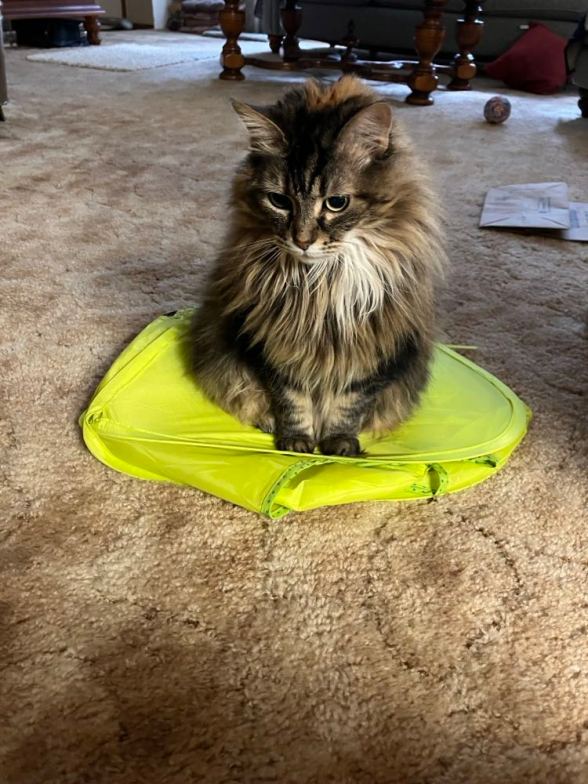
Lily is worried about her human and I am only in for about an hour and I don’t know her habits. And I am not her person. However, we have finally figured out how to play. Lily has a tent, a small one. I started scritching it one day and Lily reveals her tendencies: she is a bag stomper. She played with the tent until I get the picture above, with her sitting on it.

Next I bring a stick with line and various things tied on, including a toy mouse. Lily and I play and I don’t leave with large hand scratches. I could grit my teeth, but it was not that fun. Lily wants me to pet her now too.

Lily wins and I do too.

We hope her person will be home soon.

For the Ragtag Daily Prompt: grit.

Stand up

I am in a large room, like an expensive hotel lobby. There is a large black bowl like structure, fountain size, but without a fountain. There is a big woman bullying me. She is making me dump containers of ice into the bowl structure. It will overflow and I will be blamed. Another woman whispers to me: “You have to sing a song about abuse, so that people will know that she is making you do this.” I know songs about abuse but at that moment I can’t think of any. Then I do. I remember a song my mother sang, this verse:

“Two little babies, crying for bread. With none to give them, don’t you wish that you were dead. Don’t you wish you were a single girl again.”

I wake up. The song is about a young woman, married, whose husband is drinking up his paycheck. She and the babies are starving and he beats them. Not a pretty picture of marriage, is it?

I wake up. One way to think about dreams is that each person in the dream represents an aspect of ourselves. So WHY is my inner bully showing up? I don’t like this!

That day my friend goes from the hospital to a nursing home for rehab. I speak to three people on the team, because my friend has a cardiology appointment the next day and I want to be sure that she will be taken to the visit. She is going to a nursing home 40 minutes away.

On the appointment day, I call the rehab just after 9 am when the internet says they open. There are three choices: two halls and a main office. I leave a message on hall one. I call back and leave a message on hall two. I wait another ten minutes and call the office. No answer, I leave a third message. I wait until 9:30 and call again. This time that inner voice with gumption is fired up: “I need a call back by 11:30 or I will drive up there, I need to know that my friend has transport to cardiology for her 12:45 appointment.”

I get a call back at 10:30. The rehab person introduces herself. “Oh, we can’t transport her because she just got here yesterday.”

“You don’t understand,” I say. “This visit is to make sure her heart is ok after restarting a medicine. It is not optional.”

“We can’t transport her.”

“I am sick, I can’t transport her. What is your name? What is your position? Who is in charge of the facility? What about her heart, your facility has no concerns if her heart is poisoned?”

“Just a moment.” Papers rattle. “Oh, we DO have transport arranged. Someone else wrote it down and I didn’t see it.”

“Oh, thank you so much. I was so worried!”

I go to the appointment, masked. The driver says my friend was a last minute addition. The visit goes well. I am on the tail end of a cold, not covid, and I am very tired from trying to be sure that my friend gets good care. I think THAT is what the dream is about, the inner strong voice who is not going to let my friend be abandoned, be bullied, be ignored. She is too ill to fight for herself so I am fighting for her. And I am formidable.

For the Ragtag Daily Prompt: gumption.

Double standard: AI technology can take jobs but improving healthcare can’t

The United States could go to single payer healthcare, but one objection has been “People will lose their jobs with health insurance companies.” Yet no one seems to object to AI, Artificial Intelligence taking jobs. It’s technology so it’s fine! The wave of the future! Coming whether we like it or not!

One form of single payer healthcare is medicare for all. Expand medicare so that it covers everyone. At first, it only covered retired female teachers. Women were only considered for teaching jobs if they were single. A married woman was expected to work in the home. The teaching pay was low. Men were expected to be supporting a family, so they got more. Women were often supporting parents or children if spouses died or divorced or abandoned a family or were disabled. Early census information was a finagle: any male in the household was listed as “head” even if it was an elderly disabled father or a boarder or a teen. So the true numbers of women as head of households were obscured.

Single payer would improve healthcare. There would be ONE set of rules. Physicians would know if something was covered. Right now there are over 500 health insurance companies and they each have multiple different policies. Not only that, but the policies can change monthly in what they cover. Did you know that? I would get monthly postcards from multiple companies saying that I could go on line to one of the 500 different websites and see what they had changed and were no longer covering. I found little time to learn 500 websites. We spend enormous amounts of healthcare money on communication back and forth from insurance companies to hospitals and clinics. Trying to prior authorize CT scans, MRIs, surgeries, referrals, medications (even old cheap ones!) and then attempting to get the health insurance companies to pay for the care. Remember that the insurance companies are allowed a 20% profit: so for 1 million dollars of healthcare money, $200,000 can go to profit. The people and computer work is not in that profit, so what percentage of your healthcare dollar goes to attempting to prior authorize and get paid? How much of your healthcare dollar would you like to go to healthcare?

Medicare’s overhead is either 1.4% or 6%, instead of that 20% profit and the prior auth/collection effort. There are two different estimates (from here):

1. There are two different measures of Medicare’s administrative costs. One figure comes from the Medicare Board of Trustees’ annual report, while the other comes from CMS’ National Health Expenditure Accounts. According to the latest trustees’ report, Medicare’s overhead represented 1.4 percent of its total expenditures. According to the latest NHEA, Medicare’s overheard was 6 percent of expenditures.

2. The discrepancy between the two figures is due to Medicare Parts C and D. Mr. Sullivan wrote that the difference between the trustees’ measure of overhead and the NHEA measure β€œis due almost entirely to the fact” that the NHEA figure includes administrative expenses incurred by health insurers that participate in Medicare Advantage (Part C) and Medicare’s prescription drug program (Part D). In essence, the overhead associated with the private insurers involved with Medicare raise the program’s overhead by almost 5 percent, or $24 billion in 2010.

People worry about “socialized medicine” but really, the closest system to socialized medicine is the Veterans Administration. I don’t think anyone wants to take their healthcare away, and some of it is specialized depending on where they were deployed and what they were exposed to. I saw veterans in my clinic because we were more than 30 miles by car from a VA hospital.

What about medicare fraud? I saw way more fraud with the insurance companies. Companies will maximize revenue by sending equipment at the exact interval insurance allows (like sleep apnea equipment and diabetes glucometers). It doesn’t matter to them if it’s being used or not. After my father died, there were 16 full oxygen tanks full in his house. The company was happy to pick them up and no, they did not want to reimburse the payments. A biller told me that often the health insurance companies will pay less then the contracted amount. When challenged, they say, “Oh, that was a computer error! We will fix that!” She said, “I have never once seen the error in the physician’s favor.” When I had cobra insurance, they would not pay my bills and I had to call them every single time to force them to pay. It took enormous amounts of time and again they claimed, “Oh, computer error!” I finally called their counseling line and said, “I want to be counseled for your company refusing to call me back and screwing over this cobra policy, and by the way, I have a family member dying of cancer.” That finally made them fix it.

WHY is our culture ok with technology taking jobs, while improving healthcare can’t? Get rid of the health insurance companies! Medicare for all! If we all had secure health insurance, think of the work innovation in our country!

For the Ragtag Daily Prompt: finagle.

Less Long Covid if vaccinated

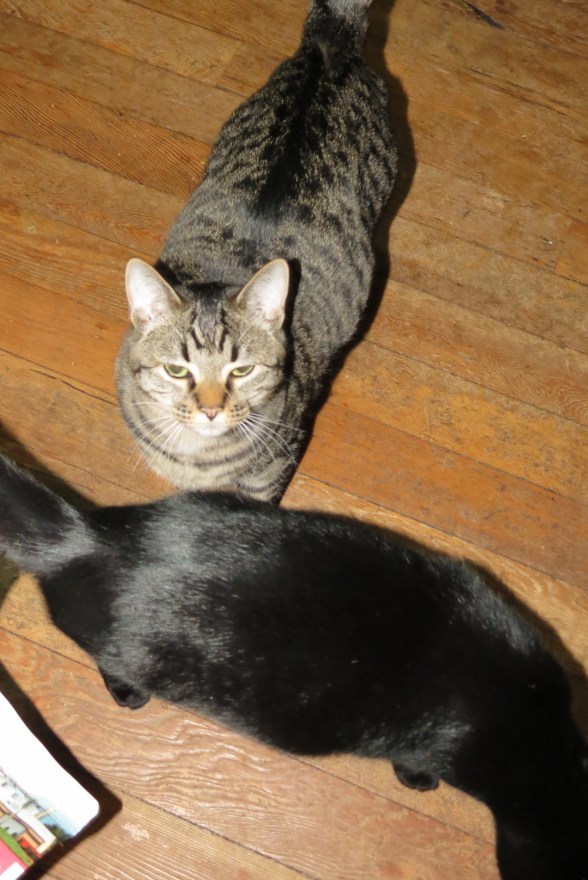
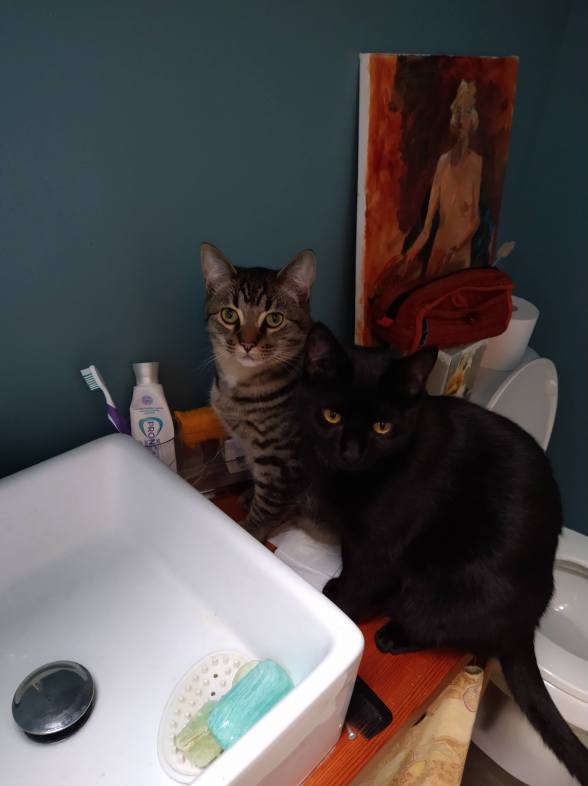
My cats are pound kitties, rescues that were still half-starved kittens when they arrived. They were supposedly six weeks old when I got them, so born in August 2021. This photo is from February 2022. They are still exploring and fascinated by water and faucets and showers. They are doing cat research. Meanwhile, Long Covid research continues.

https://dgalerts.docguide.com/ncov-home/article/lower-long-covid-prevalence-symptom-severity-in-vaccinated-individuals

This is a report on a study which started in October of 2020. “Participants were actively followed for severe acute respiratory syndrome coronavirus 2 (SARS‑CoV‑2) infection. In the study, Hannah E Maier, PhD, University of Michigan, Ann Arbor, Michigan, and colleagues compared the prevalence of symptoms and symptom severity between vaccinated and unvaccinated individuals.” People were enrolled for a year as they got infected, with demographic and health information recorded as they enrolled. They turned in information every two weeks and had blood draws every two months. After a year they were invited to continue for a second year. 3375 were enrolled, more than 1370 filled out Long Covid forms, and 1007 of the 1370 were vaccinated. Long Covid was defined after 90 days.

At 30 and 90 days post infection, 38% and 13% of individuals reported persistent symptoms, and 6% and 2% reported β‰₯5 symptoms, respectively. Fatigue (19%), cough (15%), and cognitive dysfunction (12%) were the most commonly reported symptoms at 30 days, whereas loss of smell/taste (8%), fatigue (6%), and cognitive dysfunction (5%) were the most commonly reported symptoms at 90 days. The mean score of symptom severity was 3.6 and 3.9 at 30 days and 90 days post infection, respectively.

At 90 days post infection, 8% of vaccinated individuals reported persistence of any symptoms compared with 27% of unvaccinated individuals (relative risk [RR] = 0.31; 95% confidence interval [CI], 0.22-0.42). Similarly, vaccinated individuals were less likely to have β‰₯5 symptoms compared with unvaccinated individuals (RR = 0.34; 95% CI, 0.15-0.79).

Furthermore, vaccinated individuals had significantly lower average symptom severity scores at 90 days post infection compared with unvaccinated individuals (relative severity [RS], -2.70; 95% CI, -1.68 to -3.73).

There also was more Long Covid in the pre Omicron group than Omicron and beyond.

This study is community based and most of the patients were not hospitalized. Overall it has a lower estimate of how common Long Covid is than studies in hospitalized patients. It is reassuring that Long Covid symptoms and prevalence are lower with vaccination, but some people are still severely affected even with vaccination. Vaccination does not stop Long Covid completely though I certainly wish that it did. Mixed good news, but vaccination still looks like the best bet other than moving to a bunker permanently.

The study is published in Open Forum Infectious Diseases: https://academic.oup.com/ofid/advance-article/doi/10.1093/ofid/ofae039/7585852. The quotations are from the DGAlerts article.

Elder care: stairs

Most of us do NOT live in homes practical for aging. My house has four steps in the front and five in the back to get in and out. The main floor has almost everything needed if I cannot climb a flight of stairs: only the laundry is in the basement.

I am helping a friend in her 80s. The issue, from my practical and pragmatic Family Medicine standpoint, is that she is falling. She told me that she was falling, five times in a day, in November. I got involved right away, because she had a surgery canceled because of it. She has three specialists and a primary. I called them all and took her to the emergency room first and then to her primary.

We asked her primary for disabled parking and for home health services. In Washington State, if you can’t leave your house except to the store or the doctor, you qualify for home health. I also fussed about her blood pressure, but her primary thought she was fine.

The thing is, we should not always have a blood pressure goal of 130 or less systolic once we hit 75 or 80. With weight loss, people can drop a blood pressure point for each 2 pounds lost. The blood pressure range that is safer at age 75 or 80 is to keep it around 140-150, unless the person has heart disease or congestive heart failure. Over 150 is getting too high. The brain must get good oxygen by blood flow and if it doesn’t, there are sensors in our neck that make us faint. That can be a full on loss of consciousness, or just a decrease and drop to the floor. There are some instances where the blood pressure still needs to be kept down at 125-130 systolic: bad coronary artery disease and congestive heart failure especially. But being able to stand up and walk is rather important to elder health.

The distraction for my friend’s physicians is that she has had cancer for three years. We are told that she needs an MRI of her head to rule out brain tumors, metastases from her cancer. Yes, brain tumors can cause falls, so that does need to be ruled out. My friend only falls when standing, sometimes at the counter, gets lightheaded and once has had a full on syncope. No chest pain or heart racing.

It took two months to get the brain MRI, which is negative. We saw her oncologist this week and I pushed for her cardiologist to see her sooner than June. He saw her yesterday. She is on medicine for a heart arrhythmia, but it doesn’t sound like her arrhythmia is acting up. He’s still checking: a monitor and heart ultrasound, but meanwhile he says, “I don’t tell many people this, but you need to drink more fluid and eat more salt.”

“They told me low salt. I stopped salt when I cook.”

“Start salt again and more fluid and return in 3 weeks.” She has been falling 1-5 times a day in her home. She lives alone. She is stubbornly resisting leaving her home and I am ok with that. But, it would be most helpful for her health if she was not falling. That is the priority here. She will not live forever, but she wants to stay in her home. Let’s help with that.

I am NOT saying that everyone over 75 should increase salt. If a person has bad hypertension, or heart disease, or congestive heart failure, they should not increase salt unless their doctor has a specific reason. And heart is the number one killer, so there are lots of people who should continue to eat a low salt diet. But falling and breaking a hip is also a killer.

My friend has three steps to get out of her house. The first day last week that I took her to get labs, she fell three times. “But Jim, I’m a doctor, not a nurse!” Ok, I am not a good nurse. However, we got her back inside after labs and getting the CT scan contrast for her to drink. She has not fallen when I have gotten her in or out since. I’ve had to enlist help twice, since she’s taller than me. Going down the steps is worse than going up. Home health is doing physical therapy and she has a raised seat on her commode. That is good, except those are the muscles that help us go up and down stairs. She has a walker too. She is still falling, because to cook, one has to let go of the walker, right?

So if someone wants to stay at home, think about the home. Are there steps? How strong is the person? Do they have the resources to pay for around the clock care if they become bedridden? I am practicing getting down on the floor and back up every single day, because I want to be strong. I have an upstairs and a basement, and I am going to continue with stairs for as long as possible. If I break my leg, those four front stairs are going to be an issue, but I am thinking about it. Perhaps I should design a decorative ramp, or a sloping earth entry.

Will the house accomodate a wheelchair? Is there a bathroom and a bedroom, as well as the kitchen, on the main floor? Is there clutter? I know I am supposed to keep the floors clear to reduce fall risk. I had one person who kept falling at night because he wouldn’t turn on a light. “It would wake my wife and disturb her,” he said. “It will disturb her more if you break your hip.” I said. “Turn on a light or a flashlight or something.”

Harvard Medicine agrees: https://www.health.harvard.edu/staying-healthy/master-the-stairs

Be careful out there. Or maybe in there.

For the Ragtag Daily Prompt: Elder care can’t be laissez-faire.

The photograph is not my friend. This is Tessie Temple, my maternal grandfather’s mother. I do not have a date nor who took the photograph. Another photograph is stamped on the back: Battle Creek. She must have gone to one of the famous sanatoriums, like Kellogg’s, for rest or the cures.

Envy

I am supposed to write about envy
but what I am feeling is grief
I walked five miles yesterday
and it was fun, talking, a group
but then a nap from 2 to 5, three hours
and to bed at seven pm and up at five
so 13 hours sleep in response to exercise

It is time to downsize what I think I can do
I still have my mind, but the energy is halved
I can’t work full time as a physician
and I am not sure I can work half time
Do I try it? The risk that I crash again?
Pneumonia and death? Or do I curl into the grief
and find something else to do.

Even the thought makes me tired.

Not envy of other doctors, oh, maybe a little
but the truth is, my survival to date is something
of a miracle. Babies with mothers with active tuberculosis
usually die very quickly, infected, overshelmed.
My mother kindly coughed blood so the doctors knew
before I was born, from the protection of the womb
to the protection of the family, away from my mother.
She is dead, my father is dead, my sister is dead
so even if I cannot work half time
it’s still miraculous to be here at all.

I hope that each and every one of you
feels the miracle of not being dead and gone
some days. And that you do not envy
your dead.

For the Ragtag Daily Prompt: envy.