Long Covid and fatigue

Sometimes medical articles are SO IRRITATING! Like this:

Symptomatic Long COVID May Be Tied To Decreased Exercise Capacity On Cardiopulmonary Exercise Testing Up To Three Months After Initial SARS-COV-2 Infection

Healio (10/18, Buzby) reports a 38-study systematic review and meta-analysis “suggested with low confidence that symptomatic long COVID was associated with decreased exercise capacity on cardiopulmonary exercise testing up to 3 months after initial SARS-COV-2 infection.” According to the findings published in JAMA Network Open, “underlying mechanisms may include but are not limited to deconditioning, peripheral mechanisms, hyperventilation, chronotropic incompetence, preload failure and autonomic and endothelial dysfunction.”

Wouldn’t it be nice if they believed the patients?

Let’s break this down. What does it all mean? Ok, the “low confidence” irritates me because it implies that the physicians can’t believe the patients who say “hey, I am short of breath and have a fast heart rate and get really fatigued if I try to do anything!”

I have had my fourth bout of pneumonia with shortness of breath and tachycardia. This time, since I am older, I had hypoxia bad enough to need oxygen. This is the FIRST TIME that some physicians have actually believed me. They believed the pulse oximeter dropping down to 87% and below, with a heart rate in the 140s, but they did not believe me and some accused me of malingering, for the last 19 years. Can you tell that I am a little tiny bit annoyed? If my eyes shot lasers, there would be some dead local physicians. And I AM a local physician, disbelieved by my supposed peers.

Let us simplify this gobbdygook: “underlying mechanisms may include but are not limited to deconditioning, peripheral mechanisms, hyperventilation, chronotropic incompetence, preload failure and autonomic and endothelial dysfunction.” The way I think of it is that sometimes a pneumonia will cause lung tissue swelling. Ok, think of the air space in your lungs as a large balloon. Now the wall of the balloon swells inwards and suddenly there is half as much air space. Guess how your body takes up the slack? The heart goes faster and you have tachycardia. This is a very simple way to think about it. I have tested patients who complain of bad fatigue after an upper respiratory infection with a very simple walk test. 1. I test them at rest, heart rate and oxygen saturation. 2. I walk them up and down a short hallway three times. 3. I sit them back down, and watch the heart rate and oxygen saturation. I watch until they are back to their seated baseline.

A friend tested recently and his resting heart rate was 62. After walking, his heart rate is in the 90s. H does not have a pulse oximeter, but his oxygen level is probably fine. However, that is a big jump. He has had “a terrible cold” for 8 days. I would bet money that his heart rate normally doesn’t jump that much. He still needs recovery time and rest.

In clinic, I had people who were ok at rest but needed oxygen when they walked. We would get them oxygen. More often, they did not need oxygen, but they were tachycardic. When they walked, their heart rate would jump, over 100. Normal is 60-100 beats per minute. If they jumped 30 beats or jumped over 100, I would forbid them to return to work until their heart rate would stay under 100 when they walked. If they went back to work they would be exhausted, it would slow healing, and they might catch a second bacteria or virus and then they could die.

Patients did not need a pulse oximeter. I would teach them to take their own pulse. The heart rate is the number of beats in 60 seconds. I have trouble feeling my own wrist, so I take mine at my neck. It’s a bit trickier if someone has atrial fibrillation but the pulse oximeters aren’t very good with afib either.

When I have pneumonia, my resting heart rate went to 100 the first time and my walking heart rate was in the 140s. I had influenza and felt terrible. My physician and I were mystified. It was a full two months before my heart rate came down to normal. I was out of shape by then and had to build back up. If I tried to walk around with my heart at 140, I was exhausted very quickly and it also felt terrible. The body does NOT like a continuous fast heart rate and says “LIE DOWN” in a VERY FIRM LOUD VOICE. So, I lay down. Until I recovered. For a while I was not sure if I would recover, but I did. This time it was a year before I could go to part time oxygen.

The fatigue follows the heart rate. Tachycardia is not good for you long term. If the heart is making up for reduced air space in the lungs, it doesn’t make sense to slow the heart rate with drugs. You NEED the heart to make up for the lungs. You need to rest, too!

Blessings and peace you.

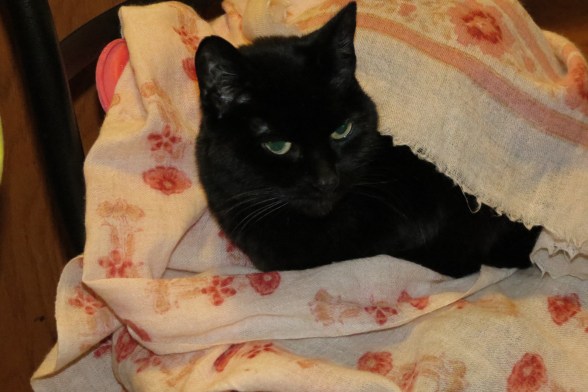
The photograph is Elwha, helping me knit socks. With the bad air from the fires and my still recovering lungs, I am staying indoors and knitting socks .

drkottaway’s werewolf theory

Papers about antibodies and immune system responses are proliferating. About Chronic Lyme disease, fibromyalgia, chronic fatigue, long haul Covid-19. We are near the tipping point of understanding vastly much more about the immune system, though understanding what is happening and being able to “fix” it are poles apart. You have to invent the germ theory before you can invent an antibiotic.

Allopathic medicine currently says that behavioral health disorders are caused by “neurotransmitter imbalances” in the brain. That’s a bunch of vague hooey, isn’t it? There is one mouse neuron that has been studied and has 300 different kinds of receptors for serotonin. Scientists blocked one and the mice acted obsessive compulsive. That was one kind of receptor. They are trying to figure out the other 299 and what they do in combination. Does this sound like we understand the brain? No, it doesn’t.

BUT there are papers about antibodies. Antibodies can mimic neurotransmitters, like dopamine, like serotonin, like adrenaline, like norepinephrine. Hmmmm. With multiple different types of receptors for each neurotransmitter, the antibodies could be specific for some receptors and not others. The antibodies could block the receptor, like the wrong key in a lock. Or the antibody could act like a key and turn the receptor on.

One barrier to understanding Long Haul Covid-19 and chronic fatigue as autoimmune diseases is that they do not cause a rise in the usual inflammatory markers. Those are the ESR (erythrocyte sedimentation rate) and CRP (um, I forget — oh, C-reactive protein). This does not mean that there is no inflammation or that these are not autoimmune disorders. This means we have not found a diagnostic marker. Rheumatoid arthritis can be “sero-positive”, with a positive rheumatoid factor marker. Or it can be “sero-negative”, with a negative rheumatoid factor lab, but it’s still rheumatoid arthritis.

What does this have to do with werewolves? Great question! I am thinking about the adaptive advantage of making antibodies to our own neurotransmitter receptors. How could that POSSIBLY be an advantage? What it means is that when someone is very very ill, or very very stressed, or both, at a certain point the immune system starts making crisis antibodies. These cause neurotransmitter and other symptoms. Brain fog, obsessive compulsive disorder, anxiety, muscle pain, fatigue and on down some very long lists. A recent study of fibromyalgia patients looked at 8 antibodies. One was an antibody to the GABA receptor. All of the patients had some of the antibodies, none of them had all of them, and they all had different patterns. So there is no marker and the neurotransmitter antibody could explain brain function changes.

Why werewolves? I am thinking of the old legends that are embedded in multiple countries and languages. Werewolves, demons, vampires, angels. My fourth pneumonia has left a problem: I can’t tolerate gluten any more. We did the antibody tests last week. I think they will be negative, because my gluten intolerance is relatively mild. I can have a tiny bit. People with bad celiac really can’t have any. I may have an antibody that is either a low level or one that has not been described yet. So with repeated infections, four pneumonias plus the exposure to my mother’s antibodies to tuberculosis in the womb, I now have what is looking like a permanent change in diet. This pneumonia started in March 2021, so it’s over a year. I had diverticulitis after that in August. I ate a piece of tempura two months later and thought, ooops, that has gluten! The next day I hurt in the same place as the diverticulitis and decided that I would stay well away from gluten for a while.

The adaptive advantage of having antibodies that change our diet or character or make us stronger or weaker would be to force us to change. To leave a community. To ask for help. To hide during a pandemic. To fight or be suspicious of everyone. Being a grumpy werewolf might save your life in a pandemic, as long as you don’t break any laws and eat someone. A friend likes the dark and hibernates and likes protein best: vampire or bear? I am not sure, maybe a vampire bear. Chronic fatigue seems to “save” or at least stop people from working 20 hours a day and driving themselves to illness. I am not saying that chronic fatigue is good or fun: but it might be adaptive. Brain fog and stiff muscles: zombies, anyone?

Can we do anything to prevent ourselves from getting these mysterious but probably autoimmune disorders? Yes. Lower stress. BUT WE ARE IN A PANDEMIC. Yes, but we can still lower stress. Here are three things to do:

  1. Do not work yourself into the ground, into illness, into the grave. Take breaks.
  2. BREATHE. A simple exercise to quiet the nervous system is to breathe in four seconds and out for seconds. You have to pay attention or count, unless you do it as part of facing a wall meditating, but it works. The veterans I worked with agreed that this works and they are not an easy crowd to please.
  3. LOLCATS or whatever makes you laugh. Sit under a tree. Throw rocks in the water at the beach. Play with a child’s toy with or without the child. (Remember to share.) Sit in a rocking chair and rock gently. Go for a walk, slowly, no ear buds. Listen to the birds. Watch the tops of trees move in the wind. This quiets the sympathetic fight or flight response and switches us to the relaxed parasympathetic. Do this every day at least once.

These all quiet the nervous system which in turn quiets the immune system.

But wait, some people are in a war zone or a disaster zone or an earthquake! Yes. Help them. Get them out. Send something locally or internationally. Give something to your local “buy nothing” group or Heifer or one of the groups in your town: Rotary, Soroptmists, Elks, your local Area Aging help group.

And that is Drkottaway’s Werewolf Theory, a work in progress, under study. I need NIH West. Contact me to start the fund drive.

____________

References:

Overview of fibromyalgia: https://www.verywellhealth.com/autoimmunity-neuroinflammation-in-fibromyalgia-5197944

Fibromyalgia as an autoimmune disorder: https://spondylitis.org/research-new/fibromyalgia-might-be-an-autoimmune-disorder-a-new-study-says/

They have given human antibodies from fibromyalgia patients to mice. The mice get fibromyalgia. https://www.nature.com/articles/s41584-021-00679-y

I took the photograph of Sol Duc today.

welcome home

home home welcome home
home is where you are, Beloved
and you are everywhere

not in churches, not for me
I run outdoors, long to be free
you are everywhere I see

the beauty in the world
love and grief and pearls
small child dance and twirl

I have crossed the boundary
over and over again
Beloved, let me stay, friend

I’ve searched for you so long
Beloved, you make us so strong
look everywhere that’s wrong

home home welcome home
home is where you are, Beloved
and you are everywhere

________________________________

August 31, 2022

abstract

This is a cell phone snap from a few days. It reminds me of Jackson Pollock’s paintings, all the complex colors and layers.

The tide was way way way out and it’s a snap of the green layer on the beach. Gorgeous. The beaches here are an endless wonder.

For the Ragtag Daily Prompt: wonder.

Exercise mets

Mets could be metastases, a terrible word in cancer. But this is exercise mets. I am half way through my pulmonary rehabilitation for pneumonia and getting stronger. So what is a met? “One MET is approximately 3.5 milliliters of oxygen consumed per kilogram (kg) of body weight per minute.” (from https://www.healthline.com/health/what-are-mets#definition).

Ok, that doesn’t seem very useful. I find this way more useful, a chart of how many mets are used for certain activities:

https://www.healthline.com/health/what-are-mets#examples

The treadmill I am using at pulmonary rehab tells me how many mets I am using. However, last time I turned it on and didn’t enter my weight. It uses 155 pounds, which is more than I weigh. I think that then the mets are wrong. It isn’t exact anyhow. The important thing is that I am improving and off oxygen! I am now up to 5.3 mets, going at 3.3 mph, on a 4% grade, for 40 minutes. Pulmonary rehab is twelve weeks, twice a week, with a respiratory therapist and a physical therapist.

My respiratory therapist asks my goals. To bicycle distance, hike across the Olympics, and to ski again, off oxygen. That means altitude. Once we are above 5500 feet, the body really starts noticing the thinner air. I am not there yet but I am so pleased to be improving.

On the chart, I am in the moderate exercise range. To bicycle, I would have to be able to sustain 8 mets. Not yet, not yet.

Being off oxygen (except night, flute, sustained singing and heavy exercise) is GREAT! The intrinsic problem has not been fixed, thought. Fully twenty specialists since 2012 have not figured out why I get pneumonia easily and how to protect me, other than masking and not working in Family Medicine or anything people intensive. It’s annoying, my career has been blown up. I don’t have much hope of an overarching diagnosis at this point, but I’m willing to keep trying. We don’t know everything in medicine and really, I do not think we ever will. It’s endlessly complex and fascinating.

I think the mets chart should be shared with patients. I had one couple who insisted that the woman had PMS even though she was postmenopausal. I scratch my head and continue to watch her. After months something made me suspicious and I order an echocardiogram. She had congestive heart failure, seriously reduced heart output. I promptly called the cardiologist and said, “This is new, she is on NO MEDICINES.” He saw her within a week. Sometimes things do not present in a straight forward manner. She felt much better once we got her heart functioning better. If a person is losing their ability to perform moderate intensity mets, they should see their doctor. It could be spending too many hours in front of a screen (turn it off, get up, go outside, walk daily!) but it could also be something else. Heart is the number one killer still.

Stay healthy and keep those mets up!

Ha. I did use the word certain, didn’t I? And one of my favorite exercises is dancing. Listening to this right now: