Gleaning

This is for Ronovanwrites weekly haiku challenge #70, with prompt words crane and gold.

quick look gleaning fields
sandhill cranes glean gold near Sand
Dunes National Park

I lived in Alamosa, Colorado for three years, at 7500 feet in the San Luis Valley, land of cool sunshine. The sandhill cranes would migrate through and glean the potato fields, flocks with thousands. There were more cranes than people at the height of migration. And in the northeastern corner of the Valley, surrounded by the Sangro de Cristo Mountains and the San Juans, is the Great Sand Dunes National Park and Preserve, with dunes up to 600 feet high. We were surrounded at 7500 feet by 14,000 foot peaks and passes out the Valley in all four directions. It is an amazing place.

I took the photo in 2007 at the dunes: I chose this one to try to give an idea of the scale…..we had just climbed up to the top of the first dunes….

Where oh where is love?

How could we have love without grief?

The US culture seems to suppress grief, take grief away, heal grief, get over grief, but think about love without grief.

Could we love someone if we didn’t grieve when they died?

No. We couldn’t. That wouldn’t be love. Or that would be the pale shadow of love, love without loss, love that turned from the grave and forgot.

We cannot love without grief, so we need to make room for grief. We need to stand by each other during grief. We need to help each other, be present, be there, say the wrong thing, say the right thing, say nothing and just give love.

Love builds the Taj Mahal. Love writes Rumi’s poems. Love is the memories of the person we loved, we tell our children about them, we hold them in our hearts.

Love loves without logic, without sense. Love in spite of alcohol, addiction, lies, how can a person love an abuser? They love the person, not the abuse. They love the person, not the actions, not when the alcohol takes over, when the meth takes over, when the oxycontin takes over. Love loves the whole person and grieves the damage.

Love and grief are intertwined, a rosebush with thorns, there is no one without the other. No joy without despair, no light without dark, no you without me, no joining without separation.

I enter grief as I enter love, whole heartedly, oh, I may be afraid of the dark but I go there anyhow, I know as the waves close over my head and I sink into the depths:

There is no love without grief.


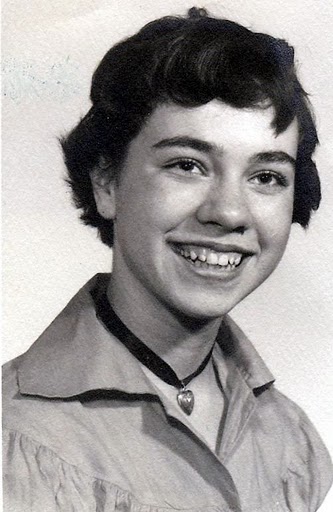
The picture is my mother, Helen Burling Ottaway, in high school. She died of cancer in 2000 and I still miss her terribly.

Songs to raise girls: Long Black Veil


This and The Fox are what I think of as the two core family songs. We sang this from as early as I can remember and my father played the Band’s version on the record player all the time. I taped his records to take to college…

This is the song my parents chose to raise girls on? Oh, and I do have it memorized….

Ten years ago on a cool dark night
There was someone killed ‘neath the town hall light
There were few at the scene and they all did agree
That the man who ran looked a lot like me

Ok, it starts with a murder. Someone is killed, in the town, at night. Be careful, little girls, bad things can happen at night.

The judge said “Son, what is your alibi?
If you were somewhere else then you won’t have to die”
I spoke not a word although it meant my life
I had been in the arms of my best friend’s wife

It is about infidelity and not only infidelity, but infidelity with his best friend’s wife. This song is a morality play. He doesn’t speak. I see the magazines at the counters in the grocery store and think about how different this song is from our current culture. Divorce and splashed all over the papers, that’s what the celebrities do today.

She walks these hills in a long black veil
She visits my grave where the night winds wail
Nobody knows, no, and nobody sees
Nobody knows but me

So she doesn’t speak either. She remains faithful to him in visiting his grave, but the marriage must continue, because she only goes at night.

The scaffold was high and eternity neared
She stood in the crowd and shed not a tear
But sometimes at night when the cold wind moans
In a long black veil she cries over my bones

She watches him die for what they considered a sin. This song is about ethics, really. The two of them had broken their code of honor and paid the price, which was that he died for a different crime. And did the man who really killed the person in the first stanza then go free?

Why wouldn’t they speak up? Perhaps she had children and he couldn’t support them. Perhaps they truly considered it a sin, a dishonor, a horrible mistake. Perhaps honor and honoring his best friend was more important than love…. Our current culture seems to think that love conquers all, but it doesn’t in this song. Did they do the right thing? This is a song to discuss and to think about and yes, a song to raise girls.

Though I think the husband and any children would know that there was something…. a parent and partner can’t really hide that deep sorrow….

It was written by Danny Dill and Marijohn Wilkin in 1959 and originally recorded by Lefty Frizzell.

Lefty Frizzell: [https://www.youtube.com/watch?v=50k18gL76AU]

The Band, 1968

Johnny Cash, 1968

Lots of others…. and us.

The photo is me and my sister, probably in 1993 or 1994.


Songs to raise girls: Pack up your sorrows

This song interests me. It is the fourth in my series about the songs that my sister and I learned growing up.

When we recorded our family songs, my sister said she liked it. I said, I think it is creepy, with that juxtaposition of a sweet tune and then words that are not so sweet.

No use cryin’
Talking to a stranger
Namin’ the sorrows you’ve seen

Oh, ’cause there are
Too many bad times
Too many sad times
Nobody knows what you mean

If somehow
You could pack up your sorrows
And give them all to me

You would lose them
I know how to use them
Give them all to me

The line that bothered me was “I know how to use them”. What does that mean? Use them for what?

No use ramblin’
Walkin’ in the shadows
Trailin’ a wanderin’ star

No one beside you
No one to hide you
An’ nobody knows where you are

Ah, if somehow
You could pack up your sorrows
And give them all to me

You would lose them
I know how to use them
Give them all to me

And how could you give your sorrows to someone else? The singer is offering to listen to sorrows but also take them away. “You would lose them.” And then the singer “knows how to use them”.

No use roamin’
Walking by the roadside
Seekin’ a satisfied mind

Ah, ’cause there are
Too many highways
Too many byways
Nobody’s walkin’ behind

Ah, if somehow
You could pack up your sorrows
And give them all to me

You would lose them
I know how to use them
Give them all to me

I never got around to asking my sister if it was the tune she liked or the words or what it meant to her. I chose to play that recording at her Washington memorial. I could not go to her California memorial because I was too ill. My father had terrible emphysema and was on oxygen. I thought I had pertussis but it turned out to be systemic strep A, which hurts. At any rate, I was too sick to travel. Her Washington Memorial was a month or two later, when I was well enough to organize it…..

You would lose them
I know how to use them
Give them all to me

It is by Pauline Baez. The version by Richard and Mimi Farina is the one I’m familiar with, so my parents probably had the record:Β  https://www.youtube.com/watch?v=U4LbU8w7Th4.

Joan Baez, Pauline and Mimi Farina were sisters. Joan Baez recorded it https://www.youtube.com/watch?v=NAMe1bRW8Ao. So did Peter, Paul and Mary: https://www.youtube.com/watch?v=IVxNleqVpx4.

And so did Johnny Cash and June Carter: https://www.youtube.com/watch?v=_ctVhDEuTYE

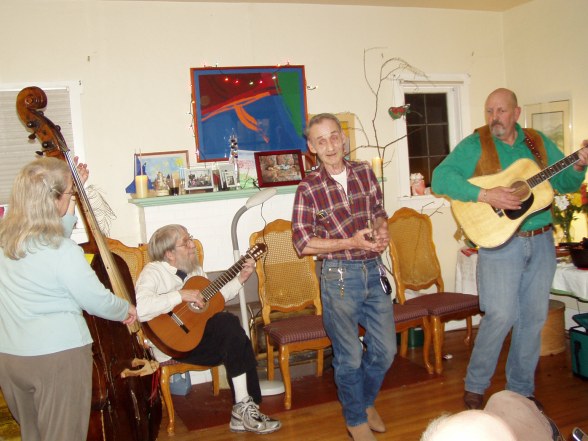
The picture is a music party at my house in 2009, my father seated and Andy Makie on harmonica, Jack Reid standing with the guitar.

Swim fast

This is for Photrablogger’s Mundane Monday Challenge #31. I shot this at the senior swim meet in our 1950s pool. The windows are covered so that everyone can see. The team members each have a secret sister for the meet and deliver posters and gifts at school. This was shot with a zoom lens, across the pool, back lit by the afternoon sun…..

Adverse Childhood Experiences 7 : Revisiting Erikson

Welcome back, to Adverse Childhood Experiences, and I have been thinking about Erikson’s Eight Stages of Psychosocial Development.

These were mentioned in medical school and in residency. I was in medical school from 1989 to 1993 and in Family Practice Residency from 1993 to 1996. Family Practice is at least half psychiatry, if you have time. We are losing the time with patients in order to achieve “production”. I complained about the 20 minutes I was allotted per patient and was told that I should spend 8 minutes with the patient and 12 minutes doing paperwork and labs and calling specialists. This is why I now have my own practice. A new patient under 65 gets 45 minutes and over 65 gets an hour and my “short” visits are 25 minutes. I am a happy doctor. And on the Boards last year I scored highest in psychiatry….

So, back to Erikson. The first stage, at birth to one year is Basic Trust vs Mistrust. “From warm, responsive care infants gain trust or confidence that the world is good.”

I was taught that people would have to “redo” the stage if they “failed”. Let’s look at that a little more closely.

Take an infant in a meth house. No, really, there are babies and small toddlers that have addict parents, alcohol, opiates, methamphetamines. We do not like to think about this.

A social worker told me that the toddlers from a meth house were really difficult to deal with. They do not trust adults. The first thing they do in foster care is hide food.

Hide food? Well, adults on meth are not hungry, sometimes for 24 hours or more, and they are high. So they may not feed the child.

Now, should this child trust the adult? No. No, no, no. This child is adaptable and would like to survive. So even under three they will learn to hide food. In more than one place. This is upsetting to foster care parents, but perfectly understandable from the perspective of the child.

So has the child “failed” the first stage? Well, I would say absolutely not. The child looked at the situation, decided not to starve and learned not to trust adults and hid food. Very sensible. Adaptive.

Is the child “damaged”? That is a very interesting question. After 25 years of family practice medicine I would say that no, the child is not damaged. However, the child has started out with a “crisis” brain. The brain is plastic, all our life, and so this child did what was needed to survive.

Is the child “sick”? Again, I would argue no, though our society often treats the child as sick. We think everyone should be “nice” and “warm” and “why isn’t he/she friendly?” Well, if you started in an addiction household or a crazy household or a war zone, it would not be a good adaptation to be warm and fuzzy to everyone.

How do we treat the adult? In a warm fuzzy nice world the child would have a foster parent who adored them, was patient with them, healed them and they would be a nice adult. I have a friend who said that foster care was so bad that he chose to live in an abandoned car his senior year rather than stay in foster care. He couldn’t play football because he had to get back to the car and under the layer of newspapers before it got too cold. I am sure that most foster parents are total wonders and angels. But some aren’t.

I have a person who says that he lived on the streets from age 8. He did get picked up and put into foster care. He kept running away. “The miliary loved me because I could go from zero to 60 in 60 seconds.” That is, he has crisis wiring. He is great in a crisis. The military is a sort of a safe place, because it has rules and a hierarchy and stands in for the failed parenting. Expect that then you get blown up by an AED in Afganistan and hello, that makes the crisis wiring worse.

How DO we treat the adult? We treat them horribly. We say why can’t this person be nice. We diagnose them we drug them we shun them we isolate them we as a society discriminate against them deny them and we are a horror.

I get so angry when I see the Facebook posts where people say “surround yourself with only nice people”. Ok, how dare you judge someone? You don’t know that person’s history. You don’t know what they grew up with. How dare they say that everyone should be NICE.

I am a Veteran’s Choice provider. I have 6 new veterans in the last 3 months. I suspect I will get more. They are not “NICE”. They come in suspicious, hurt, wary, cadgy. And I don’t care, because I am not “NICE” either. We get along just fine.

When I run into someone who isn’t “NICE”, I think, oh, what has happened to this person? What happened to them when they were little? What happened to them as an adult? How have they been hurt?

Pema Chodron writes about sending love: to your loved ones, to a friend, to an acquaintance, to a stranger, to a difficult person and to an “enemy”.

Send love. And do something about it. Help at your local school, help families on the edge, help single parents, sponsor a child to a sport if their parents can’t afford it, pay for musical instrument lessons, do Big Brother/Big Sister, become a “grandparent” to a child at risk, be a good foster parent, donate to addiction care….

The photo is from 2007, when my children and I visited their father in Colorado. A stranger in the parking lot took it at our request…..
Songs to raise girls: Billy Barlow

I knew the song “Billy Barlow” as “Let’s go hunting”. It was one of the silly songs that we recorded. I adored this song when I was little for two reasons. One was that it was funny. The other was that I interpreted it as a song that could be changed and sung about more than one animal. I can remember when I realized that no, the adults sang it the same way each time and they would not change the animal. I was disappointed but I still loved the song. And I could change the animal on my own.

It’s a good song to raise girls: an illustration of a group of guys….

Let’s go hunting, says Risky Rob
Let’s go hunting, says Robin to Bob
Let’s go hunting, says Dan’l and Joe
Let’s go hunting, says Billy Barlow

When my son was a teen, another parent commented that the IQ dropped in half for each teen added to a group. Two boys cut the IQ in half, three had it to one quarter and four was trouble.

What’ll we hunt for, says Risky Rob
What’ll we hunt for,
Let’s hunt rats, says Billy Barlow

How’ll we catch them,
Let’s borrow a shotgun, says Billy Barlow

How’ll we divide them,
How’ll we divide them, says Billy Barlow

I also loved this song because the last line changed. Sometimes Billy Barlow said the same thing and sometimes he said something different. When I was very small and still learning the song, that was part of the joy of it, to see what Billy Barlow would do. And clearly he was wicked, like Coyote or Pan or Loki and going to lead the group to trouble if he could….

I’ll take shoulders,
I’ll take sides,
I’ll take hams
Tailbone mine, says Billy Barlow

How’ll we cook them,

I’ll fry shoulders,
I’ll boil sides
I’ll bake hams,
Tailbone raw, says Billy Barlow

Oh, delicious ickiness, raw rat tailbone… It would give my sister and me shivers….

Let’s go hunting, says Risky Rob
Let’s go hunting, says Robin to Bob
Let’s go hunting, says Dan’l and Joe
Let’s stay home, says Billy Barlow

And relief. Billy was messing with them all the time and he doesn’t want to go and he never did, which is why he suggested a shotgun to hunt rats…. I like this Billy.

When I search on Billy Barlow, here is an entirely different song, a civil war marching song for Company B from New York City that marched into Maryland in 1863 and had a 63% loss. My sister had a civil war marching band play at her rehearsal dinner and we ended up marching in pea gravel for a couple hours. It turns out that my oldest cousin had ambitions to be a marching band drum leader. The band thought we were so funny that they offered to return. But the civil war fighters on both sides had marching bands with them. https://www.youtube.com/watch?v=M1ZlfsP7dZA

And here is Pete Seeger with our song, in a slightly different style: https://www.youtube.com/watch?v=FrgTOPufru4

And here is another site that says the song is a version of “The Cutty Wren” or “The Hunting of the Wren”. https://www.youtube.com/watch?v=P_oAPCVkMP0

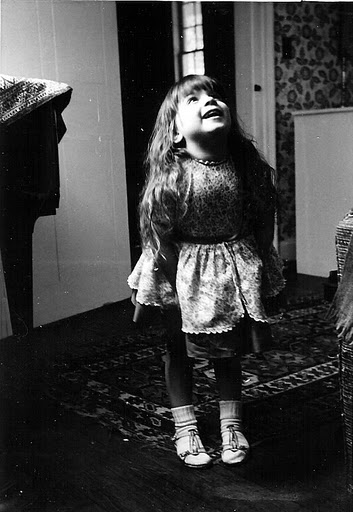
The picture is my daughter. She was playing alone and was having a wonderful time with her imagination. I am not sure who took this picture…..