Does pain mean danger?

Does pain mean danger?

From a physician standpoint, sometimes the answer is “No.”

One example, sent by an alert friend, is a lump on the back of the neck, with pain radiating downwards.

This could be an abscess or an infected cyst, but since they didn’t mention infection, it is most likely an enlarged lymph node. This is one example where the doctor or nurse practitioner or psychic healer will look at it, say “Does it hurt?”, poke it and then be all cheerful while you wonder WHY they have to poke it* after you say, “Yes, it hurts.”

A newly enlarged tender painful lymph node is usually a reactive lymph node. It is swollen with cells from the immune system and is trying to heal something in the vicinity. A cut, irritated acne, a cold virus, that shaving accident, a low grade infection, an ear infection. Usually I talk about it and recheck it in two weeks.

The lymph node that will make your healthcare person worry is the one that DOESN’T hurt. A slowly or quickly enlarging lymph node that is not tender is worrisome for lymphoma or for metastatic cancer. Once it gets to 1 centimenter, I am calling the surgeon to consider doing a biopsy. We have lymph nodes throughout our body, but the ones that we can feel on the surface are only in the neck, the supraclavicular nodes, the axillas (aka underarms) and groin. The rest are under bone or muscle, though they can show up on CT scan or xray: enlarged mediastinal nodes along the great vessels and trachea in the middle of the chest.

So pain does not always correlate with the level of danger of an illness. The reactive nodes hurt because they swell quickly, and they usually go down quickly as well.

*They poked it to be sure that it is not fluid filled, that it is firm but not hard and fixed, so not an abscess or cyst, and doesn’t feel like a cancer.

I took the photograph last night with my cell phone, during a rare thunder and lightning storm here… beautiful.

Emergency preparedness

In Venezuela now
some people get water once a week
and sicken from it

First, withdrawal
When we have our eathquake
Tsumani and roads and bridges are gone

If one in three adults in Utah
Got an opioid prescription in 2014
What are the numbers here?
Opioids
Alcohol
Benzos
Caffeine
After the first wave of death
and grief, withdrawal begins
Not just addictive drugs
from insulin
from blood pressure meds
anticoagulants
seizure medicine
chemo ground to a halt
I read that alcohol is best to trade in disaster
and chaos and loss
Guarded by guns in small gangs
We are told to store water
Where?
If the house falls down
and I can get out, where would I put water?
A bunker in the ground?
I stock straws for water
I wish I could buy 9000
for my town
I stock books for when the computers
go silent
I stock songs in my head
memorized all
I fight for all my patients
Who would I not fight for?
Maybe it would be better to die
or be captured early
I stock love not guns.

http://www.nytimes.com/slideshow/2016/05/26/world/americas/desperate-times-in-venezuela/s/27VENEZUELA-SS-slide-3ZIT.html?_r=0

http://www.theguardian.com/us-news/2016/may/26/utah-mormons-prescription-painkiller-addiction

http://www.newyorker.com/magazine/2015/07/20/the-really-big-one

Weaning methadone

Weaning high dose methadone down to a lower, safer, less likely to stop breathing and die dose is difficult, but it can be done. It needs both a determined patient and a determined physician who are willing to work together.

In 2010 I took a class in buprenorphine treatment for opiate overuse syndrome from the University of WA Medical Center and got started with their telemedicine, once a week, on line with the Pain and Addiction Clinic. Each week there was a teaching half hour and then an hour where we could present patients anonymously on the telemedecine to a panel: a pain specialist, an addiction specialist, a psychiatrist, a physiatrist, and a guest physician. Five consults at once! And they would discuss the case and fax recommendations to me.

Three weeks after the course, police and Medicaid and the DEA shut down the pain clinic 5 blocks from me, taking the computers. I acquired 30 patients in 3 weeks. Trial by fire.

By 2012 Washington State passed a pain medicine law. This says that a primary care physician can only prescribe up to 120 morphine dose equivalents for chronic pain. Anything higher and the patient should be checked by a pain specialist and there were not that many in the state.

120 morphine dose equivalents is up to 20 mg of methadone or possibly 30mg. Methadone has a very long half life so it’s a bit weird. Hydrocodone is one to one with morphine and oxycodone is 1.5 to one, so 90 mg of oxycodone is 120 morphine dose equivalents.

The law requires urine drug screens, careful record keeping, screening for adverse childhood experiences and regular visits. If the pain medicine is not effective, it is to be weaned. I had a couple of patients with over 100mg of methadone daily. That is way over the 120 morphine does equivalents and UW helped me help the patients start weaning.

First, they recommended dropping the dose by about 1/3. Some patients left immediately. I would give patients links to the law on line and explain that the concern is that opioids in combination with other sedating drugs and alcohol are killing more people than either guns or car wrecks or illegal drugs in the United States and the CDC has declared it an epidemic. Honestly, doctors really take the “first, do no harm” seriously and we do not want to kill people. One angry patient said “Your first job is to keep me pain free.” I said, “No, my first job is to not kill you.”

For those who stayed, dropping the dose by 1/4 or 1/3 worked. They had about two weeks of mild withdrawal symptoms and then gradually felt better. These were at doses of 120-150mg methadone daily. We started weaning then by 10mg or about 10% every couple of months. The UW Pain Clinic was doing this simultaneously.

In 2012 the WA PMP started as well. This is a central pharmacy reporting for all controlled substances. Controlled substances means addictive and monitored by the DEA. Even the head of the WA Pain Clinic found that he had 5-6 patients who were getting opioids from 4-5 different doctors. He said, “We do have to check because I thought I knew my patients and I would have none. I was wrong and I was surprised.” Those patients could be taking way more than any of their doctors knew or could be selling pills. Not a happy thing.

Once the methadone folks got down to about 1/3 of the high dose, we had to slow down. For my patients that meant at 40-50mg. The head of the pain clinic said wean by 5 mg or 2.5mg and do it every 6-8 weeks.

As people were weaned, their pain level stayed about the same. They would have an initial increase for the first two weeks. I describe it as follows: Think of it as if you are in a room listening to a stereo. The pain medicine is like noise protecting headphones. Once you are wearing the headphones, your brain says, uh, I can’t hear (feel pain). Hearing (feeling pain) is important information, so the brain turns up the volume. Way up if the dose is really high. Then you take the headphones off: OW!! IT’S TOO LOUD! THE SOUND (PAIN) IS BLOWING OUT YOUR EARDRUMS (HURTING LIKE HELL)!!!

Weaning slowly gives the brain a chance to turn the volume down on the receptors. UW said that at best chronic opiates lower pain an average of 30%. After a while, I said I had trouble telling the difference between withdrawal pain and increased chronic pain: they look the same. UW said, “Looks the same to us too.” But we had frequent visits and an ongoing discussion about pain. Pain is necessary for survival: you have to know if you are injured. Diabetics who can’t feel their feet are instructed to look all over their feet every day to check for injury and infection. I had one gentleman who couldn’t feel his feet and put them on a wood stove because they felt cold. He was needing skin grafts from the burns. So we need to feel pain and not numb it all the time. Also pain has three or more componants: the sharp cut/broken/bruised immediate pain. Second is nerve pain. Third is emotional pain, and we don’t yet have a meter that gives us what percentage each is contributing to the total sum. When I have a new chronic pain patient, I say that ALL THREE must be treated. We can argue about the details, but they can’t leave the emotional piece out…. or they have to find another doctor.

Also, at the higher doses, hyperalgesia is common, pain from the opioid itself. People felt better at lower doses. I gave people the links so they could read the law and the CDC information themselves. They were shocked and angry and threatened at first, but the “I don’t want you to die from too high a dose and it’s not safe and I am sorry.” message would get through eventually.

“Why do you have to do urine drug screens?” say some people. “You are treating me like an addict.”

My reply, “What do you think the addicts tell me?”

The person thinks about it. “The same thing?”

“Absolutely. So I can’t tell unless I check. Also, the boundary between chronic opiate use and opiate overuse is a lot thinner than we thought, so I have to check because all chronic opiate people are at risk for overuse.” The DSM-V combines opioid dependence and opiate addiction into opiate overuse syndrome, a spectrum from mild to moderate to severe.

We also talked about other ways of dealing with chronic pain. John Kabat Zinn’s mindfulness meditation classes drop pain levels by an average of 50%, so better than opioids. And way safer.

Meanwhile, since people could no longer get opioid pills from 4-5 doctors at once, the supply in Washington started drying up. Some people realized they had opiate overuse syndrome as well as chronic pain and turned to methadone clinics or buprenorphine clinics. Others went to heroin. The heroin overdose death rate has risen. I hope that as the stigma surrounding “addiction” changes into a better understanding of chronic pain and opiate overuse syndrome, more people will be able to get treatment and the death rate and heroin use will go back down.

https://depts.washington.edu/anesth/care/pain/pain-roosevelt.shtml

http://www.cdc.gov/cdcgrandrounds/archives/2011/01-february.htm

http://www.doh.wa.gov/ForPublicHealthandHealthcareProviders/HealthcareProfessionsandFacilities/PainManagement

http://www.doh.wa.gov/ForPublicHealthandHealthcareProviders/HealthcareProfessionsandFacilities/PrescriptionMonitoringProgramPMP

http://www.uwmedicine.org/referrals/telehealth-services

https://www.drugabuse.gov/publications/research-reports/prescription-drugs/opioids/what-are-opioids

http://www.umassmed.edu/cfm/about-us/people/2-meet-our-faculty/kabat-zinn-profile/



does chronic pain kill you?

Another writer sent me this story, saying that chronic pain killed Prince, not an overdose.

http://www.rawstory.com/2016/05/prince-did-not-die-from-pain-pills-he-died-from-chronic-pain/

My response is complex.

1. Is chronic pain an “illness” in it’s own right?

My answer is yes and no. It’s complicated and our understanding is evolving. Right now I think of chronic pain as a switch in the brain that gets thrown. It can be thrown by adverse childhood experiences, by infection, by trauma or war or abuse, by too much stress… or a combination of any of these.

2. Why a switch in the brain?

In fibromyalgia patients we can’t find much on physical exam, except that the pain seems out of proportion to the exam. Ditto with chronic fatigue, reflex sympathetic dystrophy, TMJ, etc. However, now we can image the brain with a functional MRI and watch which parts are lighting up and how much. A study of “normal” and fibromyalgia patients involved a standardized pain stimulus: a thumbscrew. (Kinky, right?) The normal patients said the pain stimulus was 3-4 out of 10 and their brains lit up a certain amount. The fibromyalgia patients said the same pain stimulus was 7-8 out of 10 and the pain parts of the brain lit up MORE corresponding to their pain level. So they are not lying… and it IS in their heads. Sort of. We aren’t sure whether the muscle is yelling more than normal or whether the brain is hypersensitive or both. My guess would be both.

And I think this is an adaptation. It is to get us to rest, heal, calm down, introspect, stop being type A, etc. Boy, do we suck at it. Though recently I had a person in clinic who said what their body wanted to do was nothing. They just wanted to lie around. I said, well, ok, so when can you do that? They did, for two weeks, at the holidays. And my patient said, “One day I had a cup of tea and a book and the cat on my lap and the dog at my feet. I realized that my adrenaline system was turning off and I felt calm and relaxed. Healed.” Back at work the person cannot always maintain it but is getting better at it.

3. What does this have to do with Prince?

The problem is that for 20 years we treated chronic pain with opiates. Unfortunately on continuous opiates, the brain cells change in many people and “down-regulate” the opiate receptors. Less receptors, the pain rises. The person needs more opiate. The brain removes more receptors. So two myths: one that if you have chronic pain and take medicine as directed, you can’t get addicted. Only dependent. Since that is a myth, the DSM-V has combined addiction and dependence into one diagnosis: opioid overuse syndrome. It is a spectrum, not two separate responses.

The second myth is that if you give enough opioid, it will help the pain. Well, no. UW Pain and Addiction Clinic says that on average pain is reduced about 30% by opiods, whatever the dose. And high doses start causing some weirdΒ  hyperalgesias. I’ve weaned two people from over 100mg methadone daily down to 20-30mg. It took two years. They felt better on the lower dose after they got through withdrawal symptoms and a short term increase in the pain receptors complaining at them. And they are much less likely to overdose and die.

Page two here http://www.supportprop.org/wp-content/uploads/2014/01/PROP_OpioidPrescribing.pdf discusses current knowledge about opioids.

4. So like, Prince?

He may have died from a combination of fatigue and sedating drugs. If you get enough sedating drugs, then you stop breathing. Opioids are the biggest offenders combined with alcohol or sleep medicine like ambien or benzodiazepines like valium or ativan or alprazolam or muscle relaxants like methacarbomal or a combination of all of the above. I am a strict physician about urine drugs screens and I do the dip in clinic in front of the person. Way too often, the person does not tell me about the alprazolam or whatever until I am holding the dip over the cup…. and that’s when they tell me. They got it from the ER or a friend or two years ago or … took their dog’s. Really.

He may have died from influenza, if he had it, with sedating drugs. Bad influenza causes lung tissue swelling and can mess up your oxygenation. Your heart has to take up the slack and go faster. If you are trying to work and your heart rate is well above normal, it’s exhausting. It can kill you.

He may have died from overwork, another infection, sedating medicines…. but not directly from chronic pain. Chronic pain slows us but I do not think it kills us*. What kills us is trying to treat it with a pill instead of resting and doing gentle exercise and saying: What does my body want?


5. Overdose?

Also, are we talking about an accidental overdose? Are we talking about drug abuse? Are we talking about accidental death or suicide or do we as a society think that addiction deserves overdose death but a person taking medicine for chronic pain is a tragedy? Aren’t we a bit judgemental?

Prince may have taken a pain pill as directed but taken it with too many other controlled substances or with alcohol or while sick and exhausted. Overdose means too high a dose. If it was two percocets, alcohol, flu and xanax…. it could be an accidental poisoning.

6. Are you sure?

No. Medicine changes. Our understanding of the brain changes. Science is about change and deepening understanding. We are barely getting started on the brain and I would say that we are in preschool there.


*Stress alone can cause heart attacks and sudden death:Β  Β  http://www.health.harvard.edu/blog/stress-cardiomyopathy-a-different-kind-of-heart-attack-201509038239

The photograph is from a week ago, part of my Maxfield Parish cloud series, zoomed way in to the mountains across the water.


B is for bored

B is for bored? All of the emotions that I could pick that start with B, and I pick bored?

But I am going to talk about bored in the context of chronic pain: and suddenly it is not boring at all.

Welcome to 7 Sins and friends, a spectrum, a kaleidoscope, an ABC of emotions.

B

If you hear the same sound over and over, like a faucet dripping, can you tune it out? I can. I can tune out practically any noise and I have fallen asleep under bright light in a Casino room full of ringing and blinging and alarming machines.

You may not have quite that level of ignoring something, but you can certainly tune things out. I have been reading Jon Kabat Zinn’s books on Mindfulness Meditation and I have used his mindfulness CD. I was having trouble sleeping after my father died, and I would use the CD. However, I used it in the reverse of how it is meant.

I used the body scan. Dr. Zinn talks in a slow calm tone and has the listener move from body part to body part, just feeling what is there. Not tightening or releasing muscles, but just starting with the left toes. At the start he says, “This is to fall more awake, not to fall asleep.” And I fell asleep every time.

But what does this have to do with pain? If you have tried meditation and focusing on your breath, your mind wanders. It gets bored. It starts think about the grocery list, or that person who yelled at you or ….. anything but the breath. You keep returning your mind to the breath. One day I had a hurt knee and was trying to go to sleep and thought…. hmmm. So I focused all my attention on the knee pain. Really tried to get inside my knee. Felt the pain fully and entirely….. and soon I was thinking about my grocery list. I pulled my mind back to my knee. My mind was sulky: yes, it hurts some, so what? Can’t we do something else? I am bored!

We are taught that pain is bad and I see many people in clinic who are afraid because of back pain. They are afraid to move because pain means something is wrong. Only most of the time it means that they have injured back muscles. The back muscles cramp up to protect themselves. The muscles must be soothed and stretched and healed and to do that we have to both pay attention to the pain and move without hurting the muscles worse. Sounds a bit boring,Β  right? Bored is more important than we think….

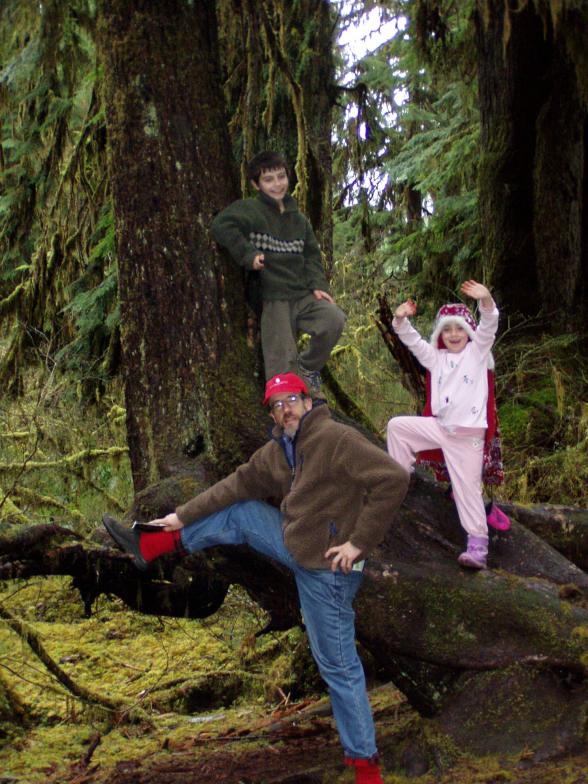
I took the photograph at the Hoh Rainforest on the Olympic Peninsula Washington, in 2004. We were not bored.


Four myths about death

Currently I see myths about death and dying in the United States. These myths are very strong and lead to a disconnect between medical personnel and non-medical. The medical personnel talk about end of life and want the answers to certain questions. But we often fail to address the persons deep fears and concerns because medicine sees them as myths, and so there is a disconnect between what the patient and the medical person see as important about the discussion of death.

Here are the four questions and fears:

1. How can I avoid being kept alive on a machine?
2. How can I avoid dying in pain?
3. How can I avoid having too much done, too many resources used, and dying in a hospital?
4. How can I avoid dying of starvation or thirst?

1. How can I avoid being kept alive on a machine?

The myth here is that we can keep someone alive on a machine. We almost never can. Comas are extremely rare. There are a very few people who survive a high spinal cord injury, like Christopher Reeves, and can be kept alive for a period on a ventilator. Or people with a disease that leads to the failure of the breathing muscles: Steven Hawkings with ALS has outlived all predictions.

But for the most part we can’t. I have tried: I have had two patients in 25 years with brain death who had signed organ donor cards. When brain death is established, an organ donor team will fly in to a rural area. Meanwhile, I was to attempt to keep the patient’s body alive. One lived long enough and the other did not. I could not stop the death with machines or drugs and that person was already on a ventilator.

Part of this myth is fear relating to hospital settings. ICUs, intensive care units, frighten people. There are alarms going off and machines with blinking lights and it is brightly lit and quiet and alien. Why? If a person is on a ventilator, they are sedated. Otherwise they will automatically pull the breathing tube out or the urinary catheter or the iv or all of them. It is instinctive. They are sick, may be delirious or injured, they are not in their right minds, they are not logical. So they are sedated. Most of the alarms are rightly ignored by the nurses: most alarms are going off because the patient has moved and the machine is not picking up. The nurses learn to filter automatically which alarms are trivial and which alarms do need attention and are an emergency.

I wanted to see an elderly aunt. When I arrived, my cousin said I couldn’t because she was in the emergency room. I said that I am pretty comfortable in emergency rooms and thought I could talk my way back to see her, since I am a physician. We had to wait in the lobby for a couple of hours, but then they let me back.

Part of the drama and horror that shows up in ICUs is the family’s feelings. Family members may feel guilty or angry or afraid and they often lash out at each other. Families are both at their best and their absolute worst when someone is critically ill. I have a friend who still doesn’t speak to a sibling after their father died in hospice three years ago, because they disagreed so strongly on how he should be cared for. The hospital staff and nurses and doctors and maintenance people and laundry people and dietitians are used to families crying or arguing or even yelling at each other. We try to support the patient and the family. But we cannot make them agree and don’t try.

We will return to the “in hospital” death later.

2. How can I avoid dying in pain?

Wear your seatbelt, wear helmets, don’t drive in blizzards, change the batteries in your smoke alarm, don’t text while driving….

That seems like a joke, but not really. Accidents are in the top ten causes of death in the United States currently. People do die in pain if shot, in car accidents, in falls. If we can’t get to them and get pain medicine on board in time.

When death is coming, the fear is that we will die in pain from, for example, cancer. However, most people that I have seen dying of cancer DECREASE the pain medicine rather than increase. There are at least two reasons. One is that they want to be awake. As the kidneys fail, the pain medicine lasts longer. They may not need as much. If they are in hospice and have family present, my experience has been that they say “Turn it down. I don’t want it. I don’t need it.” They want to be awake with their family.

The second reason is that it really may hurt much less. When people stop eating and go into ketosis, some pain receptors are turned off. This is very interesting. I have been using it in clinic: my patients with osteoarthritis who try a ketotic diet say that the joint stops hurting when they become ketotic. One patient said that when her right hip stopped hurting entirely, she realized that the muscles from the left hip were very sore from limping. “After two weeks, I tried one piece of bread,” she said, “And the right hip joint pain came right back.” So a person with end stage cancer or end stage dementia, who does not want to eat, may have little pain or different pain.

Lastly, the most important pain when there is not a sudden violent death, is emotional pain. We may not want people to feel it, but it is better if we can stay present and let them. Stay present, stay kind, listen, do not shut them off. If we shut them off, it is because of our OWN fears.

3. How can I avoid having too much done, too many resources used, and dying in a hospital?

First, fill out a POLST form: Physician orders for life sustaining treatment. The first question is the one medical people want you to answer: if your heart and lungs STOP, and you are dead, do you want us to try to revive you? If someone is over 80, I don’t want to do CPR. I will break their ribs and if we DO get them back, they WILL have damage. People often say, “Bring me back if I will be ok.” I joke that we don’t have the little turkey pop up that says “Too late. Done.” But it is minutes until brain death. If you want to be revived, your best bet is to die in the emergency room in front of the emergency room staff. They can move very fast. The security guards in Las Vegas are also very very good at putting AEDs on people who drop dead from a big win or a big loss.

Living wills are better than nothing, but they often say “If two doctors agree that I am terminal within six months, no extraordinary measures.” This is entirely too vague. What do YOU mean by an extraordinary measure? A ventilator? Aspirin? An iv? No one has ever defined what an extraordinary measure is.

The other questions on a POLST form ask specifically about resources. Hopefully the medical person will explain a little: what is a ventilator, when would we use it, would oxygen be ok, are antibiotics ok, have you talked to your family about this? The POLST form can’t cover everything but it does give us an idea of what someone wants when they can’t talk to us. And it takes some of the burden off the family: father DID say what he wanted and it is in writing and he talked to his doctor about it. If you are the family, how are you going to decide what an extraordinary measure is?

Now: dying in a hospital. Our culture currently pays lip service to dying at home. Sort of. A survey of Veterans revealed THREE DIFFERENT IDEAL DEATHS. One: the Hallmark death, in hospice, at home, surrounded with friends and family making peace with the world. Two: Sudden death, no warning, no attention. Three: fight to the death. This person won’t go, will fight, a miracle is possible and they are NOT at acceptance. Do EVERYTHING.

And dying in a hospital. In residency in Portland I had two patients dying on my medicine rotation. One was a young man in his 20s, surrounded by family and friends, of HIV. He was in the hospital because that is where he felt comfortable and safe and could get immediate help. The friends asked if our team was tired of wading through a crowd to check on him each day. I replied, “No. I am so glad you are here. I have another person dying, and he has no one, an elderly man. He is alone except for me and the staff.” So we, the hospital staff, are the ones who try to comfort the elderly alcoholic dying, the cancer patient estranged from her family, the lost and depressed and solitary and addicted. And we don’t care what they did to get there, the sins committed, the regrets, the mistakes. We try to help as much as we can. I do addiction medicine in part because I felt so sad watching people with addiction die alone. So dying in the hospital is NOT a failure. Sometimes it is where the person feels safest or they don’t have anyone. And not having anyone is a failure of our culture, not of medicine.

4. How can I avoid dying of starvation or thirst?

When someone is dying of cancer or dementia or another slow disorder, they want to stop eating at some point. Sometimes the family gets them to continue eating and the patient will do so out of love for their family. They have no hunger or thirst. Renal failure sets in and the rising creatinine takes them into a gentle coma and then into the great mystery. This looks like a kind death to me: the brain is quietly sedated and put to sleep by the body, by the rising creatinine. Let them go. We will offer food and drink to anyone, but sometimes they are letting go….let them.

And here is a book I want and haven’t read yet: http://www.tc.umn.edu/~parkx032/AD-OUT-NET.html

Fraud in medicine: FAXMANIA!!

All right, the latest trend in the complete insanity that is the United States Medical Corporate Black Hole Eating The American Dream: FAXMANIA!!!!

I am a Veterans Choice rural provider. Well, I thought I was. But turns out even though the VA keeps calling me to accept new veterans who are more than 40 miles from the nearest VA, they have not paid me for one visit in 2015. And I did between 20 and 30.

Because, you see, even though they have me listed as a Veterans Choice Provider, the paper work is SPECIAL and it has to be PERFECT and we have to fax EVERYTHING.

So I have to fax every single clinic note to Veterans Choice. Where, presumably, they lose it and have plausible deniability. Also, when a patient comes to see me, they are only approved for ONE NEW PATIENT VISIT, TWO FOLLOW UP VISITS, WITHIN THE STATED DATES, which is two months. Then I have to fill out a form and send it to Veterans Choice, who sends it to triwest, to get approval to continue to be my patient’s primary care doctor FOR ONE YEAR ONLY. Then I have to remember to do it again. AND I have to fill out a form to send to Veterans Choice, who sends it to triwest, for every single referral or test more complicated (read: expensive) than an xray AND for labwork AND don’t forget to fax a copy of every clinic note to Veterans Choice so they know I did it AND now for one patient’s medicine, I have ALSO fax a copy of every note to his VA PRIMARY CARE DOCTOR so that she will refill his pain medicine because: Hell if I know, apparently it’s EASIER to fill from her than me because the VA has no frigging idea who I am.

And the Veterans Choice 40 mile rule? We have two patients now from Whidby Island. They have to take a ferry to see me. Yes, they can bring a car on the ferry. Yes, they can get here except when the ferry is canceled for very low tides or weather….Yes, it’s insane.

Meanwhile, this note from the State of Washington Health Care Authority, aka medicaid: “The Contractor shall require that when subcontracted provider organizations with certified EHRs see an Apple Health Managed Care enrollee, they send a care summary (CCDA) from the providers EHR to the WA Link4Health Clinical Data Repository beginning no later than February 1, 2017.” Translation? Oh, we have to send bloody proof that we saw the bloody patient in the form of a CCDA electronically OR ELSE! OR ELSE WE ARE BREAKING THE LAW! They wouldn’t want to fire us but you betcha they would love to fine the hell out of us. Note: This requirement only applies to provider organizations who have already invested in certified EHR technology.

Hi, Big Brother.

Now, fax is HIPAA compliant, as long as we include the cover disclaimer that IF WE SENT IT TO THE WRONG PLACE SHRED WITHOUT READING OR YOU WILL BE STRUCK DEAD BY LIGHTENING FROM THE SKY GODS AND/OR THE ORBITING LASER HIPAA POLICE.

And meanwhile I have lab order forms for the three labs in town (all completely different and even with different panels) and one in Sequim, also 6 different forms for 6 different places for xrays, CT scans, MRIs, a form for the Vascular imaging, a form for cardiology, different ones for each physical therapy office. Now the DMV disabled parking form must be accompanied by a prescription on legal Washington State prescription paper saying yeah, he is disabled. Why use one piece of paper when you can require two?

When I fill out lab orders for the local hospital, the patients sometimes say, “Can you fax that over?”

“Yes,” I say, “but they lose 50% of them.” No, really. We fax them and keep a copy and then the patient goes in and the lab calls and says, “We don’t have the order.” I am not sure if they are “lost” or just in a pile to be entered into the TIME SAVING ELECTRONIC MEDICAL RECORD COMPUTER SYSTEM THAT MAKES EVERYTHING FASTER AND MADE US PAPERLESS EXCEPT FOR THE TEN MILLION FAXES DAILY. “You are better off picking it up and handing it to them, or I can mail it to you.” The other day a patient asked if that was malice, since I am not in the hospital system. “No,” I said, “I think they have laid people off until there aren’t enough and the corporation dumps the long timers that know stuff and cost more.”

Once I was working on a holiday Monday. I had a patient who I thought had a new arrythmia. I called the hospital and asked the tech if we could do an outpatient ECG on this holiday.

“I don’t know.” the tech said.

There was a silence. I wondered if the tech would ask someone in authority.

“I’m new.” said the tech. “They’ve laid a lot of people off.”

Someone in authority WAS present. “We can do one on a holiday.” I said firmly. “I will send her right over. Call me when it’s done.” So the tech did it.

Where medicaid goes, medicare follows and then the insurance companies will too. Next, I predict that we will have to fax every note to the appropriate company every single visit, and to the secondary insurance too. And then they will install a video camera in each office and videotape every clinic visit…. and I will either be a physician in another country or be doing something else….


What, you say, does the shack have to do with this? I can always go live there, off the grid, if I can’t stand the paperwork and hoops I have to jump through. It is a play house at my family’s land on a lake in Ontario, built in the 1970s. Friends and I put a new roof on this year: their 6 year old was delighted. It would be frightfully cold in the winter and anyhow, I can only stand straight in the middle….

Armour Suit IV: Walk like a toddler

At each massage, one every two weeks, I have locked my hips back up in the Armour suit. This is really annoying.

My massage person says he wants to be able to lie face down like a baby: head, arms and legs all lifted and playing. That is core strength. Babies can do that… why can’t we? He says that when he does play therapy with kids, by a certain age they lose that. He picks them up and flies them around lying on his arms: by age 4 or 5, they fold up. They have lost touch with that core.

I think about that.

During a massage a few months ago he pokes my lower belly. “Tilt your hips using your abdominal muscles.” Feels weird, but I do. “You aren’t engaging your core.” I find it really annoying to have to relearn how to walk.

Engaging my core. Little children who have just learned to walk do lead with their bellies. And they can still lie on the floor on their bellies, all limbs up.

I am trying to picture an adult who walks with their belly. Who? The Buddha’s belly comes to mind. But I can’t see him walking. Who? Toshiro Mifune: the old samurai movies. He and the others walk like small children: from their core, from their bellies.

I try it for two weeks. I flatten the arch of my lower back by using my abdominal muscles, not my gluteus maximus. I walk with my feet apart a bit, my belly leading. I am trying not to walk with my toes gripping the ground. I walk with toes up. He says I have walked with my toes gripping the ground for years, and that is the only place that I have early arthritis.

It feels a bit silly to walk like a samurai. When I do it right, I can feel that engaged core and my legs and hips feel looser. It is not elegant, not a catwalk uptight shake your ass walk. It is more of a loose free walk, like a toddler, like a buddha. I don’t care. I have to concentrate to keep my abdominal muscles flattening the arch of my back, and so I walk slower.

After two weeks I am back: it’s worked. Partially. My hips are LESS locked. The metatarsal phalangeal joints, the big toes, are less sore then they’ve been for years. And I can feel that abdominal core.

Skiing I try to do the same thing. Engage the abdomen and keep it engaged, and ski with my toes up. I ski slowly and with great swooping turns, letting the skis do the work. Rentals. They give me 158s the first day, I talk them into 165s the second day and then I am on 172s. Finally feels stable. I am getting used to that core feeling. I quit when I get too tired, going in before my kids.

Walk like a toddler, walk like a samurai, walk with core engaged.

First published on everything2.com January 7, 2016. I needed the right picture: this is my sister and me about a month before she died of breast cancer. I miss her so.

I will fight no more

I am tired of fighting
I am tired of fighting for justice
I am tired of fighting discrimination
I am tired of fighting for health care for all

I am tired of fighting insurance companies
I am tired of fighting medicare’s contractee
I am tired of fighting for prior authorization
I am tired

I will fight no more forever

I heal
I am a healer
I am trying to heal patients
I am trying to help patients heal

I am a healer
I help heal cancer
I help heal heart disease
I help heal PTSD
I help

heal cancer
heal heart disease
heal PTSD
heal addiction

I am a healer

heal the insurance company
heal the medicare contractor
heal the pharmaceutical company
heal

heal anxiety
heal depression
heal addiction

I will fight no more forever

I heal

The legs in the photograph don’t look delicate, do they? They are strong and beautiful and powerful. I took this at the National Junior Synchronized Swimming Competition in 2009. Those girls on the edge of being women are strong, they are a team, they work and play together. They have the skills and the strength to lift their bodies out of the water that far using their arms… think about the practice and strength needed to do that. We all want to heal and create fun and play and beauty. Let’s work as a team.

also on everything2.com