small pirate

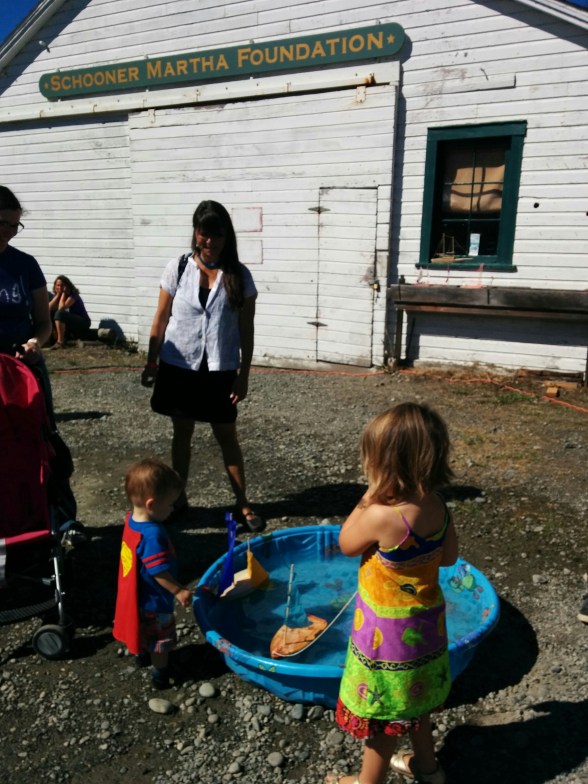
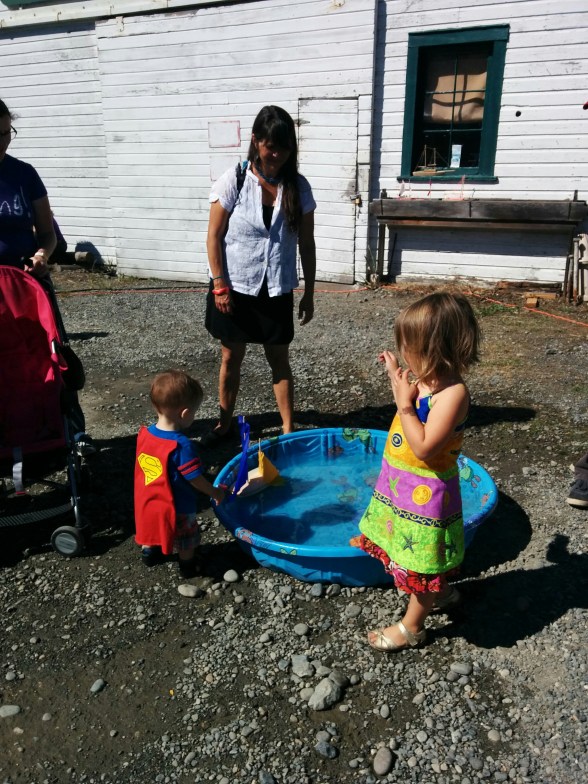
In September at the Wooden Boat Festival I went down to look at the boats. There was a square rigger with a pirate. A 22 foot square rigger with the largest sail about the size of a baby blanket. After we had exchanged introductions, Captain Jack explained that his grandfather had built the square rigger to play with his grandchildren and he has restored it. It has an outboard in the middle, well, an inboard outboard so to speak. I asked how it sailed and he said, “Downwind.” I asked about hull speed and currents and he replied “AAARRRR, don’t talk to me about current.” A small child came by towing parents and he handed a pirate toy over from a big gold chest.
Then another small child came up. Very small with red hair. He gave her a pirate flag, which she waved. But she still looked at the boat. “You can come aboard,” he said. He told dad to bring her. Dad stepped aboard with her and Captain Jack put a black bandanna hat with a skull and crossbones on her. Then she saw the swords. Cutlasses made of foam! She reached for one. “Go ahead, you can have a sword fight with your father!” IMG_20150913_131056
She did, with me and mom laughing. “Would you like to take the wheel, matey?” said Captain Jack. She nodded. She and dad went back in the very small wheelhouse and she practiced steering the squarerigger. “Me boat has been shanghied, I’d better escape!” said Captain Jack, stepping ashore and leaving her and dad in full possession. The small pirate was very serious the whole time. This seemed to be new territory and she was concentrating on all of it.
Captain jack told me that he came to the festival last year and got invited back. He was very pleased and towed his boat from the inland lake. Hooray for Captain Jack and for all of the boat owners and contributors to the Wooden Boat Festival that encourage the children to be involved and Joey Pipia and all of the play pirates….

PTSD and The Singing Tree

The Singing Tree by Kate Seredy, 1939, is a children’s book that illustrated PTSD for me long before I went to medical school. The Singing Tree is the sequel to The Good Master, and describes the survival of a Hungarian family and farm during World War I.

The good master is Marton Nagy, and he is called up as a Corporal, leaving the farm to be cared for by his wife, son, niece and workers. The farm suffers because so many men are called up. They are getting behind on the work and then find a diary from Marton, which gives suggestions and instructions for the year round work on the farm. One of the instructions is “to make out an application for Russian prisoners if necessary.”

They do. They apply and take 6 Russian prisoners, homesick farmers, who don’t speak Hungarian. Jansi and his cousin Kate take the chains off them and the prisoners quickly become part of the family. “Comrade, eh? Friend?” says one of the prisoners. And they are. They are also excellent workers and homesick.

As the prisoners are taken home in the wagon, they also take Peter, a deserter from the Hungarian army. He has panicked about his wife and new baby. He is crazy with worry. He is hidden under the six Russians, who sympathize. After seeing the baby he returns to his regiment. But Peter is angry and expresses his rage at Jews, even though it is Uncle Moses, the Jewish shopkeeper, who has helped hide him.

    Mother took Jancsi’s arm then and they left he room. They didn’t speak; what was there to say? Something, somebody had poisoned Peter’s soul against those who had been good to him all his life. Into Jancsi’s mind flashed the words Father had said: “The stampede… the mad whirlwind that sucks in men…and spits out crippled wrecks.” Crippled in body and soul, Jansci thought then, with an understanding far beyond his years.
    “Poor Peter,” he said aloud. Mother pressed his arm. “I knew you would see it that way, Son. I only hope the war ends before this poison has spread too far.” p 163.

Marton is missing and they have not heard from him. Jansci and Kate make the wagon trek to bring back their grandparents, because the front is now too close for them to be safe. Kate and Lily smuggle the cat along. The cat gets “sick” and the girls insist at stopping at a hospital. The sickness is kittens. The nurses laugh at the girls, but then let them help on the wards. Injured soldiers who are healing.

    “Almost an hour passed before all the patients had been fed. “There was only one asleep,” Lily said, coming back with the empty bowls; “he even had the sheet pulled over his face.” The nurse followed Lily’s pointing finger with her eyes. “Oh, the amnesia case. He sleeps most of the time.”

    “Whats am-amnesia?” Kate wanted to know.

    “Loss of memory. They forget who they are and have to begin life all over again; like babies.” “Does it hurt?”
    “No,” smiled the nurse. “It comes from a shock; like a big scare, you know.” She looked toward the bed again. “He is such a nice man too, poor fellow. He tries so hard to remember. if we could find out who he is, find something to remind of his home, he might remember. You wan tto see him?” she asked as Kate kept staring at the bed. “Come on then, but be quiet.”
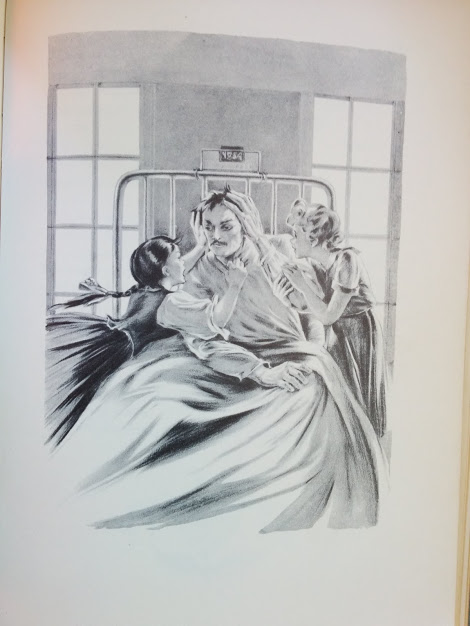
    “No. 54, Amnesia,” was written on the headboard. The nurse gently lifted the sheet. Pandemonium broke loose immediately. Kate, with her famous tin-whistle scream gong at full blast, threw herself on the bed. “UNCLE MARTON! UNCLE MAAARTON! IT’S KATE. Can’t you….? UNCLE MARTO-O-O-ON!”

    Every patient was sitting bolt upright. Doctors and nurses were running in, Lily joined Kate, tugging at Uncle Marton’s hands. “Say something…you know us, don’t you? Say something.”

    “Kate, if you don’t stop that infamous yelling this minute, I’ll take Milky away from…Say! Where am I? Who are these people?” Uncle Marton was looking around dazedly.

    “Never mind them,” sobbed Kate, laughing at the same time. “You know who you are now, don’t you?”

    “Why shouldn’t I? Let me out of this bed!” Uncle Marton cried, trying to peel Kate and Lily off his chest.
    “Take it easy, take it easy,” said a doctor who stepped up. “What is your name?” “Lieutenant Marton Nagy of the Seventh Infantry,” snapped Uncle Marton, glaring at him. “Seventh Infantry… Seventh…oh…”His eyes clouded.
    “Now it all comes back, doesn’t it? You’ll be all right now, Lieutenant Nagy. Don’t think about that now. Tell me who this…this calliope is. That scream was the best I ever heard.” The doctor sat down on the bed, smiling at Kate. “I wish we could produce for each amnesia case we get; we wouldn’t have any.” pp 186-189

He gets to go home.

    “From Corporal to Lieutenant in a year. Pretty good, Lieutenant Nagy,” an officer with a lot of gold braid all over him said to Father. “And a handful of medals to catch up with you, as I heard. What did you do?”
    Father looked him straight in the eye. The muscles in his jaws were working. “I don’t know sir. I would rather not try to remember.”

    The officer sighed. “Go home, Lieutenant. Forget, if you can. I wish I could.”

And will he have to return?

    “Then Father went to report to the hospital and this time Mother and Jansci went with him. The doctors found that in body he was sound, but only time, long months or even years, could make him forget the things he never spoke about.
    “There are none braver than he is,” the doctor told Mother, “but the human mind can stand just so much of horror and no more. We dare not tke the risk of sending him back to war.”
    “Thank God!” Mother had exclaimed, and the doctor smiled very sadly.
    “I hear that every day now. Wives, mothers thanking the Lord for an injury their beloved ones have received. A broken bone, a brave mind darkened with nameless fear, anything that takes a long time to heal, has become a blessing, a gift. They are safe for a little while longer.”

And Jansci talks to one of the Russian prisoners.

    “Big boss come home…maybe war over?” Grigori wanted to know when they had come with Father. Jansci tried to explain and he thought that Grigori didn’t understand because for a long while he didn’t say anything. Then he sighed: “Grigori know. Hear, Jansci. Bad man, stupid man, he go kill and laugh. Good man, man with good heart, good head, no can kill and laugh. He cry inside. Baby cry with big noise. Man cry–no noise, but it hurt very bad. Me know….me know.” p. 203

Death affects the village.

    “More white envelopes were coming to the village now than ever since the war started. The hands of Uncle Moses began to tremble and he seemed to grow smaller, more bent. Aunt Sarah was like a silent little wraith, going from house to house to comfort, to help, or just sit, holding the hand of a woman who would never wait for the mail again because there was no one left to writ to her. Often she and priest met in one of the houses and the priest would bow deeply to her Once he told Father: “She seems to give more comfort, more strength to these poor women than I can.” pp 203-204

I wish that we had the sense expressed in this book about PTSD and the effects of war. When I worked at Madigan Army Hospital, some soldiers were getting ready for their fourth or fifth tour of duty. If we as a country are going to continue these wars, we must take more responsibility and have more care for the damage done. When people talk about “curing” PTSD or keeping it from happening: if we didn’t respond with PTSD as a species with horror for the evils of war, we don’t deserve to survive. We will be the Bad People, the Stupid People, who Kill and Laugh. We need to stop. This book was written in 1939 and clearly they knew the effects of PTSD. It’s been almost 80 years since Kate Seredy’s book was published: and still we question PTSD?

http://www.pdhealth.mil/clinicians/assessment_tools.asp
Civilians too: http://www.mirecc.va.gov/docs/visn6/3_PTSD_CheckList_and_Scoring.pdf

illustration from p. 187

Magical childhood

Let’s keep the children
safe and warm
cuddled close
and free from harm

No, but what monster
hides underneath the bed
let’s find and name
the monsters all instead

we are wired not for safety
but for truth
don’t hide grief and fear
from the youth

a child survives by attunement to
your heart
they listen deeply from
their start

long before they understand
your words
they sense the world’s
monsters as a herd

a disney childhood is
a lie
the heartfelt child
wonders why

name your sorrows and
your pain
then your child will know
they have a name

no monsters hide beneath
my childrens’ bed
they know I hold them
close and dear instead

also published on everything2.com

Nuf canoe

Platosgroove asks for a picture of the Nuf canoe I am repainting. Here it is sanded. It is a flat bottom plywood canoe that was designed by Carl Chamberlin of Basic Boats originally for a child to paddle around it. My two kids and I built it over ten years ago at the Wooden Boat Festival in Port Townsend, Washington. The family boatbuilding allowed us to pay for materials, plans, space and volunteer help. My father came and provided tools. My daughter was four or five, I think, and son around ten. At one point my daughter said, “Mom, let go of the drill.” I did and she drilled the holes herself.

I have two coats of paint on the inside and one on the outside. I am painting it red to match “Sun Tui”, the 23 foot sailboat. One more coat on the outside and it can go back in the water.

This canoe weighs only 30 pounds, so I can move it from car to water easily. However, if we use it in the sound, we stay very close to shore: too tippy in the cold sound water.

Veracity

V for veracity in the Blogging from A to Z challenge.

I am thinking about veracity and my father. Veracity is truth, faithfulness, accuracy, correctness.

I was frustrated about how someone was reacting to something and asked my father about it.

My father said, “Most people don’t want reality.”

“What do you mean?” I said.

“Most people work hard to avoid reality. They have a set of ideas and a world view and they get upset if something does not fit in it or if it is questioned.”

I have been thinking about a song that I learned as a kid. It falls into one of the “Dead Girl” songs, as my sister called them. I think of them as teaching songs. I am taking guitar lessons and my teacher says that he won’t sing those songs.

I will. I like the dark songs. And I am very ambivalent about this song:

There was a wee cooper wha lived in Fife,
Nickety, nackety, noo, noo, noo;
And he had married a gentle wife,
Hey, willy, wallacky, ho John Dougle
Alane, quo rushity roo, roo, roo.

She would na bake nor would she brew,
For spilin’ o’ her comely hue.

she would na caird nor would she spin,
For shamin’ o’ her gentle kin.

The cooper has gone to his wool pack,
And he’s laid a sheep’s skin on his wife’s back.

“I’ll no be shamin’ your gentle kin,
But I will skelp my ain sheepskin.”

“O I will bake and I will brew,
And think nae mair o’ my comely hue.”

“O I will wash and I will spin,
And think nae mair o’ my gentle kin.”

A’ ye what hae gotten a gentle wife,
Send ye for the wee cooper o’ Fife.

This is Child Ballad number 277 and has been recorded by Burl Ives and others.

Ambivalence. It’s a song about wife beating, I don’t approve. But it’s also a song about surviving. A cooper builds barrels. The job division was that the wife would bake and brew, card wool and spin. However, this wife is “gentle” as in gentleman, of “good birth” and rejects the work as beneath her. Does she expect to be served? In the stories of happily ever after, we are happy when the poor underdog poor person wins the love and admiration of the other person, but we don’t see what happens when they go home. In Disney movies, the girls are poor and win a prince. Or Aladdin becomes a prince.

Skelp is defined as “hit, beat, slap”. The song doesn’t say whether the cooper does beat the sheepskin tied to his wife’s back or only threatens to do so.

I love word play so I like the “alane, quo rushity roo, roo, roo.” Nonsense words delight me aside from the topic of the song and I like the tune.

I think that our culture has years of men dominating women and expecting women to obey. I dislike that intensely. At the same time, I don’t like it when people won’t contribute and when they avoid work, so I also have some sympathy for the wee cooper. And our culture spends too much time thinking “happily ever after”, trying to find just the right person. We do not enough time actually asking each other what “happily ever after” would look like. And anyhow, it doesn’t exist. For richer, for poorer, in sickness and health: that is the veracity. We all will have challenges and everyone will have illness and hopefully good times too.

I am thinking of the many people lost in the recent earthquake. Lost: killed suddenly. Enjoy each day and be kind to yourself and others. We never know when grief will strike.

Want some taters

T for taters in the Blogging from A to Z challenge and for Ronovan writes weekly Haiku challenge: this week’s words are want and tatters. I suppose I have cheated by changing the tense. Tatters brought up taters and I am hungry and a bit insomniac. I am back at work, have less time to write, but apparently writing eventually trumps sleep…. want to write, too.

want some taters not
too tattered on a platter
save me gravy do

I made the most delicious potato salad the other day. Potatoes from a local farm: they have a 24 hour walk in buy vegetables, on the honor system. They have the best potatoes ever: Colinwood Farm.

Cut potatoes into 1 cm approximate chunks
Steam the potatoes until just tender
Sprinkle with the vinegar of your choice while hot
and a little hot chili oil.
Wait 10 minutes. (I failed on that.)
Add mayonnaise, not sweet.
A chopped dill pickle.
Salt and pepper.
Whatever else you want, but that is all I added.
Eat while warm…. I couldn’t wait for my daughter to get home….

The photo is from Thanksgiving at my cousins’ in 2013.

Fly dream

F in the A to Z Challenge: Fly.

I returned to work yesterday after ten months off very sick and then convalescing. In the afternoon I came home. I ate a late lunch and fell into a deep sleep. Relief that I am back at work.

I dream: I am in a metallic boxy house. It is very modern, glass and metal. It is very spare, elegant and uncluttered. My daughter and cat are there but are one being. She keeps shape shifting from cat to daughter and back. There is a man and a teen, his son. He owns the house and built it. It is up high perched on a tower. It feels very precarious and the tower moves with the wind. The views are stunning, wilderness and mountains. The house falls and the man shows me that it is a spaceship. It hovers over the earth. He and his son are aliens. I am a bit annoyed that he deliberately scared me, but I also know that he is showing off. He is showing me his strength and power and maleness. I do find it very sexy. I want him.

I tell him that he can set the ship down in a safe place. I am suitably impressed and admiring. He does not need a spaceship or to scare me or to fly to be loved. He intimates that we can fly to explore other planets. I say “I am happy to explore this one for a while. It is ok to be grounded.” He sets the house spaceship down in the mountains.

I wake up.