Soldier on

Older
bolder
golder
told yer
moulder
soldier on

What is older? Anything and anyone older than me? At one point I have 5 women who are over 100 years old as patients. Two are 104. One is local indigenous tribe and tells me about white women moving to another pew if she sat down near them in church, back when she is in her twenties. I am apologetic at that visit because it is hospital week. Our pacific northwest hospital has chosen cowboys as the theme so being a bit oppositional defiant, I have braids with one feather hanging down. I swear that EVERY ONE of my indigenous patients comes in, including the 104 year old. I apologize, but they mostly seem amused by my rebellion.

They also influence me. Now when a 72 year old complains about being OLD, I say, “You are not old in my practice.” They look confused. I say, “I’ve had five people over 100 all at once, so you don’t get to complain about being old until you are 90.” People laugh, but they also usually look pleased. Over 100 is a LOT older than 72. When someone is over 100, I don’t really doctor them much. I might say, “This is what the book says we should do.” “I’m not doing that,” says my 101 year old. “Ok, cool.” I say. It’s hard to argue with.

And the joke about the centurian? What do you like best about turning 100? “No peer pressure.” Um, yes. I want them to tell ME what they’ve done to reach 100. The one thing that they all have in common is that they are all stubborn. I don’t know if stubbornness is what gets them there or if we just get more stubborn as we get older. Both, perhaps.

By stubborn, I don’t mean that they don’t learn and do new things. I had a woman in her upper 70s who I diagnosed with diabetes. At the next visit she said cheerfully, “I found these five apps for my phone. This one tells me the carbohydrates, this keeps track of the distance I walk, this one tracks my blood sugar.” I don’t remember what the other two did. This was a decade ago. She was retired from Microsoft. I wanted her to teach a class for me and all of my other diabetic patients.

My grandmother took classes in her 80s in lip-reading. She was going quite deaf and her hearing aides were not terribly helpful. She had videotapes and a rather shy teacher who would come to the house. She would glare at him and the videotapes. She attacked learning it like a piranha and was furious that she couldn’t learn it faster. I am like that too and my son learned some patience from the violin. He couldn’t play well immediately and found that practice works.

At what age is someone old? I think that’s moving target and the older we get, the older we think it is. I do think 104 is a lot older than 72. When does your culture think that people are old? My fierce grandmother said that she would look out her window. “I see little old ladies across the street and think, oh, poor things, they are so old. But then I think, OH, I am older then they are!” She died at age 93, fierce until the end and curious about death too. Her last words to my father were, “Look, Mac, I’m dying.” He said, “I’m looking,” and she stopped breathing. She was always curious and funny and could tease quite terribly and she and my mother butted heads and loved each other. She loved my father too, and me.

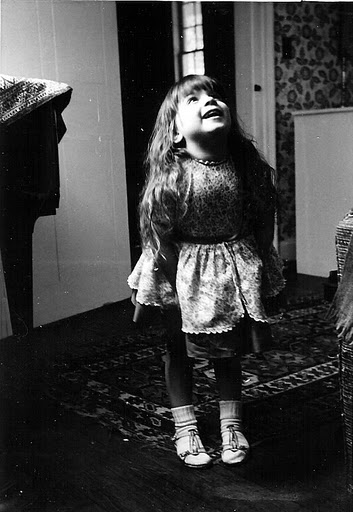
The photograph is my maternal grandmother, Katherine White Burling and it’s one I took.

For the Ragtag Daily Prompt: older.
Ages

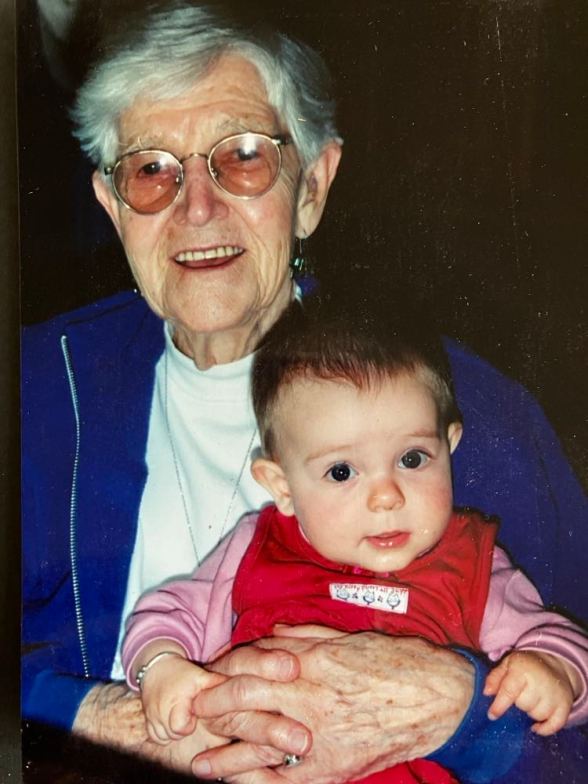
Here is my daughter on the lap of her great grandmother Evelyn Ottaway. I think my daughter was a little over one and my grandmother was 90 or very close. We flew from Colorado and visited friends and family. My grandmother was living with my aunt Pat right then. My daughter was very relieved when we got home, but she let many people that she didn’t know hold her. This was the only time she saw her great grandmother.

For the Ragtag Daily Prompt: age.

split

The pandemic splits the thin veneer of civilized behavior
like a heavy maul falling on delicate antique wood
and wild fear emerges and riots through the streets
while some hide, some stay calm
and try to sooth the selfish unleashed beast

For the Ragtag Daily Prompt: veneer.

Taken in 2015.

sweep

sweep through the woods
sweep past the forest
the car winds along the road
we are warm inside

new broom sweep clean
new years starts again
old broom used and worn
old year illness torn

new broom brought to floor
new year contemplated
old broom set aside
old year must abide

new broom awkward feel
new year challenge real
old broom may have use
old year research truth

__________________________

For the Ragtag Daily Prompt.

Admitting diagnosis: old guy, don’t know

I wrote this in 2010, after I worked for three months at Madigan Army Hospital. I really enjoyed working there. It was the first time since residency that I had worked in a big hospital — 450 beds — and in a not rural setting. I kept asking to work with residents and eventually the Captain and I worked it out to both our satisfactions.

______________________________________

During my three months temp job at a nearby Army Hospital, I am asked to help the Family Medicine Inpatient Team (FMIT) whenever a faculty member is sick or out or deployed, which turns out to be fairly often. I enjoy this because I want to work with residents, Family Practice doctors in training. It is very interesting to be at a training program, watch the other faculty and work at a 400 bed hospital instead of my usual 25 bed one.

Two patients need to be admitted at the same time on our call day, so the second year resident takes one and I take the other. The report on mine is an 82 year old male veteran, coughing for three weeks, emergency room diagnosis is pneumonia.

The resident soon catches up with me because her person is too sick and gets diverted to the ICU. Mr. T, our gentleman, is a vague historian. He says that he has always coughed since he quit smoking 15 years ago and he can’t really describe his problem. He’d gotten up at 4:30 to walk around the assisted living; that is normal for him because he still does some o the maintenance. He had either felt bad then or after going back to sleep in a chair and waking at 10. “I didn’t feel good. I knew I shouldn’t drive.”

He’s had a heart attack in the past and heart bypass surgery. Records are vague. The radiologist reads the chest xrays essentially as, “Looks just like the one 3 months ago but we can’t guarantee that there isn’t a pneumonia or something in there.” He has a slightly elevated white blood cell count, no fever, and by then I do a Mini-mental status exam. He scores 22 out of 30. That could mean right on the edge of moderate dementia, or it could be delirium. I get his permission to call his wife.

“Oh, his memory has been bad since he spent a year in a chair telling them not to amputate his toes. And he was on antibiotics the whole time. He wasn’t the same after that. This morning he just said he didn’t feel right and that he shouldn’t drive.” So his wife called an ambulance.

The third year chief resident comes by and wants to know the admitting diagnosis. “Old guy, don’t know.” is my reply. “Either pneumonia or a urinary tract infection or a heart attack maybe with delirium or dementia or both.

The second year is helping me put in the computer orders, because I am terrible at it still. She could put them in upside down and asleep. “Why are we admitting him, anyhow? We can’t really find anything wrong, why not just send him home?”

“We can’t send him home because he can’t tell us what’s wrong. He might have an infection but he might not, and he has a really bad heart. If we send him home and he has a heart attack tonight, we would feel really bad. And he might die.”

I was getting a cold. I had planned to ask to work a half day but half the team was out sick so I just worked. But by morning I had no voice and felt awful. I call in sick.

At noon the phone rings. It is the second year. “You know Mr. T, who we admitted last night?”

“Yes,” I say.

“He had that heart attack during the night. Got taken to the cath lab. You made me look really good.” We had worked on the assumption that it could be early in a heart attack though the first labs and the ECG were negative. I had insisted on cardiac monitoring and repeating the enzymes. The resident had finished the note after I left and the night team had gotten the second and abnormal set of enzymes.

82 year olds are tricky. With some memory loss he couldn’t tell us much except that “I don’t feel right.” He was right not to drive and we were right to keep him in the hospital. And if it had all been normal in the morning, I still would not have felt bad about it. The residents are looking for a definitive diagnosis, but sometimes it’s “Old guy, don’t know,” until you do know.