first impressions

I am taking a writing class and our next book is on cultural appropriation.

This interests me. I tend to be a little gender blind and race blind when I meet people. I am using my super skill instead. My skill is developed from a really scary childhood: I read the stuffed emotions. The stuff people are hiding.

No way, you say. Oh, yes, I say.

My sister described coming home from high school and stopping when she walked into the house. She was trying to sense what was going on. Were our parents fighting? Was our father drunk? Yes, he was drunk, but which stage?

We talked about the stages and which we hated most.

Stage goofy/silly was annoying but not toxic. We said we had homework.

Stage asleep in a fetal ball in the upstairs hallway. My sister said she would step over him to get to her room.

Stage maudlin. We both agreed this was the worst. He would cry and say, “You can tell me anything.” Once he caught me in that stage and I was in tears by the time my mother got home. I left the room. The next morning mother said, “He said you two were discussing the cat’s disappearance.” I didn’t answer. We never said a word about the cat. I didn’t know if he was lying or was too drunk to remember it the next day, so made it up. Don’t care. Avoid.

He was never physically abusive. He and my mother would scream at each other at 1 or 2 am through most of high school. Reading her diaries, she writes that she drinks too much. I think they were both alcoholics, thought the family story is that he was the bad one. But I can’t imagine yelling with a drunk at 1 or 2 am for an hour. What is the point? They are drunk. So either she was drunk too or needed to fight.

Emotionally abusive, yes, both parents. My mother would take any show of fear or grief and tell it as a very very funny story to every person she ran into. Is it any surprise that I had to go into therapy after she died to learn to feel fear or grief? My sister would say, “She’s got her stone face on,” about me. Um, yeah, I am NOT going to let my family see my emotions…

Anyhow, that is what I read in people when I first meet them. It’s not the suit, the clothes, the make up, the race, the gender. I pretty much ignore those. I was fashion blind in junior high, a girl geek, could not read the code and did not care. I had given up on socializing with my fellow students. I was hopelessly bad at it. I did a lot better with the adults around my parents. I could have actual conversations with them.

I had one patient who was transgender where I couldn’t remember which direction. I didn’t care, either. That was a really angry person. Anger is always covering other emotions, so I avoided pronouns and tried to be as gentle as possible.

I complained to a counselor once that I can’t turn this “off”. And that it’s fine in clinic with patients, but it screws with my relationships with my peer doctors. They do not like it if I “read” them.

It took me years, but I finally realized that I have to use my clinic skills with everyone. I can’t turn off “reading” any more than you turn off your eyes when you meet a new person. But I can be as gentle with everyone as I am in clinic. I realized that as I started on a trip and the trip was amazing, everyone was so nice.

This reading is a product of a high ACE Score: Adverse Childhood Experiences. I score about a 5. One of my patients set off my ACE alarms on the first visit. I asked if he had had a rough childhood and gave a very short explanation of ACE scores. “Oh, I am a ten out of ten,” he said. He was, too. Ran away from home at age 6 or 8.

The ACE scores of all the children are rising from the last two years. The war will raise them even more, worse for the children there and the kids trying not to starve in Afganistan and Syria and world wide.

It will be interesting to read about cultural appropriation. But I don’t care much: I don’t “see” those things when I meet someone.

Hugs and blessings.

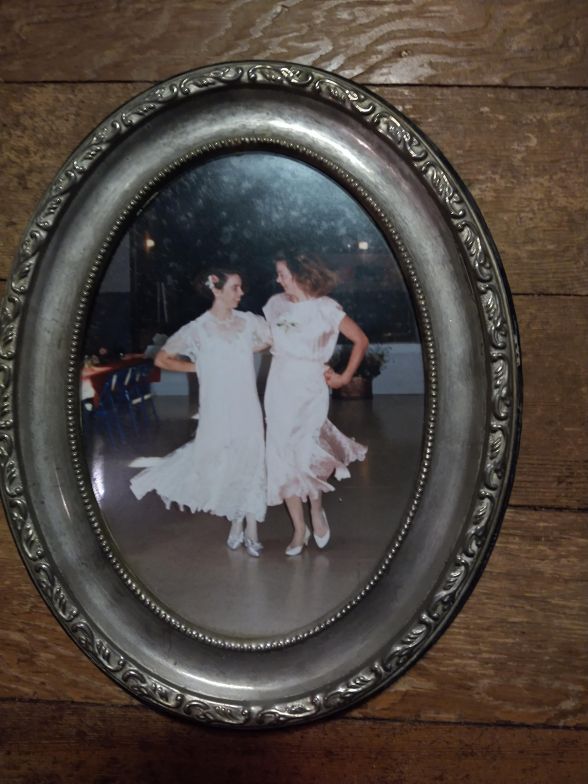
The photograph is me and my sister Chris in 1987, before my wedding. We were dancing before the wedding. She died in 2012 after 7 years of breast cancer.

Doctors and nurses and hospital staff are the last caregivers for the elderly alcoholics and addicts who are alone, whose families have finally cut them off. I think this song illustrates their pain. We try to take care of them.

Songs to raise girls: Bessie the Drunkard’s own child

I am posting this from another site, originally posted November 2016. I am posting it because of a comment on a paper in my town about “homeless drug dealers”. It’s not the drug dealers that are homeless, it’s the addict. Ok, you can definitely have an addict dealer… But I worked hard to treat any kind of addiction, not only because of the patient, but also the family and especially the children. And every patient was a child once….

This is another temperance song that my mother taught me, learned from her father. Both of my mother’s grandfathers were Congregationalist Ministers in Iowa.

Out on the stormy night sadly I roam.
No one to love me, no dear pleasant home.
Dark is the night and the storm rages wild.
God pity Bessie, the drunkard’s own child.

Chorus:
Mother, O why did you leave me alone,
No one to love me, no dear pleasant home.
Dark is the night and the storm rages wild
God pity Bessie, the drunkard’s own child

We was so happy til father drinked rum.
Then all our trials and troubles begun.
Mother grew weary and wept every day.
Brother and I were too hungry to play.

Barefoot and hungry we wander all day
Looking for work, but “too small” they all say
On the damp ground to lay my head
Father’s a drunkard and Mother is dead.

Thus the two wandered, ’til one stormy night
Brother and sister both faded from sight
Then gazing at them, sadly I said
“Father’s a drunkard and Mother is dead.”

Cheerful, right? Again, I know the tune and only have the chorus memorized. My parents quit singing it in front of me so that I wouldn’t sing it at Show and Tell.

And small children shouldn’t hear this sort of thing, right? I don’t know. I learned an awful lot about the dark side of the world and danger from these songs. I found them helpful. I think they influenced me to be careful….

And think of the refugee children and children everywhere. This is still happening.

here: http://www.pdmusic.org/1800s/66fadamid.txt
and here: http://mudcat.org/thread.cfm?threadid=57166
The tune I learned is slightly different and darker than this: http://mudcat.org/@displaysong.cfm?SongID=6196
And some overlapping words with a different tune: https://www.youtube.com/watch?v=7ooDfYaH08E and https://www.youtube.com/watch?v=9KGiFkcxOus

The photograph is my maternal grandfather, F. Temple Burling, sitting on his grandfather’s lap. His grandfather was Morris Temple. My grandfather taught my mother this song and she taught me.

At what age should we talk to our kids about drugs?

I am a rural family physician and my recommendation: before age 9. Before third grade.

WHY? Your eyes are popping out of your head in horror, but my recommendation comes from surveying my patients. For years.

The biggest drug killer is tobacco. However, it takes 30 years to kill people. It is very effective at taking twenty years off someone’s life, destroying their lungs, causing lung cancer, heart disease, mouth cancer, breast cancer, uterine cancer, stomach cancer, emphysema, heart disease….

I ask older smokers what age they started smoking. This is informal. This is not scientific. But most of my male older smokers say that they first tried cigarettes at age 9. I think parents need to be talking to their children about cigarettes by age 9.

And then start talking about alcohol and illegal drugs and the terrible dangers of pills.

“My innocent child would never….” Unfortunately my daughter said that as a senior in high school in our small town, there were 4-5 kids out of the 120+ that were not trying alcohol and marijuana. But there are kids trying far worse substances. We have methamphetamines here, and heroin, and pain pills sold on the street.

The perception that pills are safe is wrong too. Heroin is made from the opium poppy and it’s rather an expensive process, not to mention illegal and has to be imported from dangerous places. But teens take oxycodone and hydrocodone, bought on the street, to get high. And now drug sellers are making FAKE oxycodone and hydrocodone and selling that on the street. It contains fentanyl, which is much much stronger. If the dealer gets the mix wrong, the buyer can overdose and die.

Talk to your children young! NEVER take a pill from a friend, never take someone else’s medicine, never take a pill to party! YOU COULD DIE! And if you have a friend that is not making sense, that you can’t wake up, DON’T LEAVE THEM! Call an ambulance. Your friend may have used something illegal, and may not want you to call an ambulance. But if you think they are too sleepy….. don’t take a chance. People can get so sleepy, so sedated, that they stop breathing.

And parents, you are the ones that have to set a good example. Don’t drink alcohol every night. Don’t use pot every night. Take as few pills as possible. Pills aren’t necessarily safe because they are “supplements” or “natural” — hey, opium and heroin are plant based! Stop using tobacco and if you have a hard time doing it, tell your children you are struggling. It takes an average of eight tries to quit smoking. Get help.

Lastly, we talk about childhood innocence, but we let kids babysit at age 11. That is the Red Cross youngest age. My daughter took a babysitting course at age 11 and babysat. If we think they are responsible enough to do CPR, call 911 and do the heimlich maneuver, shouldn’t we also be talking to them about addictive substances by that age?

Talk to your children about addiction young… so that they can avoid it.

I am submitting this to the Daily Post Prompt: calm. I am not calm about this topic, but the photograph is calm…. and if we can help more children and families…..

Why care for addicts?

Why care for addicts?

Children. If we do addiction medicine and help and treat addicts, we are helping children and their parents and our elderly patients’ children. We are helping families, and that is why I chose Family Practice as my specialty.

Stop thinking of addiction as the evil person who chooses to buy drugs instead of paying their bills. Instead, think of it as a disease where the drug takes over. Essentially, we have trouble with addicts because they lie about using drugs. But I think of it as the drug takes over: when the addict is out of control, the drug has control. The drug is not just lying to the doctor, the spouse, the parents, the family, the police: the drug is lying to the patient too.

The drug says: just a little. You feel so sick. You will feel so much better. Just a tiny bit and you can stop then. No one will know. You are smart. You can do it. You have control. You can just use a tiny bit, just today and then you can stop. They say they are helping you, but they aren’t. Look how horrible you feel! And you need to get the shopping done and you can’t because you are so sick…. just a little. I won’t hurt you. I am your best friend.

I think of drug and alcohol addiction as a loss of boundaries and a loss of control. I treat opiate overuse patients and I explain: you are here to be treated because you have lost your boundaries with this drug. Therefore it is my job to help you rebuild those boundaries. We both know that if the drug takes control, it will lie. So I have to do urine drug tests and hold you to your appointments and refuse to alter MY boundaries to help keep you safe. If the drug is taking over, I will have you come for more frequent visits. You have to keep your part of the contract: going to AA, to NA, to your treatment group, giving urine specimens. These things rebuild your internal boundaries. Meanwhile you and I and drug treatment are the external boundaries. If that fails, I will offer to help you go to inpatient treatment. Some people refuse and go back to the drug. I feel sad but I hope that they will have another chance. Some people die from the drug and are lost.

Addiction is a family illness. The loved one is controlled by the drug and lies. The family WANTS to believe their loved one and often the family “enables” by helping the loved one cover up the illness. Telling the boss that the loved one is sick, procuring them alcohol or giving them their pills, telling the children and the grandparents that everything is ok. Everything is NOT ok and the children are frightened. One parent behaves horribly when they are high or drunk and the other parent is anxious, distracted, stressed and denies the problem. Or BOTH are using and imagine if you are a child in that. Terror and confusion.

Children from addiction homes are more likely to be addicts themselves or marry addicts. They have grown up in confusing lonely dysfunction and exactly how are they supposed to learn to act “normally” or to heal themselves? The parents may have covered well enough that the community tells them how wonderful their father was or how charming their mother was at the funeral. What does the adult child say to that, if they have memories of terror and horror? The children learn to numb the feelings in order to survive the household and they learn to keep their mouths shut: it’s safer. It is very hard to unlearn as an adult.

I have people with opiate overuse syndrome who come to see me with their children. I have drawings by children that have a doctor and a nurse and the words “heroes” underneath and “thank you”. I  have had a young pregnant patient thank me for doing a urine drug screen as routine early in pregnancy. “My friend used meth the whole pregnancy and they never checked,” she said, “Now her baby is messed up.”

Addiction medicine is complicated because we think people should tell the truth. But it is a disease precisely because it’s the loss of control and loss of boundaries that cause the lying. We should be angry at the drug, not the person: love the person and help them change their behavior. We need to stop stigmatizing and demeaning addiction and help people. For them, for their families, for their children and for ourselves.

I took the photo of my daughter on Easter years ago.