Diabetes update

Friday I attended a Zoom diabetes update all day. Sigh. We are really doing diabetes wrong.

Diabetes affected every system in the body and so the guidelines want us to check everything. They made the point that controlled diabetes does NOT lead to blindness, kidney failure, and amputations. Only uncontrolled diabetes. There, do we feel better now?

There are three NEW things to check for. One is CHF, aka Congestive Heart Failure. Heart Failure is pump failure. It makes a lot more sense if you think of the heart as a pump. Diabetes doubles the risk of heart failure in men and increases it by five times in women. We are now to do a yearly BNP (Brain Natriuretic Peptide, got that?) except that it is useless if the person is in renal failure, because that raises it artificially.

The second NEW thing is liver problems. Liver failure is back in the top ten causes of death, having fallen off that list for a while. People drank more alcohol during COVID, there was more drug abuse adding to hepatitis B and C, but the biggest cause is NASH and NAFLD. More acronyms: NASH is Nonalchoholic Steatohepatitis and NAFLD is Nonalcoholic Fatty Liver Disease. This is related to overweight and obesity. Being overweight or obese messes up fat storage and over time this inflames the liver and then cells die, leading to cirrhosis. We are to watch liver tests, think about an ultrasound, and then there are two specific tests for cirrhosis.

Third NEW thing is Diabetes Distress. This is not depression. People score “depressed” on the PHQ-9 test, but don’t respond to anti-depressants. The lecturer said that we have to talk to the patient and find out why they are distressed, or what part of diabetes is getting them down. I thought that we should have been talking to the patient all along. There is a convenient 30 question tool we can use for this, if we have time. Will we?

Now, the old guidelines said that we are to check these things:

HgbA1C every 6 months if not on insulin, every 3 months on insulin and even more in pregnant patients.

Microalbumin/creatinine ratio: a urine test that tells us if the kidneys are starting to leak albumin. They shouldn’t.

Yearly eye test to check for diabetes damage.

Specific blood pressure ranges.

Keep everyone’s LDL cholesterol under 70. So nearly every person with diabetes gets a statin drug.

Do a foot check yearly for neuropathy.

So six things plus the new three. Can’t explain that in one visit and can’t do it in one visit either. I think we should revamp the Diabetes Distress tool and check if physicians and nurses have Guideline Distress. Diabetes is the most complicated set of guidelines other than pregnancy.

Diabetes also takes a lot of time for the person who has it. To check things “correctly”, it takes a minimum of two hours a day for Type II not on insulin and more like three or more for Type I and II on insulin. Think if you have to take two or three or more hours away from your current daily activities and devote it to diabetes. No wonder people are distressed.

The medicines are also confusing. Wegovy is in the same class as Ozempic, but is FDA approved only for weight loss in people who are overweight and have a complication, or people who are obese. Ozempic is for diabetes but people often lose weight so think about it if the person is overweight. Some of the medicines in that class also are approved to reduce the risk of heart disease, which goes up with diabetes. Another class has medicines some of which have approval for diabetes and others for diabetes and renal problems, BUT don’t use it if the eGFR is under 20, got that? The lecturer on medicines said that we’ll see less in each of those classes after they fight it out for dominance of the market. He’s been an endocrinologist for 30 years and remembers when the very first non-insulin medicine was approved. Cool! He is not discouraged, but another lecturer said that we have one endocrinologist for 5000 people with diabetes, which is not enough. We were encouraged to do more continuing medical education.

There is one guideline that I disagree with and would like to see changed. I will write about that next. After I memorize all of the different things the new medicines do, which is changing every month as new research comes out! Stay tuned!

I think I will put the clutch in and coast a bit. Or perhaps clutch handfuls of hair and pull at them, I don’t know.

For the Ragtag Daily Prompt: clutch.

I hiked again yesterday and had a very cooperative bunny stop for a snack in camera range.

Spirit take flight

Death from memory loss is a mixed bag for families.

In the past, the average time to death from Alzheimer’s was 8 years. I don’t find a number on the CDC website, CDC Alzheimer’s. I find these statistics:

  • Alzheimer’s disease is one of the top 10 leading causes of death in the United States.2
  • The 6th leading cause of death among US adults.
  • The 5th leading cause of death among adults aged 65 years or older.3

The site also says that the number of people with Alzheimer’s doubles every five years after age 65. Sigh. Those numbers are the same ones that they taught me years ago, in a different format. 6% at age 60, then 2% more every year. By 70, 26%, by 80, 46%, by 90 66%. Like hypertension, if you live long enough, you may well get it. And yet, I have had patients over 100 years old with intact memories.

The death of a family member with memory loss can have complicated grief. On the one hand, loss and grief. On the other, a burden is lifted. If the person is in memory care, the cost may be very heavy. In our town, the memory care facility costs $7000 per month. That is a heavy burden to carry when the person no longer recognizes the family or speaks. The family may feel hugely relieved when their person passes and at the same time, feel guilty. This is someone that they love and loved. And yet, they are relieved by death. I think of it as a patient of mine described it: “The grief group at the hospital said that my husband isn’t gone. I said, yes he is, he just left his body.” It is very very hard for a family to watch their loved one deteriorate, lose skills, become confused and/or frightened and/or paranoid and the process can happen for years. With an average death at 8 years, some people live beyond 8. Maybe 12 years. It is very hard.

Blessings on those who care for the memory loss people and the families who do their best for them. Alzheimer’s is one sort of dementia, but we now have many. Pick’s disease, frontotemporal dementia, Parkinson’s dementia, multi stroke dementia, alcohol induced dementia, illegal drug dementia, primary progressive supranuclear palsy, and others.

The spirit has already taken wing and let the body follow.

For the Ragtag Daily Prompt: wing.

My son took the photograph while he was visiting.

Here is the top ten causes of death in 2022: https://www.cdc.gov/nchs/data/databriefs/db492.pdf.

Rumor

Oh, kindness. I think one huge kindness is not to listen to rumors and not to assume that they are correct. Whew. Though if you are ever the victim of a rumor, it will tell you who your real friends are. They will stay present, stay in touch, stay with you. Some will ask about it, others won’t, but they will stay. And you may be amazed by how many people disappear into the woodwork. They are staying “neutral”, they’ll say, but they don’t call, answer calls, or include you any more. Then they may show back up in the future. You will not trust them again. Ok, if they were going through some trauma of their own, but otherwise, no.

Sol Duc is keeping an eye on the neighborhood. She never tells me rumors, ever.

Here are three versions of Nobody Knows You When You’re Down and Out. I like the Bessie Smith one best. The John Lennon tune is different.

For the Ragtag Daily Prompt: kindness.

And another:

Lily wins

I have been cat sitting Lily, for my friend who is in a nursing home.

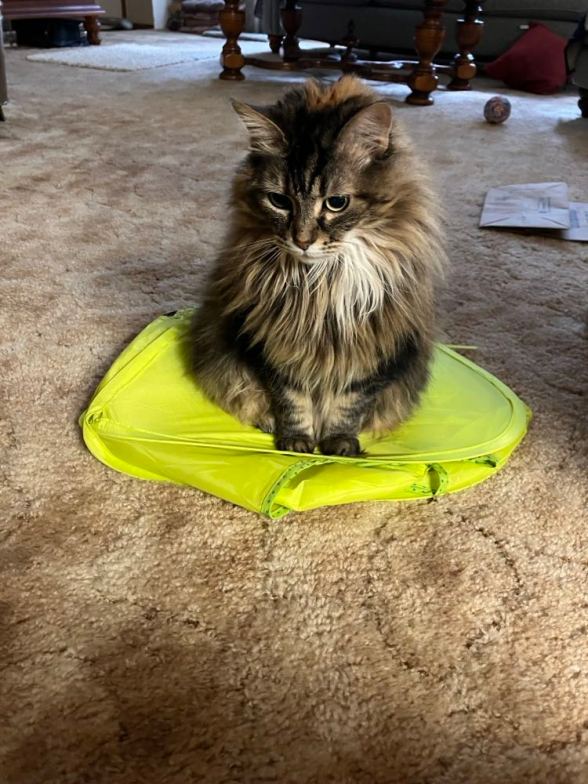
Lily is worried about her human and I am only in for about an hour and I don’t know her habits. And I am not her person. However, we have finally figured out how to play. Lily has a tent, a small one. I started scritching it one day and Lily reveals her tendencies: she is a bag stomper. She played with the tent until I get the picture above, with her sitting on it.

Next I bring a stick with line and various things tied on, including a toy mouse. Lily and I play and I don’t leave with large hand scratches. I could grit my teeth, but it was not that fun. Lily wants me to pet her now too.

Lily wins and I do too.

We hope her person will be home soon.

For the Ragtag Daily Prompt: grit.

Double standard: AI technology can take jobs but improving healthcare can’t

The United States could go to single payer healthcare, but one objection has been “People will lose their jobs with health insurance companies.” Yet no one seems to object to AI, Artificial Intelligence taking jobs. It’s technology so it’s fine! The wave of the future! Coming whether we like it or not!

One form of single payer healthcare is medicare for all. Expand medicare so that it covers everyone. At first, it only covered retired female teachers. Women were only considered for teaching jobs if they were single. A married woman was expected to work in the home. The teaching pay was low. Men were expected to be supporting a family, so they got more. Women were often supporting parents or children if spouses died or divorced or abandoned a family or were disabled. Early census information was a finagle: any male in the household was listed as “head” even if it was an elderly disabled father or a boarder or a teen. So the true numbers of women as head of households were obscured.

Single payer would improve healthcare. There would be ONE set of rules. Physicians would know if something was covered. Right now there are over 500 health insurance companies and they each have multiple different policies. Not only that, but the policies can change monthly in what they cover. Did you know that? I would get monthly postcards from multiple companies saying that I could go on line to one of the 500 different websites and see what they had changed and were no longer covering. I found little time to learn 500 websites. We spend enormous amounts of healthcare money on communication back and forth from insurance companies to hospitals and clinics. Trying to prior authorize CT scans, MRIs, surgeries, referrals, medications (even old cheap ones!) and then attempting to get the health insurance companies to pay for the care. Remember that the insurance companies are allowed a 20% profit: so for 1 million dollars of healthcare money, $200,000 can go to profit. The people and computer work is not in that profit, so what percentage of your healthcare dollar goes to attempting to prior authorize and get paid? How much of your healthcare dollar would you like to go to healthcare?

Medicare’s overhead is either 1.4% or 6%, instead of that 20% profit and the prior auth/collection effort. There are two different estimates (from here):

1. There are two different measures of Medicare’s administrative costs. One figure comes from the Medicare Board of Trustees’ annual report, while the other comes from CMS’ National Health Expenditure Accounts. According to the latest trustees’ report, Medicare’s overhead represented 1.4 percent of its total expenditures. According to the latest NHEA, Medicare’s overheard was 6 percent of expenditures.

2. The discrepancy between the two figures is due to Medicare Parts C and D. Mr. Sullivan wrote that the difference between the trustees’ measure of overhead and the NHEA measure “is due almost entirely to the fact” that the NHEA figure includes administrative expenses incurred by health insurers that participate in Medicare Advantage (Part C) and Medicare’s prescription drug program (Part D). In essence, the overhead associated with the private insurers involved with Medicare raise the program’s overhead by almost 5 percent, or $24 billion in 2010.

People worry about “socialized medicine” but really, the closest system to socialized medicine is the Veterans Administration. I don’t think anyone wants to take their healthcare away, and some of it is specialized depending on where they were deployed and what they were exposed to. I saw veterans in my clinic because we were more than 30 miles by car from a VA hospital.

What about medicare fraud? I saw way more fraud with the insurance companies. Companies will maximize revenue by sending equipment at the exact interval insurance allows (like sleep apnea equipment and diabetes glucometers). It doesn’t matter to them if it’s being used or not. After my father died, there were 16 full oxygen tanks full in his house. The company was happy to pick them up and no, they did not want to reimburse the payments. A biller told me that often the health insurance companies will pay less then the contracted amount. When challenged, they say, “Oh, that was a computer error! We will fix that!” She said, “I have never once seen the error in the physician’s favor.” When I had cobra insurance, they would not pay my bills and I had to call them every single time to force them to pay. It took enormous amounts of time and again they claimed, “Oh, computer error!” I finally called their counseling line and said, “I want to be counseled for your company refusing to call me back and screwing over this cobra policy, and by the way, I have a family member dying of cancer.” That finally made them fix it.

WHY is our culture ok with technology taking jobs, while improving healthcare can’t? Get rid of the health insurance companies! Medicare for all! If we all had secure health insurance, think of the work innovation in our country!

For the Ragtag Daily Prompt: finagle.

The women don’t see

A man I know is writing about retirement. He says that he has made excuses for years, that he has to travel for work, and not participated with family or entertaining activities.

That work is the only thing he is good at.

I don’t see the problem.

He has four people who have given him accolades for his write up. All men.

The women don’t see the problem.

In college I play soccer. I am not good, but adequate. None of us are really good. We have 12 people. Men and women. I ask a friend to join us.

“No.” he says.

“Why not?” I ask. “You’ve been saying you need exercise.”

“I am not good at it.”

“So what?”

“People expect men to be good at things. You don’t know what it’s like to have that expectation.”

I glare at him. “You don’t know what it’s like to be a woman and have people expect you to be bad at things.”

I knew a veteran. He complained to me about women. “I want a woman who is interested in cars and guns. That’s what I’m interested in.”

“Um,” I say. “Maybe you could develop some other interests? Join a club?”

“No.” he says. “Cars and guns. Why aren’t women interested?”

I am sure that some are. I am also sure that they are expected to know nothing about cars or guns and then are hazed and finally celebrated for being an amazing woman who is interested in cars and guns and has skills and knowledge. How amazing.

The women don’t see the problem with being good at work and not having developed anything else. We often are treated as if we are morons and have a man explain things to us. I have a skill that I have been developing and practicing for decades. Yet a man about 15 years younger than me who is in his first year of practicing, explains it all to me. I look at him and think, you are an idiot. Really. You KNOW I have years and years of experience. I offer to show him another way to do part of it and he soundly rejects and scolds me. “You’ll confuse me! I do it the way I was taught!” I clam up and just think, well, he’s over 30 and still stupid. Bummer. He talks about his amazing development and tells me what he has learned and advises me. Snort. I am ready to take a restroom break the next time he explains what I should be doing. The toilet is more fun than he is.

The women and the single fathers don’t see the problem. If you are raising the kids while working and keeping track of all the stuff: laundry, soccer practice, dentist appointments, helping your 8 year old pick a present for another kid, when is the party and where? Oh, the same day as the parent teacher conferences. Your child may want to do a sport that you know damn-all about or play an instrument that sounds like a rabbit is being strangled or join the young Rotary group. You are not a joiner and view this with an awed horror. But an involved parent will extend themselves into this new unknown alien arena and learn with the child.

And the people who do not have children but are trying to take care of an aging parent or disabled sibling or a long time friend. They too have to learn the systems and the medical one is a deteriorating nightmare labyrinth.

So to say one is good only at work and afraid of retirement: We don’t see it. What are you talking about? We are doing stuff we know nothing about initially as fast as the darn children grow. This month they want their own laptop and are installing linux and “Mom, we need faster wi-fi.” “I am making dinner.” “But mom, the game is timing out.” Huh. Ok, time to call the woman who we know who will explain wi-fi. “Figure out how much it costs, you’ll have to earn part of it if it’s more expensive.” “Mo-ommmm!”

Retirement: begin again. What have you wished to learn, to do, to explore? Be a beginner. Join us. We begin again daily.

Messy

Everyone I get to know and really become friends with, has a messy life with difficulties. I think we are terribly afraid to admit it, with the curated lives on the place that is not a book but has lots of Faces. I write that all of my patients are smart and they are. I had my own rural family practice for eleven years. My goals were more time with patients and to do good medicine. I succeeded at both. With more time, I could learn a little more about my peoples’ lives. People that I would never suspect of having very messy lives still have them. Does everyone in our culture have estrangements, family that they don’t talk to, parents that they find difficult, friends that they have gotten upset at and abandoned?

In high school my daughter says, “Most of the fights are stupid. Usually someone says something without thinking, even in passing. Person B takes it personally, gets upset, talks about it to others and then person C or D says something back to person A or shuns them. Person A has no idea what is going on and is hurt and upset. It is stupid.”

Adults do this too. I had a friend where I would think about something for a week and then go back to him. “You said this. What did you mean?” Usually he didn’t mean anything or meant something very far from what I was thinking. At least I went to him and did not add person C or D or E to the mix. He said, “You think about it for a WEEK.” Well, that was his own fault, actually, because he can’t tolerate anger. Even if I was upset or hurt, it was still interpreted as anger. Raised in an alcohol household and trained by medicine, I can hide feelings. After a while he could tell when I was chewing on something.

We grow up physically by our mid twenties, but often we don’t grow up emotionally. Especially if relationships are interrupted and colored by drugs and/or alcohol. People miss developmental stages. Everyone is trying to cope as best they can, but I do wish our culture celebrated mature calmness and quiet adulthood, rather than just the wild youth. Wouldn’t that be a change?

If you were to curate your life for something like the site that is not a book and has Faces, what would your ideal be? What do you aspire to? Kindness? Emotional maturity? Peace? My feed has friends, insects, birds, rocks, fossils, funny animal videos and music. I get almost no politics in it. I have not blocked anyone or anything. I try not to friend people I do not know. It is peaceful and a celebration of nature and yes, that is what I would like to curate.

Blessings.

For the Ragtag Daily Prompt: curate.

Marijuana update

https://newsroom.heart.org/news/marijuana-use-linked-with-increased-risk-of-heart-attack-heart-failure

Marijuana is still illegal at the federal level, but some states have legalized it. I agree with legalization but I don’t think of it as benign or safe at all. It’s clear that it can be addictive. A study of teens (with parental consent and where they paid the teens to try to quit for a month) showed that the teens that smoked daily had real trouble stopping, even when quite motivated. The U of WA Pain and Addiction telemedecine said that about half of daily users have “overuse syndrome” and have trouble quitting.

I worked with two people who were trying to quit. The big issues for them in quitting were insomnia and anxiety. Marijuana can suppress both anxiety and help with sleep. However, our brains do not really like that sort of daily interference. The neurons can remove receptors from the cell walls if they are feeling overwhelmed. It is like trying to listen to music with ear plugs. You turn the music up. The drug is the ear plug: when the earplugs are gone, the music is way too loud. We can’t really “turn the music down”, so it is not much fun letting the neurons recover.

With the edibles and THC vs the other one, it’s even more confusing. I had many patients taking edibles or tinctures to sleep. Some said, “Oh, it’s CBD, so it doesn’t make me high. So it is not addictive.” We do not know it that is true. With opioids, people can have opioid overuse syndrome without ever getting high, just from being on pain medicine as directed. And marijuana does not have only CBD and THC. There are over 300 different cannabinoids in the plants, and CBD and THC are just two of them. I have no idea if the edibles and tinctures have the other 298 or more and what they do to the cannibinoid receptors in our brains alone or in combination.

I don’t want to have any overuse syndrome: alcohol, opioids, gambling, marijuana, whatever. I know I can get off caffeine in 24 hours, though it involves an awful headache. I am nearly off coffee now, because my body only likes coffee when I have pneumonia. I quit coffee from 2014 to 2021 and now am quitting again.

The two studies in the article look at people who do not smoke tobacco and who are using marijuana. They are seeing an significant increase in heart disease, heart attacks, sudden death and congestive heart failure. Congestive heart failure is pump failure, where the heart does not pump correctly. This is a major problem, as you might guess.

Be careful out there.

I took the photograph at Fort Worden last week on a day where both the wind and the tide were howling.

Long Covid and exercise

Today’s Schmidt Initiative Long Covid and exercise talk is very interesting and discussed controversies! It clarifies an argument that I have not understood very well.

Dr. Abramoff is the speaker. He calls his talk “The E-Word and Long Covid”.

His lecture broke down into three sections.

I: Exercise is good for most people and most conditions. Hippocrates thought so and there are tons of studies. We still frequently fail: more than 1/3 of world population is insufficiently active in studies. No improvement over the last 20 years and a decrease of activity in high income countries, work more sedentary, transport more sedentary, inactivity in time off. (I would add screens to that list.)

II: Before Covid, there is a study that raised major controversy regarding ME/CFS (myalgic encephalomyelitis/chronic fatigue syndrome) and exercise. The paper randomizes people with ME/CFS into four groups. 1. GET — graded exercise 2. Adaptive pacing. 3. CBT – cognitive behavioral therapy and 4. usual treatment. The study has 160 people in each of the four groups. They report lower fatigue scores in groups 1 and 3, graded exercise therapy and cognitive behavioral therapy, but not group 2 and 4. The benefits seem to still be present after two years.

There is a significant backlash from the ME/CFS population, saying this “contradicts the fundamental experience of our illness”. Controversy came out over the study’s patient selection, outcome measure selection/subjective nature, lots of letters. The result is that exercise and PT are removed from NICE and CDC Guidance Statements for treating ME/CFS.

The problem is that exercise can lead to post exertional malaise (PEM) which is not just normal tiredness or soreness from starting a new exercise. People can be bed-bound and can have trouble with ADLs (Activities of Daily Living) for days or weeks. It can disable them from working and make them worse and we still don’t know why.

Another study looked at two days in a row of activity in people reporting PEM and impaired recovery. Day one had fairly normal exercise measurements, but day two showed lower VO2 peak, reduced peak heart rate, reduced endurance, reduced peak oxygen uptake, increase respiratory exchange ratio. Something changed. This study did not have controls.

So exercise for ME/CFS is still under study, controversial and rather loaded, since in the past patients were ignored, told they should just exercise, and treated badly.

Part III:

So does Covid trigger ME/CFS? In some people is it the same? That is still unclear.

Many of the treatments are from ME/CFS – lots overlap for many. 58% of Long Covid patients meet the definition of ME/CFS (Every lecture I’ve heard gives different statistic. Constant change.) PEM is common. PEM is a major diagnostic criteria – post exertional malaise is weighted more heavily than fatigue.

The initial studies came from Italy and were on people who survived hospitalization. They mostly improved with exercise and were thought to be deconditioned.

More studies follow. Eventually studies are partly post hospitalized and partly people never hospitalized. Most of those studies show some improvement with exercise. The length of study and what they measured are all different.

In Italy there is an observational study of 506 persistent fatigue long covid, non hospitalized, group of very active before covid, skiers and ski instructors as well as previously sedentary people. Active groups had less fatigue at 12 months compared to inactive groups. Their conclusion is that functional limitations are much more transient than ME/CFS.

Conclusions: We need more clinical trials!!!

Part of the controversy is over the Recover trial in the United States that is coming up. The Recover study has 1.15 billion in funding for 4 years. There is a proposed exercise trial with PT at different intensities. There is a backlash from ME/CSF groups, who say that people with post exertional malaise should be excluded and the money should go to studying pharmacologic treatments and a potential cure.

My take on this: it is complicated. The panel discussing this says quite sensibly that each patient is different and we have to sort out and look for Post Exertional Malaise. It does change over time. It looks as if people may recover a bit better from Long Covid PEM than overall ME/CFS. However, we have known for a while that ME/CFS can be triggered by one in ten severe infections (or by stress or both!) so it is scarcely surprising that Covid-19 would trigger it. The panel says that if it’s post hospital or there is no PEM, then go ahead with graded exercise. For the PEM folks, be cautious. And the PEM folks who are athletes don’t have a good concept of pacing and find it outrageous that their bodies are responding negatively. Function and exercise level before Covid-19 is important but it does not determine who will improve.

There, can I go? My brain is full, well fed with a lot of information today. I’ve tried to pass it on to you.

Many thanks to the Schmidt Initiative, Dr. Abramoff and the panel and speakers and organizers.

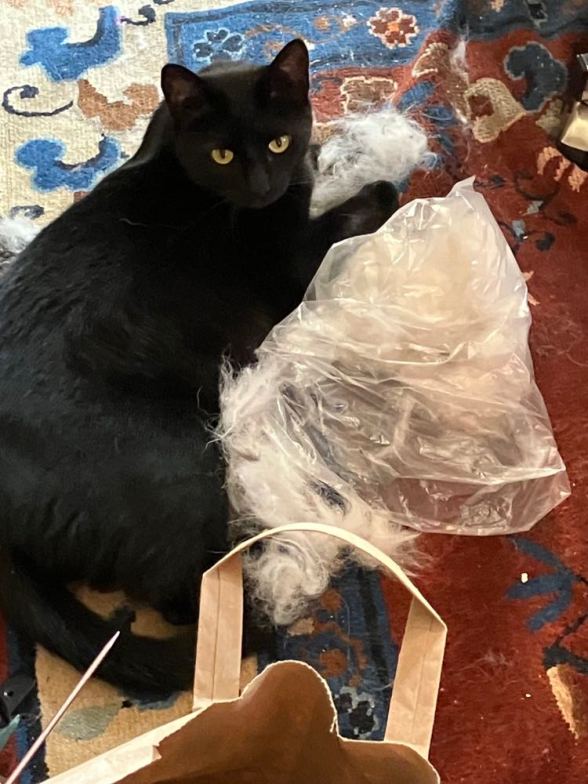
For the Ragtag Daily Prompt: feed. How many hours a day do cats loll? Is it fatigue or do they just like it?