What to check before bringing your elder home from the hospital

I get a call from the hospital (this is over a year ago). They say, “Your friend is ready for discharge. What time can you pick her up?”

I reply, “Can she walk?”

“What?”

“She has three steps up into her house. Can she walk, because otherwise I can’t get her into her home.”

“Oh, uh, we will check.”

They call me back. “She can’t walk. She’ll have to stay another day.”

I knew that she couldn’t walk before they called. She could barely walk before the surgery and after anesthesia, surgery and a night in the hospital, her walking was worse. She had been falling 1-5 times at home and the surgeon knew that. He did not take it into account. The staff would have delivered her to my car in a wheelchair and then it would have been my problem.

She was confused by that afternoon, which is not uncommon in older people after anesthesia. She stayed in the hospital for six days and then went to rehab, because she still couldn’t walk safely.

Recently I have a patient, an elder, that I send to the emergency room for possible admission. He is admitted and discharged after two and a half days. Unfortunately he can barely walk and his wife is sick as well. The medicare rules say that he needs 72 hours in the hospital before he qualifies for rehab. We scramble in clinic to get them Home Health services, with a nurse check and physical therapy and occupational therapy, and I ask for Meals on Wheels. It turns out that Meals on Wheels will be able to deliver in two months.

The wife refuses to go to the emergency room. I tell her that if she does get sicker, that they both need to check in. The husband can barely walk and is not safe home alone. If one gets hospitalized, they both need it.

If you have a frail elder, be careful when you are called about discharge. Go look at them yourself, make sure that you see that they can get out of bed, get to the bathroom, walk up and down the hall. Can they eat? Do you have steps into your house or theirs and can they go up the steps? I got away with saying please check that my friend could walk because I am a physician, because I knew she couldn’t and because there was no one else to pick her up. Do NOT ask your elder. They may want nothing more than to go home and they may well exaggerate what they can do or be firmly in denial. You want them to be safe at home, to not fall, to not break a hip and to not be bedridden.

For an already frail elder, even two and a half days in bed contributes to weakness. And being sick makes them weaker. If they are barely walking when they are admitted, it may be worse even after just 2-3 days. I used to write for physical therapy evaluation and exercise when elder patients were admitted, to help them for discharge. Once I got a polite query from physical therapy saying, “This patient is on a ventilator. Do you still want a consult?” I reply, “Yes, please do passive range of motion, thank you!”

Your elder does not have to be doing rumbustious dancing before they go home, but they need to be able to manage stairs, manage the bathroom, manage walking so that they can get stronger. Otherwise a stay in a nursing home or rehabilitation facility may be much safer for everyone.

For the Ragtag Daily Prompt: rumbustious.


Content

I never do know where a poem is going when I start it. Usually I start in the dark. To my surprise, those poems will end in the light. Apparently the reverse is true too.

Content

At the moment I am feeling content
deeply content
with monsters

At the moment I don’t need more
then this
me
a few friends
and all the monsters

I can’t fix the monsters
healer, right
the people come
over and over
and won’t admit
their monsters

the monsters sit on the floor
of the exam room
clinging to the person
chained to the person
the monsters wail and cry
while the person
ignores them

It has taken me all these years
to let go of anger
fury
rage
that almost no one
admits to monsters
or tries to heal them

Except the addicts, drunks, crazies
they see them too
many try to destroy their vision
with alcohol or drugs
or persist on telling others
about the monsters
until they are drugged

Yesterday I look on line
for local music
not bluegrass
thinking that I would like
to find a place with grown ups
quiet

I think, how silly I am
to look for grown ups in a bar
and then I try to think
of where to find some grown ups
and I think THERE AREN’T ANY GROWN UPS
it’s all just children
who’ve grown big

I do not like drama
there are no movies
that I want to see

I like clinic
where I try to help a little
sometimes a lot
sometimes a person might remove
one knife
one chain
one arrow
from their traumatized
terrified
bleeding
monster

And really
that is why I am here
and that is all that I can do

__________________________

For the Ragtag Daily Prompt: journey.

Meanwhile, rat joy: https://www.bbc.com/future/article/20241128-i-taught-rats-to-drive-a-car-and-it-may-help-us-lead-happier-lives.

More bizarre than Sasquatch

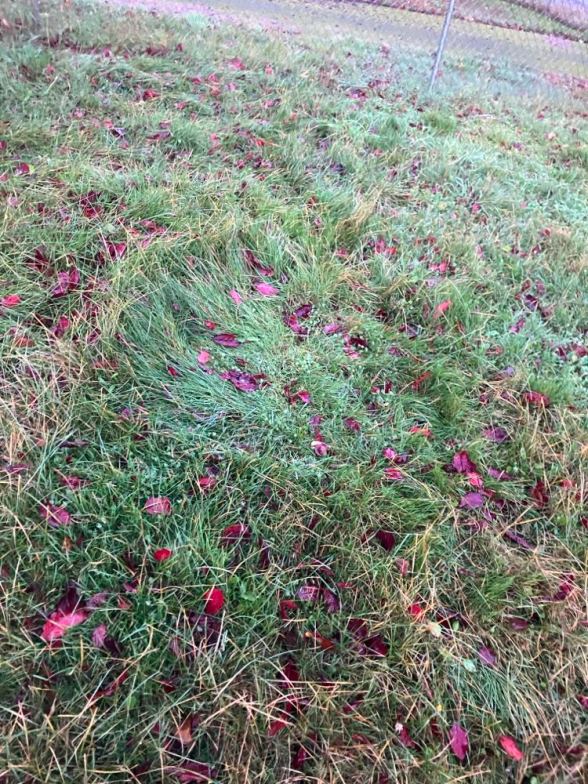
Sol Duc and I went for our walk together yesterday. This is a yard across the street, with the grass all pressed down where someone slept recently. Local deer or Sasquatch?

Meanwhile, I think the nearer we get to the election, the more bizarre I find our culture. I don’t suppose Make America Great Again has anything to do with modeling courtesy, kindness, setting a good example, lifting others up. It’s more like the drama of a “reality” show, where all the boring bits of life are edited out and it’s all drama and people getting frustrated with each other and confrontation. And speaking of discourtesies, the other party sent me a text and email, “Earth to Katherine”, wanting more money. I am offended, deleted and blocked that one. What IS this? Are we so addicted to action movies, “reality” shows, drama, violence and video games that our politics imitates them? When will people grow up?

I hardly watch movies or television series any more because honestly, no one on any of them is any more mature than Elmer Fudd. At least Bugs Bunny is funny. And the things “based on a true story”. Right, let’s add some more dramatic moments and more conflict.

I think I would enjoy Sasquatch more.

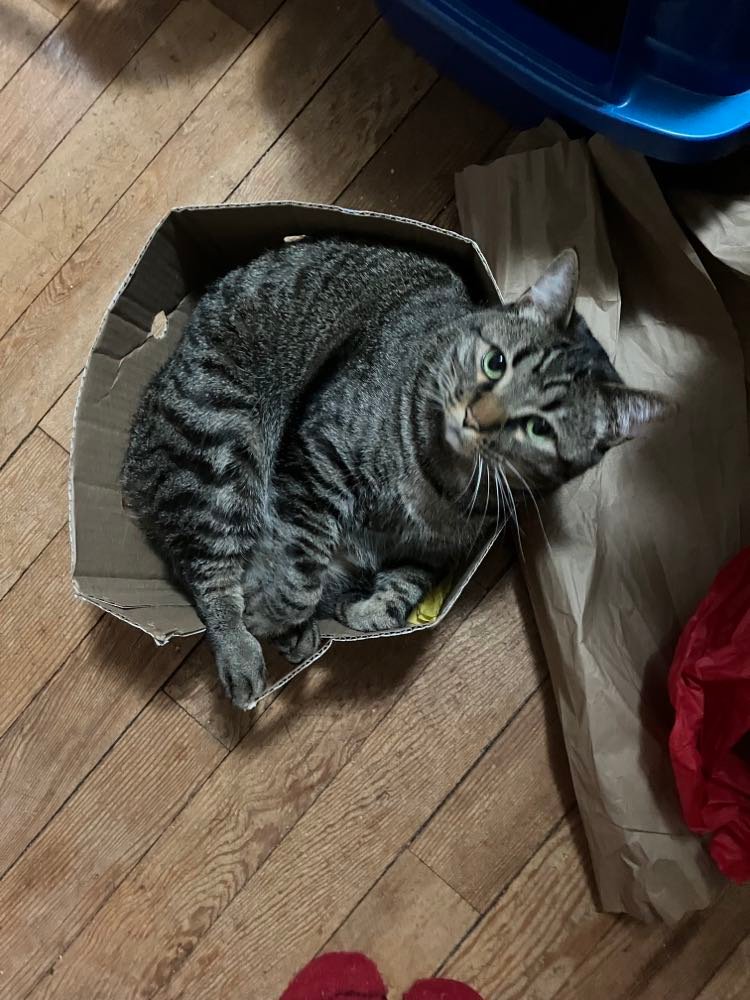
Thank goodness for my cat.

For the Ragtag Daily Prompt: bizarre.

Authenticity and masks

The Ragtag Daily Prompt today is identity. Yesterday I went to work an hour early so I could attend the Friday morning Continuing Medical Education. It was about adult ADHD and the positives and negatives.

I do not have a diagnosis of ADHD. I have one friend who insists that I have it, but I don’t much care. However, the speaker started talking about masks and authenticity. She said that we are told to be authentic at work, but that people with ADHD often find that their authentic self is not welcomed and they learn to mask.

I asked, doesn’t everyone mask somewhat at work? She said, “Good point, and yes, people do.” It got me thinking about identity and masks. I pretty much clammed up in Kindergarten because I was too much of an outlier and culturally wrong. We did not have a television and television was pretty much what the other children talked about. I knew songs and poems but these did not interest my peers. I was interested in science, too, but that was also not popular. I think I was a geek before it was named and as soon as I learned to read, I became a bookworm. I am not sure if having a television would have made any difference, either.

Fast forward to after high school. I went to Denmark as an exchange student my senior year and then needed to make up credits to graduate. Another high school student was in my Community College classes. After a bit, she said, “I thought you were shy in high school.” I said, “No, I just didn’t talk.”

Currently I am more authentic in the room with patients than with the rest of the staff. Corporations are very weird hierarchical places. My authentic self always questions authority but I am trying not to do it all the time. At least, not out loud. The patients seem to be fine with it. I had a very difficult conversation with an elderly couple this week about memory and planning, now, before they can’t. I got hugs at the end of the visit even though we’d gone into frightening and difficult territory. They did very well. Yesterday was my last day at that clinic and next week I am in another one. Even after just four months in this clinic, I will miss many of the patients and hope they do well.

Yesterday I really did Urgent Care. My schedule only had a few people and then six more sick ones were added on. We had to call an ambulance for one, the first time I’ve had to do that here.

What is authenticity and what is our identity? Is the work mask less real than the self in our minds?

I took the photograph at a small hot springs resort. A friend that I’ve known since high school and I met there. I love the bookworm rabbit. I think she represents the happy bookworm part of me. I read about 7 novels a month, haunting the library here. Maybe I will get to know some more people over the next 6 months.

For the Ragtag Daily Prompt: identity.

Love gently

Honey is older, nearly thirty years since that first feeling of being bitten by ants. She is back in corporate medicine, as a temp. Temporary, short term, maybe that will work better.

It is a joy to go in a room and be alone with a person and their monsters. Theirs and hers. Sometimes the younger ones haven’t experienced it, they are terrified if one of their monsters becomes a little bit visible, they hate seeing them. Honey tries to be gentle. If they only want to talk about the sore shoulder and not the stress and violence, well, she leaves the door open a crack. Sometimes the monsters cry.

Older people may be stiff to start with, but when they realize their monsters are seen, acknowledged, this isn’t another robot doctor in to say increase your diabetes medicine, lower your diabetes medicine, tell them a plan without ever connecting, the older ones lean back, sigh, and relax. The monsters play on the floor, Honey’s monsters playing with theirs, happy, engaged.

The hard part is the clinic staff. Honey is with them daily. The medical assistants are young. They kick their monsters aside as they walk down the hall. It is terribly hard and heartbreaking to work at her desk, with the medical assistants’ monsters cowering under their desks, kicked, abused, silent tears and holding bruises. Honey’s monsters mind. They climb into her lap and hide their faces in her shirt, under her jacket, peer over her shoulder. They don’t understand! Why can’t she be nice to THESE monsters?

Honey whispers to her monsters when the medical assistants are rooming patients. “I am so sorry, loves. If I acknowledge these, the monsters of the women working, I become a demon. It is very hard to share an office, no wonder I worked in a clinic alone for eleven years.” Honey has been through that. It is still inconceivable that some people don’t see the monsters at all. Is it learned blindness? Or just not developed unless someone had to learn it? Unless someone grows up in terror and seeing the monsters is the only way to survive.

Honey thinks some people learn to see them as adults, at least their own monsters. Hard enough to do that, without seeing the monsters clinging to other people.

Honey is tired of her monsters crying in sympathy with the staff’s monsters. She thinks maybe there are small crumbs that she can leave for these demons. Little gifts. Her monsters can creep under the desk when she is the only one in the room and leave something. A flower. A dust bunny. A crumb of a crisp. A small rock. A little gift to let them know they are seen and loved. A poem. A prayer. Just a tiny bit of love.

_____________________________

For the Ragtag Daily Prompt: crisp.

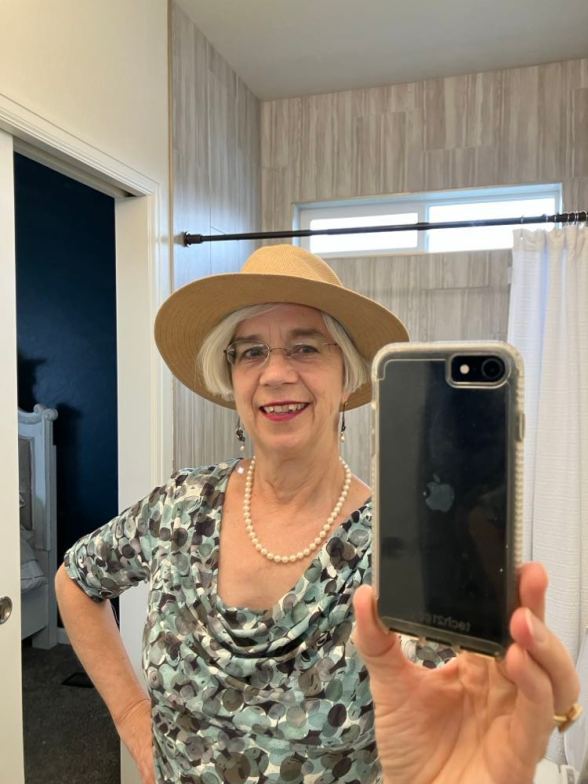
The photograph is me all dressed up for the 1940s ball.

______________________________

Free agent

The Agency contacted me yesterday.

“Yes?” I say.

“Are you free?” Dispatch always sounds so disinterested.

“Yes, I’m free.” I try not to sound annoyed. I am too good at my job. I’ve given up on dating. This frees me up for the Agency.

“Room two.”

Room two has a woman who looks frozen. I introduce myself, a stranger, her previous person left.

“Are you sleeping?”

“No. Well, I fall asleep but then I wake up. Nightmares and my heart beats so fast. Then I can’t go back to sleep.”

“Did something happen?”

Her face tightens all over. She wants to tell me but not let the emotions out. “A scam!” Now the dam is cracking and falling apart. The story comes out bit by bit. “They opened an account in my name! Took out a loan! I am so scared. And ashamed. We could lose the house.” Not many tears. She won’t let them.

“Ok, I think this is a PTSD reaction. The not sleeping is really common. Can you talk to your husband?”

“I’ve snapped at him! We never fight! Forty two years!”

The monsters are visible now. Clinging to her, but some are coming to cling to me. Fear, shame, grief, anxiety, fatigue. They aren’t really that big, because she has been a careful person, a wise person. But this has cracked her open because she never expected it.

“Have you contacted the authorities?” We talk about what she has done, the practical bits. She has already made wise moves. It’s the feelings that are upsetting her.

We pick something for sleep, a low dose, not one of the newer addictive ones. An antidepressant that will hopefully make her sleepy. Close follow up is even more important, to be sure that she is starting to comfort the monsters. Many of the monsters are crying for her. I think they will be ok.

She is more comfortable before she leaves. She brought the feelings out and I was not horrified and I did not shame her. They weren’t so bad after all, when she brought them out in the light of day. It’s when they are fighting to be felt and heard that they feel so dark and dangerous and frightening.

I leave the room. She will be back in a week, sooner if she needs to. One of her monsters smiles at me tremulously as it clings to her. I smile back and nod. I think they will be ok.

For the Ragtag Daily Prompt: agency.

I write this and then start humming. Yes, this is the right song.


Adverse Childhood Experiences 15: Guidelines

I wrote Adverse Childhood Experiences 14: Hope quite a while ago.

The American Academy of Pediatrics has a guideline that physicians should introduce and screen for Adverse Childhood Experiences. The American Academy of Family Practice is skeptical, here: https://www.aafp.org/pubs/afp/issues/2014/1215/p822.html. Here are two more writeups: https://www.aafp.org/pubs/afp/issues/2020/0701/p55.html and https://www.aafp.org/pubs/fpm/blogs/inpractice/entry/screen_for_aces.html.

It is difficult to screen for ACE scores for the same reason that it is difficult to screen for domestic violence and to talk about end of life plans. These are difficult topics and everyone may be uncomfortable. Besides, what can we DO about it? If growing up in trauma wires someone’s brain differently, what do we do?

I don’t frame it as the person being “damaged”. Instead, I bring up the ACE score study and say that first I congratulate people for surviving their childhood. Good job! Congratulations! You have reached adulthood! Now what?

With a high ACE score comes increased risk of addictions (all of them), mental health diagnoses (same) and chronic disease. Is this a death sentence? Should we give up? No, I think there is a lot we can do. I frame this as having “survival” brain wiring instead of “Leave it to Beaver” brain wiring. The need to survive difficulties and untrustworthy adults during childhood can set up behavior patterns that extend into adulthood. Are there patterns that we want to change and that are not serving us as adults?

This week a person said that they blow up too easily. Ah, that is one that I had to work on for years. Medical training helps but also learning that anger often covers other feelings: grief, fear, shame. I had to work to uncover those feelings and learn to feel them instead of anger. Anger can function as a boundary in childhood homes where there are not adult role models, or where the adults behave one way when sober and an entirely different way when impaired and under the influence. There may be lip service to behave a certain way but if the adult doesn’t behave, it is pretty confusing. And then the adult may not remember or be in denial or try to blame someone else, including the child, for “causing” them to be impaired.

What if someone had a “normal” childhood but the trauma all hit as a young adult? I think adults can have trauma that changes the brain too. PTSD in non-military is most often caused by motor vehicle accidents. At least, that is what I was told in the last PTSD talk I went to. Now that overdose deaths have overtaken motor vehicle accidents as the top death by accident yearly in the US, I wonder if having a fentenyl death in the family causes PTSD. Certainly it causes trauma and grief and anger and shame.

I agree with the American Academy of Pediatrics that we should screen for Adverse Childhood Experiences. We need training in how to talk about it and how to respond. I have had people tell me that their childhood was fine and then later tell me that one or both parents were alcoholics. The “fine” childhood might not have been quite as fine as reported initially. One of the hallmarks of addiction families is denial: not happening, we don’t talk about it, everything is fine. Maybe it is not fine after all. If we can learn to talk to adults about the effects on children and help people to change even in small ways, I have hope that we will help children. We can’t prevent all trauma to children, but we can mitigate it. All the ACE scores rose during the Covid pandemic and we are still working on how to help each other and ourselves.

Here is another article: https://www.aafp.org/pubs/fpm/issues/2019/0300/p5.html.

Blessings.

For the Ragtag Daily Prompt: open wound.

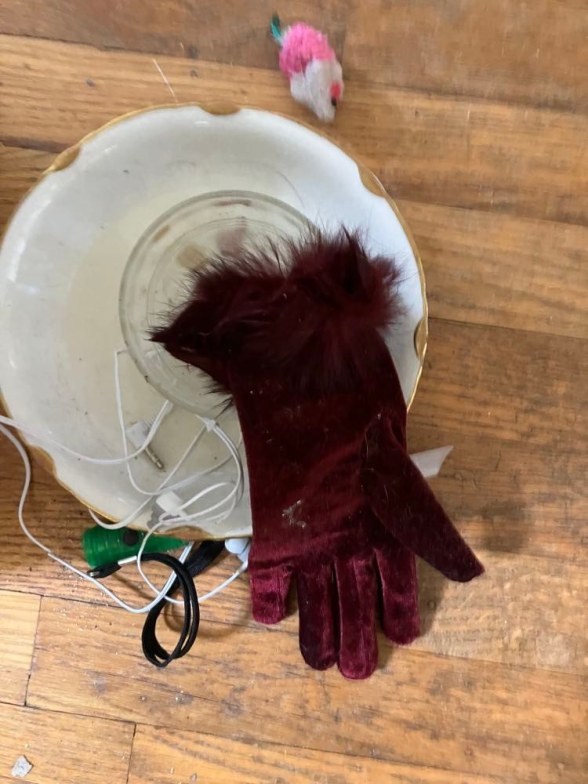
The photograph is one of Elwha’s cat art installations. He would pile toys on his bowl. Two bowels because I need to keep out the little ants. Sol Duc would do it too but not as often. I fed them in separate rooms. They would pile things on the bowl whether there was food left or not.

Elwha is still missing, sigh. That is a wound. The photographs are from March 2023.

Matter

If something doesn’t matter, is it anti-matter?

Lily’s person moved two days ago, much closer. Supposedly to a place where Lily the cat can go, but instead of a private room, there is a roommate. It took me a month to get Lily cat to let me pat her, so the roommate won’t work. We are all very very frustrated. And next week daily treatments for Lily’s person start, thirty minutes away, without enough warning to get volunteer drivers. So it will be me. I am tired. But I suppose it’s anti-matter, right? We were given 24 hours notice by the nursing home and by the physicians about both the move and the treatment and they wanted to start the treatment the same day that she was moving. Whether we can provide all the transport seems to be irrelevant.

The stealthie is from Whidby Island. Right, I’m just an irrelevant shadow as far as the medical dysfunctional machine is concerned.

For the Ragtag Daily Prompt: irrelevant.

Shame and anger in overuse illnesses

“amongst those who treat addicts of any kind generally agree that anger and shame help no one and is actively counter-productive.”*

Wait.

I have to think about that statement.

I do not agree at all.

Ok, for the physician/ARNP/PAC, anger at the patient and shaming the patient are not good practice, don’t work, and could make them worse. BUT anger and shame come up.

In many patients.

Sometimes it goes like this with opioid overuse: the person shows up, gets on buprenorphine, and is clean.

It may be a long time since they have been “clean”.

One young man wants to know WHY I am treating him as an opioid overuse patient. “Why are you treating me like an addict?”

I try to be patient. I recommended that he go inpatient, because I don’t think we will cut through the denial outpatient. Very high risk of relapse. “You have been buying oxycodone on the street for more than ten years.”

“I’ve been buying it for back pain, not to party.”

“Did you ever see a doctor about the back pain?”

“Well, no.”

“Buying it illegally is one of the criteria of opiate overuse.”

“But I’m not an addict! I’ve never tried heroin! I have never used needles!”

“We can go through the criteria again.”

He shakes his head.

He is in denial. He is fine. He doesn’t need inpatient. He is super confident, gets work again, is super proud.

And then angry. “My family still won’t talk to me!”

“Um, yes.”

“I’m clean. I’m going to the stupid AA/NA groups! Though I don’t need to. I’m fine!”

“What have you noticed at the groups?”

“What a bunch of liars!” he says, angry. “There are people court ordered there and they are still using! I can tell. They are lying through their teeth!”

“Obvious, huh?”

“Yeah!”

“Did you ever lie while you were taking the oxycodone?”

Now he ducks his head and looks down. “Well, maybe. A little.”

“Do you think your family and friends could tell?”

He glances up at me and away. “Maybe.”

“Your family may be angry and may have trouble trusting you for a while.”

“But I’ve been clean for four months!”

“How many years did you tell untruths?”

“Well.”

Shame and anger. Anger from the family and old friends, who have heard the story before, who are not inclined to trust, who are hurt and sad. The first hurdle is getting clean, but that is only the first one. Repairing relationships takes time and some people may refuse and they have that right! Sometimes patients are shocked that now that they are clean, a relationship can’t be repaired. Or that it may take years to repair. My overuse folks are not exactly used to being patient. And sometimes as they realize how upset the family and friends are, they are very ashamed. And some are very sad, at years lost, and friendships, and loved ones. I have had at least one person disappear, to relapse, after describing introducing someone else to heroin. He died about two years later, in his forties.

Shame and anger definitely come up in overuse illness.

The above is not a single patient, but cobbled together from more than one.

______________________

*from an essay titled “F—ing yes, I’m a fatphobe” on everything2.com. Today there are two with that title. The quotation is from the second essay.

Negotiating peace

I spend a long day wrestling with love
arguing with myself back and forth
I am no angel descended from above
Those undeserving of my love make me wroth
yet my core argues that it still loves them
and agrees their cruelty’s beyond the pale
I snarl and cough and choke on bitter phlegm
Defend my self staying far away and hale
My core agrees I shall not tolerate abuse
Forgive yet we despair we’ll ever reconcile
They show no guilt nor shame for their misuse
My core says let them be: she is so mild
Negotiation done: Agreed. I may love those who I love
But I leave contact with them to the angels and Beloved.

_____________________

Sonnet 10