guns in the house

During wellness visits I used to ask, “Do you have guns in the house?” in the safety/accident prevention part of the visit. Along with helmets, seat belts, smoke alarms and not driving under the influence.

As a Family Practice Board Certified Physician, I counsel patients. Family Practice is a specialty, just as internal medicine and general surgeon are specialties. A three year residency training after medical school and I retake the Boards every 10 years. I counsel patients in “annual exams” or “medicare wellness” visits.

A patient reported me to the state board because of that question. I then got a letter from the state board saying that I was being investigated but not why. Later I got a letter saying that the patient had complained that I had asked about guns. The state replied that in fact, I am supposed to counsel patients about gun safety.

I changed my counseling. Now I say: “If you have guns in the house, I am to counsel you to keep them locked up with the ammunition locked up separately.”

I get three responses:

1. “My guns are in a gun safe, locked at all times, with the ammunition locked.”

2. “I don’t have any guns!”

3. Silence.

It is the silent ones that worry me.

I did not change my counseling because I was reported to the state and the state did not tell me to change it. I changed it in hope that someone who keeps their guns unlocked and loaded, in the bedside table, under their pillow, up in a closet, or where ever, will think about it. The question “Do you have guns in the house?” is too loaded for those people.

I met a woman with an impressive star shaped radiating scar on her chest. Her boyfriend kept a loaded gun under his pillow. One night she was returning from the bathroom. He shot her in the chest.

They are not together any more.

When my son went to preschool, over 20 years ago, I counseled him. “If another child says they can show you a gun or they have a gun, say that you have to go to the bathroom. Go and tell an adult right away. People can get killed.”

He reported an overheard conversation in preschool between two other boys. One said that he knew where his parents kept a gun. The two boys were planning to leave the school to go look at the gun. I called the preschool. They already knew about it and had talked to both boys’ parents. I don’t know if the parents locked the guns up.

In Portland one of my neighbors chased his upstairs neighbor into the street one day during rush hour, stark naked, trying to hit the upstairs neighber with a 5 iron. Yes, a golf club. I am very glad the downstairs neighbor did not have a gun right then, because he would have used it. Any of us could have been killed. And later the SWAT team was called to deal with him: he did have a gun that time. He threatened to shoot himself in the head. Then he did: well, except he only creased himself. He went to involuntary psychiatry, supposedly for six months. He was back in three months. The neighborhood was very very nervous. The house next door was sold and he disappeared and we were all relieved. He was strong, completely illogical and terrifying. We discussed how to deal with him but mostly we hid.

When he chased the neighbor into the street, I had already called 911 because I heard screaming next door. My voice shook. The dispatcher said, “Yes, we know the address, we’ve had three calls and they are on their way.” The traffic stopped dead at the sight of a nude man chasing another man with a 5 iron. I unbolted my door and stuck my head out. “(C—-)! Up here!” The upstairs neighbor ran up my steps and into my house. I slammed the door and bolted it and crouched by the front window with a baseball bat, ready to hit the downstairs neighbor as hard as I could if he came through my front window.

He didn’t. The police arrived. The whole thing was over the upstairs neighbor “playing music too loud” and “not turning it down enough”. The downstairs neighbor had broken down the upstairs neighbor’s door with the five iron. The upstairs neighbor had tried to defend himself with a butter knife and then ran. The police explained to the downstairs neighbor as he was arrested that if someone breaks your door down, it is not assault to defend yourself with a butter knife.

We discussed which illegal drugs we thought he was on. This was in the 1990s, so we thought it was crack. There was a big article soon after that about a crack house. We said, whew, glad we aren’t those neighbors and then realized that it was within two blocks of our house. Great.

Drugs and alcohol and guns and anger and grief….. it is a toxic mix.

Please, lock your guns.

Weaning methadone

Weaning high dose methadone down to a lower, safer, less likely to stop breathing and die dose is difficult, but it can be done. It needs both a determined patient and a determined physician who are willing to work together.

In 2010 I took a class in buprenorphine treatment for opiate overuse syndrome from the University of WA Medical Center and got started with their telemedicine, once a week, on line with the Pain and Addiction Clinic. Each week there was a teaching half hour and then an hour where we could present patients anonymously on the telemedecine to a panel: a pain specialist, an addiction specialist, a psychiatrist, a physiatrist, and a guest physician. Five consults at once! And they would discuss the case and fax recommendations to me.

Three weeks after the course, police and Medicaid and the DEA shut down the pain clinic 5 blocks from me, taking the computers. I acquired 30 patients in 3 weeks. Trial by fire.

By 2012 Washington State passed a pain medicine law. This says that a primary care physician can only prescribe up to 120 morphine dose equivalents for chronic pain. Anything higher and the patient should be checked by a pain specialist and there were not that many in the state.

120 morphine dose equivalents is up to 20 mg of methadone or possibly 30mg. Methadone has a very long half life so it’s a bit weird. Hydrocodone is one to one with morphine and oxycodone is 1.5 to one, so 90 mg of oxycodone is 120 morphine dose equivalents.

The law requires urine drug screens, careful record keeping, screening for adverse childhood experiences and regular visits. If the pain medicine is not effective, it is to be weaned. I had a couple of patients with over 100mg of methadone daily. That is way over the 120 morphine does equivalents and UW helped me help the patients start weaning.

First, they recommended dropping the dose by about 1/3. Some patients left immediately. I would give patients links to the law on line and explain that the concern is that opioids in combination with other sedating drugs and alcohol are killing more people than either guns or car wrecks or illegal drugs in the United States and the CDC has declared it an epidemic. Honestly, doctors really take the “first, do no harm” seriously and we do not want to kill people. One angry patient said “Your first job is to keep me pain free.” I said, “No, my first job is to not kill you.”

For those who stayed, dropping the dose by 1/4 or 1/3 worked. They had about two weeks of mild withdrawal symptoms and then gradually felt better. These were at doses of 120-150mg methadone daily. We started weaning then by 10mg or about 10% every couple of months. The UW Pain Clinic was doing this simultaneously.

In 2012 the WA PMP started as well. This is a central pharmacy reporting for all controlled substances. Controlled substances means addictive and monitored by the DEA. Even the head of the WA Pain Clinic found that he had 5-6 patients who were getting opioids from 4-5 different doctors. He said, “We do have to check because I thought I knew my patients and I would have none. I was wrong and I was surprised.” Those patients could be taking way more than any of their doctors knew or could be selling pills. Not a happy thing.

Once the methadone folks got down to about 1/3 of the high dose, we had to slow down. For my patients that meant at 40-50mg. The head of the pain clinic said wean by 5 mg or 2.5mg and do it every 6-8 weeks.

As people were weaned, their pain level stayed about the same. They would have an initial increase for the first two weeks. I describe it as follows: Think of it as if you are in a room listening to a stereo. The pain medicine is like noise protecting headphones. Once you are wearing the headphones, your brain says, uh, I can’t hear (feel pain). Hearing (feeling pain) is important information, so the brain turns up the volume. Way up if the dose is really high. Then you take the headphones off: OW!! IT’S TOO LOUD! THE SOUND (PAIN) IS BLOWING OUT YOUR EARDRUMS (HURTING LIKE HELL)!!!

Weaning slowly gives the brain a chance to turn the volume down on the receptors. UW said that at best chronic opiates lower pain an average of 30%. After a while, I said I had trouble telling the difference between withdrawal pain and increased chronic pain: they look the same. UW said, “Looks the same to us too.” But we had frequent visits and an ongoing discussion about pain. Pain is necessary for survival: you have to know if you are injured. Diabetics who can’t feel their feet are instructed to look all over their feet every day to check for injury and infection. I had one gentleman who couldn’t feel his feet and put them on a wood stove because they felt cold. He was needing skin grafts from the burns. So we need to feel pain and not numb it all the time. Also pain has three or more componants: the sharp cut/broken/bruised immediate pain. Second is nerve pain. Third is emotional pain, and we don’t yet have a meter that gives us what percentage each is contributing to the total sum. When I have a new chronic pain patient, I say that ALL THREE must be treated. We can argue about the details, but they can’t leave the emotional piece out…. or they have to find another doctor.

Also, at the higher doses, hyperalgesia is common, pain from the opioid itself. People felt better at lower doses. I gave people the links so they could read the law and the CDC information themselves. They were shocked and angry and threatened at first, but the “I don’t want you to die from too high a dose and it’s not safe and I am sorry.” message would get through eventually.

“Why do you have to do urine drug screens?” say some people. “You are treating me like an addict.”

My reply, “What do you think the addicts tell me?”

The person thinks about it. “The same thing?”

“Absolutely. So I can’t tell unless I check. Also, the boundary between chronic opiate use and opiate overuse is a lot thinner than we thought, so I have to check because all chronic opiate people are at risk for overuse.” The DSM-V combines opioid dependence and opiate addiction into opiate overuse syndrome, a spectrum from mild to moderate to severe.

We also talked about other ways of dealing with chronic pain. John Kabat Zinn’s mindfulness meditation classes drop pain levels by an average of 50%, so better than opioids. And way safer.

Meanwhile, since people could no longer get opioid pills from 4-5 doctors at once, the supply in Washington started drying up. Some people realized they had opiate overuse syndrome as well as chronic pain and turned to methadone clinics or buprenorphine clinics. Others went to heroin. The heroin overdose death rate has risen. I hope that as the stigma surrounding “addiction” changes into a better understanding of chronic pain and opiate overuse syndrome, more people will be able to get treatment and the death rate and heroin use will go back down.

https://depts.washington.edu/anesth/care/pain/pain-roosevelt.shtml

http://www.cdc.gov/cdcgrandrounds/archives/2011/01-february.htm

http://www.doh.wa.gov/ForPublicHealthandHealthcareProviders/HealthcareProfessionsandFacilities/PainManagement

http://www.doh.wa.gov/ForPublicHealthandHealthcareProviders/HealthcareProfessionsandFacilities/PrescriptionMonitoringProgramPMP

http://www.uwmedicine.org/referrals/telehealth-services

https://www.drugabuse.gov/publications/research-reports/prescription-drugs/opioids/what-are-opioids

http://www.umassmed.edu/cfm/about-us/people/2-meet-our-faculty/kabat-zinn-profile/


does chronic pain kill you?

Another writer sent me this story, saying that chronic pain killed Prince, not an overdose.

http://www.rawstory.com/2016/05/prince-did-not-die-from-pain-pills-he-died-from-chronic-pain/

My response is complex.

1. Is chronic pain an “illness” in it’s own right?

My answer is yes and no. It’s complicated and our understanding is evolving. Right now I think of chronic pain as a switch in the brain that gets thrown. It can be thrown by adverse childhood experiences, by infection, by trauma or war or abuse, by too much stress… or a combination of any of these.

2. Why a switch in the brain?

In fibromyalgia patients we can’t find much on physical exam, except that the pain seems out of proportion to the exam. Ditto with chronic fatigue, reflex sympathetic dystrophy, TMJ, etc. However, now we can image the brain with a functional MRI and watch which parts are lighting up and how much. A study of “normal” and fibromyalgia patients involved a standardized pain stimulus: a thumbscrew. (Kinky, right?) The normal patients said the pain stimulus was 3-4 out of 10 and their brains lit up a certain amount. The fibromyalgia patients said the same pain stimulus was 7-8 out of 10 and the pain parts of the brain lit up MORE corresponding to their pain level. So they are not lying… and it IS in their heads. Sort of. We aren’t sure whether the muscle is yelling more than normal or whether the brain is hypersensitive or both. My guess would be both.

And I think this is an adaptation. It is to get us to rest, heal, calm down, introspect, stop being type A, etc. Boy, do we suck at it. Though recently I had a person in clinic who said what their body wanted to do was nothing. They just wanted to lie around. I said, well, ok, so when can you do that? They did, for two weeks, at the holidays. And my patient said, “One day I had a cup of tea and a book and the cat on my lap and the dog at my feet. I realized that my adrenaline system was turning off and I felt calm and relaxed. Healed.” Back at work the person cannot always maintain it but is getting better at it.

3. What does this have to do with Prince?

The problem is that for 20 years we treated chronic pain with opiates. Unfortunately on continuous opiates, the brain cells change in many people and “down-regulate” the opiate receptors. Less receptors, the pain rises. The person needs more opiate. The brain removes more receptors. So two myths: one that if you have chronic pain and take medicine as directed, you can’t get addicted. Only dependent. Since that is a myth, the DSM-V has combined addiction and dependence into one diagnosis: opioid overuse syndrome. It is a spectrum, not two separate responses.

The second myth is that if you give enough opioid, it will help the pain. Well, no. UW Pain and Addiction Clinic says that on average pain is reduced about 30% by opiods, whatever the dose. And high doses start causing some weirdΒ  hyperalgesias. I’ve weaned two people from over 100mg methadone daily down to 20-30mg. It took two years. They felt better on the lower dose after they got through withdrawal symptoms and a short term increase in the pain receptors complaining at them. And they are much less likely to overdose and die.

Page two here http://www.supportprop.org/wp-content/uploads/2014/01/PROP_OpioidPrescribing.pdf discusses current knowledge about opioids.

4. So like, Prince?

He may have died from a combination of fatigue and sedating drugs. If you get enough sedating drugs, then you stop breathing. Opioids are the biggest offenders combined with alcohol or sleep medicine like ambien or benzodiazepines like valium or ativan or alprazolam or muscle relaxants like methacarbomal or a combination of all of the above. I am a strict physician about urine drugs screens and I do the dip in clinic in front of the person. Way too often, the person does not tell me about the alprazolam or whatever until I am holding the dip over the cup…. and that’s when they tell me. They got it from the ER or a friend or two years ago or … took their dog’s. Really.

He may have died from influenza, if he had it, with sedating drugs. Bad influenza causes lung tissue swelling and can mess up your oxygenation. Your heart has to take up the slack and go faster. If you are trying to work and your heart rate is well above normal, it’s exhausting. It can kill you.

He may have died from overwork, another infection, sedating medicines…. but not directly from chronic pain. Chronic pain slows us but I do not think it kills us*. What kills us is trying to treat it with a pill instead of resting and doing gentle exercise and saying: What does my body want?


5. Overdose?

Also, are we talking about an accidental overdose? Are we talking about drug abuse? Are we talking about accidental death or suicide or do we as a society think that addiction deserves overdose death but a person taking medicine for chronic pain is a tragedy? Aren’t we a bit judgemental?

Prince may have taken a pain pill as directed but taken it with too many other controlled substances or with alcohol or while sick and exhausted. Overdose means too high a dose. If it was two percocets, alcohol, flu and xanax…. it could be an accidental poisoning.

6. Are you sure?

No. Medicine changes. Our understanding of the brain changes. Science is about change and deepening understanding. We are barely getting started on the brain and I would say that we are in preschool there.


*Stress alone can cause heart attacks and sudden death:Β  Β  http://www.health.harvard.edu/blog/stress-cardiomyopathy-a-different-kind-of-heart-attack-201509038239

The photograph is from a week ago, part of my Maxfield Parish cloud series, zoomed way in to the mountains across the water.


fraud in medicine: cow thymus guinea pig

We are making a change in clinic. We ask all new patients to bring ALL the pills they take. Prescription, vitamin, supplement. Most of them don’t. So now we are telling patients that they need to bring all pills or they will be rescheduled.

I want to know what my patients are taking. My town is a delightful spectrum mix from very conservative to very liberal and some libertarians thrown in. But I look at the ingredients of the bottles.

With prescription medicines, people will say “I am on metoprolol.”

“What strength?” I say, “And is it the short acting, middle or long acting?”

Some patients: “Uh…. it’s blue. It’s a small blue round pill.”

Eye rolling would be unprofessional. I pick the lowest dose and type in “unsure dose”. “Bring it next time.”

I examine vitamin bottles. Some contain multiple herbs as well as vitamins. Most people don’t seem aware of this. Sometimes people have four different vitamins with vitamin A in them. “The fat soluble vitamins A, D, E and K can build up in your tissues and people have managed to kill themselves. I would recommend you take less then you are taking.” And then there are the high dose vitamins: one with 3999% of the recommended daily allowance of vitamin A. Hello. Why is this being sold? I guess people have the right to take things that can kill them. But I wish they wouldn’t.

Supplements. I read the ingredients. One ingredient is cow thymus. “This has cow thymus in it.” I say. Medicine seems a bit vague on what the thymus does, though it is involved with myasthenia gravis: http://www.mayoclinic.org/diseases-conditions/myasthenia-gravis/multimedia/thymus-gland/img-20007802

“Oh.” says my patient.

“I am very unenthusiastic about taking cow thymus.” I say. “Unless you are working with a naturopath who has prescribed it for a compelling reason. Who prescribed it?”

“Uh, it’s not prescribed. It’s made by a good company.”

Right. Like I trust corporations. Scamming thieves and liars. Sell anything that isn’t nailed down in pill form. Including cow thymus.

My medical philosophy is as few pills as possible. Prescription, vitamin or supplement. Eat food, exercise, make friends, work well, be kind to yourself and others and avoid pills unless necessary. We don’t know how cow thymus and metoprolol interact. The FDA considers supplements to be natural, like a carrot. A pill is not a carrot. It doesn’t grow on a tree or in the ground. It has to be made by people. The supplement companies do not have to do any testing for medical safety and efficacy and I frankly hate the pills with multiple herbs in them. They have to use ingredients that are “generally recognized as safe” which is pretty lukewarm: http://www.fda.gov/Food/IngredientsPackagingLabeling/GRAS/. Also, kidney failure is on the rise from too many pills. Everything is metabolized by either the kidneys or the liver and kidney failure is in the top ten causes of death in the US.

And I don’t want to be a guinea pig. I don’t want to be the personal home chemistry trial of cow thymus plus metoprolol. No way. And I will bet that you don’t want to be a personal home guinea pig either.

I took the photograph with a zoom lens looking down from the dock in Port Townsend Bay in 2014.

H is for heal

H for heal, healing, healed.

Heal is not used as a feeling as much as healing or healed in conversation. Unless you are a healer and you hope to heal someone. But we use healing frequently or say, “I need to heal from that.” What do you want to heal from? A physical, a mental, a spiritual or an emotional healing? They are all tied together and we need them all. I am working with a massage therapist, once every two weeks. I chose massage for healing because my sister and father had died 14 months apart and about ten months later I thought, I need some help. And the thought of discussing my family was horrifying. I thought, I don’t want talk therapy. Let’s go at it from another angle: heal and help the body and the mind will follow. I feel much better now….

verb (used with object)
1. to make healthy, whole, or sound; restore to health; free from ailment.
2. to bring to an end or conclusion, as conflicts between people or groups, usually with the strong implication of restoring former amity; settle; reconcile:
They tried to heal the rift between them but were unsuccessful.
3. to free from evil; cleanse; purify: to heal the soul.

verb (used without object)
4. to effect a cure.
5. (of a wound, broken bone, etc.) to become whole or sound; mend; get well (often followed by up or over).

H

I am a family doctor and one area of healing that we should use more is going outside, going for a walk and going in the woods. Why? I was feeling gloomy yesterday am and walked down the wooded paths in my neighborhood. The birds are celebrating spring. A deer stood watching me on the path, immobile in hopes that I wouldn’t see her. A sapsucker was up in the top of a dead madrona tree. I only walked ten blocks, but the new information from being outside and watching and listening, blew the gloom right out of my mind. The brain is geared for new neurological information using all the senses. We do NOT use them for computer and especially not for television. So go outside and blow the cobwebs away! And if you have a feeling you are not comfortable with, take it for a walk and show it birds and squirrels and just let it be present. Be kind to it and yourself. Heal.

I took the photograph Saturday. I walked into my lower yard and the deer and a yearling were startled. I stopped and the deer did too. She kept looking at an evergreen to her right, and at last the cat walked out from the lower branches…. If a cat may look at a king, then a deer can look at a cat….


Dear Mr. Donald Trump

Two weeks ago I sent this letter to Mr. Trump and all of the presidential candidates. To date I have gotten a form letter from Mrs. Hilary Clinton.

Dear Mr. Donald Trump and all Presidential candidates:

Mr. Trump, I am a rural family practice physician, a woman, who owns and runs my own medical clinic. I take care of patients from age zero to 104. Currently my oldest is 98. I take medicare and most insurances, but not medicaid.

I am running into legal immorality across the board from health insurance corporations that are maximizing profits at the expense of my health care dollar, our taxes and my patients. I would like your advice.

For example, the Veterans Hospital contacted me in May of 2015 and asked me to accept Veterans Choice patients, veterans who live more than 40 miles from the nearest VA Hospital. I accepted. I have 6 veteran patients, who are very complicated. To date I have not been paid for one visit. Now, before you say this is the fault of our government, it isn’t. It is the private for profit government contractor Triwest who is not paying me. They have my notes and we have followed their instructions on how to submit bills. Would you advise me to drop these patients?

For example, my father died in 2014. I called the oxygen company to pick up 6 tanks of oxygen. Then I found 8 more. I gently inquired why he had 14 tanks. The company said that his medical orders said that he should wear it continuously, so they delivered it. “Medicare paid for it.” they said. Ah. Well, I kept the other 8 tanks, because it is my and my father’s oxygen in those tanks: the company can have the tanks back when they are empty.

For example, the head of the sleep apnea supply company came to see me. He said, “You are getting in the way of your patients getting needed equipment.” I said, “Really? How?” “You only allowed a refill of one of the 8 necessary pieces of CPAP tubing instead of signing off on the whole group so we can fill as needed.” “Ah.” I said, “Actually my patients are tired of you mailing them 8 pieces of plastic that are filling up their closets and they don’t want extra plastic crap.” He mails it at the interval allowed by medicare, never mind whether the patient wants or needs it.

For example, I called a patient’s insurance to get a prior authorization last week for a limited sinus CT. They no longer do prior authorizations. They will decide whether to cover the CT scan once they read my notes. I asked if there was ANY way to see if it would be approved. They offered to let me send a letter to a PO Box in Wisconsin. My patient was sick, Mr. Trump. What do you suggest the patient and I do?

This is all legal. But it is not moral. So, Mr. Trump, where do you stand? Is our country’s highest value free enterprise and profit at any cost, no matter how many of our seniors are legally ripped off? Or do we have morals that health care and our elderly are important and need to be protected from legal but predatory businesses.

Please let me know, Mr. Trump. I would rather stick with my small clinic in the United States. At this point I would be financially and emotionally better off working as a temporary doctor internationally. I am sure that there is immorality internationally, but I will be less ashamed when it is not MY country.

Thank you.


Paying as I am paid

Perhaps I will feel better about the state of medicine and corporate fraud preying on the poor and elderly and disabled in the United States, if I pay my bills as I am paid: let’s think about that.

I go to the grocery store and ask for a print out of the receipt before I pay. I look at it carefully. “I think that one sku number is incorrect. I am returning the bill for you to correct. Meanwhile I am taking the groceries. Please mail the corrected bill to me and I will check it and respond within 6 weeks. Thank you.” I smile and leave.

I look at my electric bill. My name is misspelled. I write a note. “Your bill is incorrect. Please correct it so that I can pay you promptly.” I mail it.

I look at my garbage and water bill. My ex-husband’s name is still on it. “Mr. Lizard is not at this address. Here is his forwarding address. Thank you.”

I carefully examine my gasoline bill at the pump. I step inside and explain: “I think that your pump dispensed 3 oz less then the measured amount. I have an exacto fuel measuring device, and your pump is wrong. Please mail me a corrected bill so that I can pay you promptly.”

There. I have no more bills to pay. I eat lunch, happy that I will be earning interest on the pittance that I am paid.

Thank you, United States corporations: you have taught me so much.

I took the photograph in 2011 on Halloween.


Fraud in medicine: Veterans Choice

Yesterday I tried another tack to get paid for seeing Veterans Choice patients.

We are more than 40 miles from the nearest Veterans Hospital. Starting May of 2015, I was called by the Veterans administration to ask if I would accept a veteran as a patient. I said yes. I have seven by now, but we are currently refusing to take more.

That is, I can see them, but so far I have not been paid a penny.

The VA sends me an authorization from Triwest, the (for profit) contractor in the Northwest region, I see the patient, I fax my note and everything to Triwest, I fill out forms for referrals…. my biller follows Triwest’s instructions…. and they do not pay us. Over 25 visits now, over $5000.00

I have called Triwest, I have written to my senator and representative, I have called and called….

Yesterday I looked at this site: http://www.va.gov/

From there to the US map: http://www.va.gov/directory/guide/division.asp?dnum=1&isFlash=0.

We are district 20: http://www.va.gov/directory/guide/region.asp?map=1&ID=20

VA Puget Sound Seattle: http://www.pugetsound.va.gov/

Under “about us” a dropdown menu to the leadership team: http://www.pugetsound.va.gov/about/leadership.asp

And I called the office of William H. Campbell, MD, FACHE | 206-277-1330, chief of staff, third one down.

The administrative assistant who answered asked if he was expecting my call.

No, I said and explained. I said that I very much like my veterans and would like to continue to work with them but as the owner, CEO and sole physician in a small business, I do need to get paid. Please help.

She put me on hold. And then I spoke to Dr. Campbell and explained again. I said that I am not getting paid, we have contacted Triwest multiple times and followed their instructions, when I call Veterans Choice the response I get is “I don’t know.” and that my patients can’t get their mail order refills because even though the VA called me to see the patient, I am not “entered” in to their pharmacy system.

Later I got a call from a person who promised to speak to Triwest and expedite payment.

I got a call from the head of pharmacy at the Seattle VA.

Who knows? I might, someday, get a check from Triwest.

The issue is really that this is not an isolated problem. All of the insurances are getting worse. I get postcards from 50 different insurance programs a month telling me how they have changed their benefits for the different plans and inviting me to go on line and read their detailed instructions. Noridian, the northwest for profit contractor for medicare, held my payments for 5 months last year because they were getting audited and suddenly realized that my application and everyone else’s had been wrong for years. Doctors are quitting all over the Olympic Peninsula and I suspect all over the United States. At this point I do not think anyone could DESIGN a more unintelligent, arcane, frustrating system. And if you see a US doctor, half of their staff is there to go on line or on the phone to get prior authorization to get a CT scan, get an MRI, see a specialist. And the paperwork for every lab, every insurance company, every xray, every physical therapy office is DIFFERENT: tell me, is this efficient? No, but someone is making a huge amount of money and it is certainly not me. I want my health care dollar to go to health, not to stupidity and not to corporate profit.

And I am wondering if it is worth it……

I took the photo of the trees and bunkers at Fort Worden in 2005.


Influenza 2016

No influenza cases so far this year in my clinic.

I watch the flu map faithfully each week, as I try to get my stubborn patients to get their influenza vaccine. It takes up to two weeks to get them immune, if it works. It works most years about 80% f the time. When it doesn’t work, it’s because either their immune system didn’t respond or because the influenza virus has traded genes enough that the guess six months before on which way it will evolve, is wrong.

Here is the CDC weekly influenza update link: http://www.cdc.gov/flu/weekly/fluactivitysurv.htm.

If you click on the FluView Weekly Influenza Surveillance Report, scroll down. My favorite to show patients are the Outpatient Illness Surveillance, which maps this year’s rise in influenza in the US each week, compared with past years. We are having a late year.

My other favorite is the next one down: ILIState Activity Indicator Map. It changes color each week by state as the influenza reports come in. Arizona turned red this year about a month ago, after Puerto Rico. Red is high activity level. The rest of the country was dark green, low, or light green, but has steadily been turning yellow green, yellow, orange…. Washington State is still green. But now only a few states are green and it’s still on the rise. If we continue to have unseasonably warm sunny days, like the last four days, we might avoid the influenza. But if it gets wet and cold again: boom. Like a sneeze, spreading. This is the first week we’ve had seven red states. I have been wearing a mask in clinic every time I see someone coughing. And I got a cold anyhow, but it is not influenza and I don’t think it’s strep A, thank goodness.

I said influenza is airborne but it isn’t. Or there is controversy. It is at least droplet spread, but sneezes count. Apparently influenza can get to people 6 feet away. Wear your space suit with the oxygen filter to the grocery store. http://www.cdc.gov/flu/about/disease/spread.htm — lots of information about the influenza virus. Is all of it 100% correct? Don’t be silly, this is science, not a religious text: science changes, just like the flu virus.

This year, a CDC alert was faxed to clinic on February 1: http://emergency.cdc.gov/han/han00387.asp. It is all very calm and clinical, with this sentence in the second paragraph: “CDC has received recent reports of severe respiratory illness among young- to middle-aged adults with H1N1pdm09 virus infection, some of whom required intensive care unit (ICU) admission; fatalities have been reported.” I called my son and said, “Get your flu shot now.” If you read the rest, it says ages 20-50 as the “young” and “middle-aged” adults. Not the group that we expect influenza to hit, but that is the group that got hit in the 1918-1919 influenza.

Get your flu shot… be careful out there.


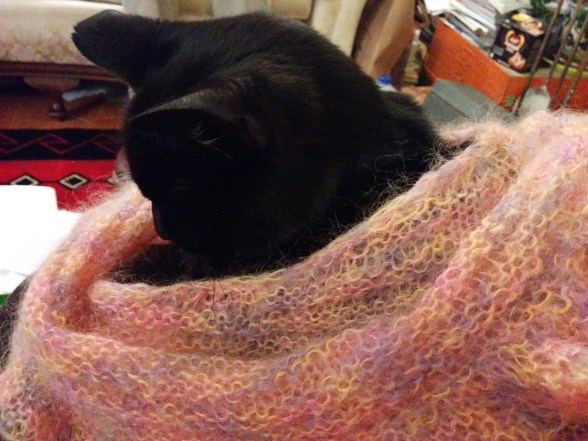
I took the photograph two days ago with my phone: Boa was on my lap and I wrapped her in the shawl I’d knit, and she was so relaxed…. that’s how we need to take care of everyone with influenza.