
fraud in medicine: navigating your failing healthcare system

Navigating health care in the United States is challenging and challenged. Currently the 800+ insurance companies, each with multiple “products”, the 500+ electronic medical records that don’t talk to each other, the increasing volume of information and the decreasing number of physicians make getting care very challenging. Here are some steps to help you navigate.

1. Get your records and keep copies.

Get the disc of any radiology studies: MRI, xray, CT scan, echocardiogram. Keep them. Hand carry to your visit with the specialist. Yes, I know your doctor said they’d be sent and I know the specialist’s office said they’d get them, but I have two friends so far this week in two days who traveled 2 hours or more to a specialist who DID NOT HAVE THE STUDIES. Do NOT give your only copy to the specialist. Demand two. Either get them on different days or just pay for the second disc.

A clinic closed in our area a year ago. It was in three counties, 3400+ patients. The physician owner was not paying the bills, including the electronic medical record. We couldn’t get records, the emr company wouldn’t release them. Gone. Thirteen people called to be new patients with me the day the clinic closed and we took five new patients a week for 6 months. You need a copy of your records.

2. In the specialist’s office or ER, do NOT give your records to the receptionist.

Hand them to the physician only. Hand them copies, you keep copies. “When will you be getting back to me?” That is, if it’s two hundred pages of complicated records, when does the physician think they can read (some) of them? The real truth is that WE CANNOT READ ALL OF THE OLD RECORDS. We don’t have time. We have to sleep. We read what we can and there are MOUNTAINS of old records that we haven’t read. I have files of old records and I pull them for visits so we can look up specific things. I have asked patients to go through and find specific things: find me the MRI report of your back.

Because what is really happening in many offices is that the information is being scanned but not read. Truly. I think this is dangerous. I had a patient who had five specialists and me. I was sending updates to his rheumatologist, with letters, asking questions and not getting a word back. Finally the patient went for the two hour trip to see the specialist, who called me: “I had not read any of your notes! I didn’t know what was happening!” I saw RED. Oh, so my letters and the ER notes and the other specialist notes that I faxed to you MYSELF about a very sick, very complicated medicine WERE NOT READ? I wanted to scream at her, but I didn’t. I just said, “We really need your help and I have been trying to keep you informed.” Through gritted teeth. Then later I kick and hit my heavy bag. And at that point the specialist was finally helpful. It still makes me furious just to think about it, so I have to work on forgiveness once again.

In my office, if a physician (me) has not read it, it has not been scanned. There will NOT be surprises in the scanned chart. The unread old records are filed alphabetically and when I have a time turner, I will have time to read them all, right? And then in a visit, the person asks if I got their mammogram report. I have to LOOK, because I sign off on about a billion different pieces of paper a day and I really don’t remember the names of all the people who had normal mammograms. I don’t try to remember that: I know who has an abnormal one, because I am worrying about them.

3. Make a record trail that you can quote.

When you call the physicians office, get the name of each person you speak to. Write it down. Have them spell it. Ask how soon you will be called back. Ask what you should do if you do not get a call back. (That being said, every physician has to prioritize the calls. It’s sickest first, not first come first served. If your call really is an emergency, then you should be in an ambulance, not calling your doctor.)Our local mental health was in such disarray, understaffed, underfunded, that my instructions to non-suicidal patients were: “Call every day, be polite, and call until they make you an appointment. Do not wait for the call back. Call daily, they just don’t have enough staff.”

If you fax them the missing notes, keep a copy of the fax proof. Call after your fax the missing records. Ask if they received them and then write down the name of the person you spoke to, date and time. I put a computer message in the chart for 99% of the phone calls I have with patients. I may miss 1% because I get interrupted or a really sick patient arrives or another phone call or whatever. Ask when the physician or his assistant will be calling you back about the records or better yet, make an appointment: “He did not have the records, so I would like an appointment as soon as possible now that he has them.” This forces your physician to look at the old records, because the patient is coming in. I do not read old records before a new patient shows up. I used to, but then people no show for a one hour new patient visit and I feel used, abused and grumpy. So I don’t touch the old records until you show up. After two one hour new patient no shows we tell the person they need to find another physician. Two strikes on the new patient visit and they are out.

4. Hospital.

If a person is really really sick, family or friends should be there. Ask questions. Who is each person who comes in the room? Do they have the clinic notes? Don’t assume they do, I am not on our hospital’s EMR because it costs 2 million dollars. The inpatient hospitalist doctors almost never call for my notes. I fax my notes anyhow and call them, but the information gap is BIG ENOUGH TO DRIVE THE MOON THROUGH. Really. I am sorry to burst the electronic medical record bubble, but we have 500ish different EMRs in the US right now and they do not talk to each other, so every patient arrives accompanied by 2 years of paper records (or more), 200 pages or more. I joke that they need a bigger doctor because the paper is too heavy for my 130 pounds. And many many times, the hospital medicine list is wrong. It is old. It’s out of date. The person is sick as hell in the emergency room and they don’t remember that their lisinopril dose was changed three weeks ago. One person in the room with the sick person and keep a notebook and write down what the physicians and nurses say, time, date. Then if they start contradicting each other, ASK.

5. In clinic

Give your doctor the whole list right away: my foot hurts, my chest is really bad when I try to run up the stairs, there’s this thing on my arm and is my cholesterol too high? Don’t discuss one thing in detail and then bring up the next. I have long visits, but I can’t do justice to that list in one visit and I have to prioritize. This requires negotiation: the chest pain has my attention. You may be focused on your foot, but the number one killer is heart, so your doctor will worry about your heart first.

If the doctor asks you to bring in all your pills, bring them all in. There are three different types of metoprolol and five strengths of each. Do you know the type and strength of every drug? I want to see your vitamin bottles because vitamin B1 can cause neuropathy from too high doses and yes, they can sell high doses. I want to see the supplements: why are you taking bovine thymus/testicle pills? By the way, if the doctor actually looks at the supplements, keep that doctor. Most don’t.

6. Be careful out there. Good luck.

Long notes and unhappy patients.

A patient of mine saw a cardiologist recently.

His previous cardiologist has retired. The patient had a cardiac bypass in the past, he has a stent, he has known coronary heart disease and he’s in the young half of my practice. That is, under 60.

He had not seen a cardiologist for 2-3 years because he had a work injury, worked with Labor and Industries, the case was closed, he couldn’t go back to work, he found a lawyer. He lost his regular health insurance along with the job, so couldn’t see the cardiologist.

The L & I case is reopened. A physiatrist recommended specific treatment that was not done, and that allowed the case to reopen.

The specific treatment center then notes that he has heart disease and that he needs clearance from a cardiologist. I set him up with a new cardiologist.

“How was the visit?” I ask.

He shrugs. “The staff was nice.”

“I have the note.”

“The cardiologist spent under ten minutes with me. It was clear that she was rushed. She did not seem very interested. It was difficult to get my questions answered.”

“Her note is six pages.”

He snorts. “Great that she could get a six page note out of that visit.”

“Do you want a copy?”

“No.”

He is cleared for the specific treatment.

I have no doubt that the cardiologist spent more than 6-8 minutes on his visit and his note. But not in the room. Other people are entering the information filled out in the waiting room, medicines, allergies, past medical history, family history. Hopefully the cardiologist is reading my note and letter. But the problem is, doctors aren’t doing it in the room. So the impression left with the patient is that we spend 6-8 minutes on their visit, we are late, we are rushed. Doctors are looking at data. They are not listening to patients.

Medical Economics, a journal that arrives without me asking for it, says over and over that we need more physician “extenders”, that we need to have people doing the data entry, people doing the patient teaching, more people and machines….No. They are wrong. We need LESS barriers between us and the patients, not MORE. We need more time with patients. Every single extender we add burns physicians out more, because the salary has to be paid AND more patients seen faster to do that AND we are still ultimately responsible for knowing and reading and absorbing every single piece of information that is placed in that patient’s chart. An extender is NOT an extension of my brain and an extender is another person I have to communicate with and train.

Just. Say. No. to the managers who pile MORE barriers between the physician and the patient. NO.


It just makes me so mad that he lost his health insurance BECAUSE he got injured at work and so then his heart disease goes untreated as well… can’t afford medicines…if he then has a heart attack while uninsured we lifeflight him to Seattle, it costs a fortune, he loses his house and property and then is on medicaid and may end up on permanent disability, and what are the chances he returns to work? The US medical corporate money grubbing is insane. Single payer, medicare for all, make the US great again.

Heart and brain and alcohol, 2018

For the Daily Prompt: infect. Maybe heart and brain health could be an infectious idea…..

Heart disease is the number one cause of death in the US, around 24% of deaths every year. Strokes are fifth most common cause of death at 5%, dementia sixth most common at 3.6%, data here from 2014. Accidents have beaten strokes out for fourth place because of “unintentional overdose” deaths.

I did a physical on a man recently, who said what was the best thing he could do for his health?

“Reduce or better yet quit alcohol.” is my reply. Even though he’s within “current guidelines”. I showed him the first of these studies.

Two recent studies get my attention for the relationship between the heart and the brain and alcohol.

In this study: http://www.onlinejacc.org/content/64/3/281, 79,019 Swedish men and women were followed after completing a questionnaire about alcohol consumption.

They were followed from 1998 to 2009 and 7,245 cases of atrial fibrillation were identified. The relative risk for atrial fibrillation was alcohol dose dependent: that is, the people who did not drink had a relative risk of atrial fibrillation set at 1.0. At 1-6 drinks per week the risk was 1.07, at 7-14 per week the risk was 1.07, at 14-21 drinks per week 1.14 and at >21 drinks per week 1.39. They also break it down by number of drinks per day. So why do we care about atrial fibrillation? “Atrial fibrillation (AF)/atrial flutter (AFL), the most common cardiac arrhythmia, is accompanied with a 4- to 5-fold increased risk for stroke, tripling of the risk for heart failure, doubling of the risk for dementia, and 40% to 90% increase in the risk for all-cause mortality.”

Atrial fibrillation, stroke, congestive heart failure, dementia and 40-90% increase in all-cause mortality. Want to protect your brain and live longer? Quit alcohol.

Well, that instantly decreased my enthusiasm for alcohol, now down to one drink per week if that.

Here is a second study: https://www.thelancet.com/journals/lancet/article/PIIS0140-6736(18)30134-X/fulltext?code=lancet-site

“Findings:
In the 599β€ˆ912 current drinkers included in the analysis, we recorded 40β€ˆ310 deaths and 39β€ˆ018 incident cardiovascular disease events during 5Β·4 million person-years of follow-up. For all-cause mortality, we recorded a positive and curvilinear association with the level of alcohol consumption, with the minimum mortality risk around or below 100 g per week. Alcohol consumption was roughly linearly associated with a higher risk of stroke (HR per 100 g per week higher consumption 1Β·14, 95% CI, 1Β·10–1Β·17), coronary disease excluding myocardial infarction (1Β·06, 1Β·00–1Β·11), heart failure (1Β·09, 1Β·03–1Β·15), fatal hypertensive disease (1Β·24, 1Β·15–1Β·33); and fatal aortic aneurysm (1Β·15, 1Β·03–1Β·28). By contrast, increased alcohol consumption was log-linearly associated with a lower risk of myocardial infarction (HR 0Β·94, 0Β·91–0Β·97). In comparison to those who reported drinking >0–≀100 g per week, those who reported drinking >100–≀200 g per week, >200–≀350 g per week, or >350 g per week had lower life expectancy at age 40 years of approximately 6 months, 1–2 years, or 4–5 years, respectively.”

Ok, over half a million people followed, 40K+ deaths, 39K+ heart events (heart attack, atrial fibrillation, new congestive heart failure, etc), that’s a pretty impressive study.

A 5% 12 ounce beer is 14 grams of alcohol. Here: https://www.niaaa.nih.gov/alcohol-health/overview-alcohol-consumption/what-standard-drink. Our local brewery and pourhouse usually serve pints, 16 oz, and the range is from 5% to over 9% alcohol. Two 9% pints is how many standard drinks? You do the math. Currently the recommendations in the US are no more than seven drinks per week for women (98 grams) and fourteen for men (196 grams) per week, no saving it up for the weekend, no bingeing. The UK stops at 98 grams for both men and women. The rest of Europe goes higher.

Heart and brain, how I love you! I like my brain and don’t want to pickle it. I think I’ll choose heart and brain over alcohol, long term over short term, health over escapism.

Have a great week!

More:
https://www.sciencedaily.com/releases/2018/02/180220183954.htm


https://www.thelancet.com/journals/lanpub/article/PIIS2468-2667(18)30022-7/fulltext

http://www.acc.org/latest-in-cardiology/articles/2016/08/26/16/48/consumer-news-stroke-esc-2016

I took the photograph. It reminds me of neurons in the brain.

from the mist

For the Daily Prompt: forest.

My town is a forest at sunrise and sunset. The trees take over, dark against the sky. And look,Β  something is rising from the mist.

Medicine is like that too. Did the epidemic of unintentional overdose deaths catch you by surprise? People, including doctors, thought opioids were safe, if taken correctly. And that we should increase them if the person still had chronic pain. But the information is still changing and taking shape from the fog.

I have worked with the University of Washington Telepain service since 2011. I can’t attend every week, but many weeks I spend Wednesday lunch in front of the computer, logged on to hear a thirty minute lecture from UW and then to hear cases presented from all over the state.

I want to sing the praises of the doctors on Telepain and the Washington State Legislature for having this program. Here is a link to a five minute King5Β  news program about UW Telepain.

https://www.king5.com/video/news/local/fighting-opioid-epidemic-via-video/281-8115411

Forty two different sites were logged on. There are also UW Telemedicine programs for hepatitis C and for patients with addiction and psychiatric problems. The advantage is that all of we rural doctors learn from one doctor presenting a patient and the panel discussing it and making recommendations. We have Dr. Tauben, head of the pain clinic, a psychiatrist, a physiatrist, a family doctor who treats opioid addiction, a psychologist and a social worker. And often a guest speaker! We have a standard form to fill out, with no names: year of birth and male or female. It is a team that can help us to care for our patients.

New information in healthcare rises out of the mist….


Resources on opioid addiction

This is a list of resources on opioid addiction that I am putting together for a talk to a community advocate group this Thursday.

The big picture:

CDC Grand Rounds: Prescription Drug Overdoses β€” a U.S. Epidemic, January 2012: https://www.cdc.gov/mmwr/preview/mmwrhtml/mm6101a3.htm

CDC 2018 (It’s not getting better yet.) https://www.cdc.gov/media/releases/2018/p0329-drug-overdose-deaths.html


Snohomish County:

Snohomish County:

http://mynorthwest.com/878895/snohomish-co-opioid-crisis/

https://drkottaway.com/2018/03/03/reducing-recidivism-snohomish-county-sheriffs-office-and-human-services-program/

http://www.heraldnet.com/news/state-house-backs-snohomish-county-opioid-help-center/

http://knkx.org/post/snohomish-county-jail-now-offering-medically-assisted-detox-inmates

Washington State Pain Law

https://www.doh.wa.gov/ForPublicHealthandHealthcareProviders/HealthcareProfessionsandFacilities/OpioidPrescribing

https://www.doh.wa.gov/YouandYourFamily/PoisoningandDrugOverdose/OpioidMisuseandOverdosePrevention


Is it genes that make people addicts?
(The short answer is genes are a minimal contribution. It is society and patterns learned in childhood and adulthood.)

Adverse Childhood Experiences (put people at way higher risk for addiction):
https://www.cdc.gov/violenceprevention/acestudy/index.html


Books that helped me understand addiction
(in my teens):

It will never happen to me by Claudia Black (about the patterns children take in addiction households to survive and cope with childhood)

Manchild in the Promised Land by Claude Brown (a black male writes about his childhood in Harlem when heroin hit the community. He was in a gang at age 6.)

conversation

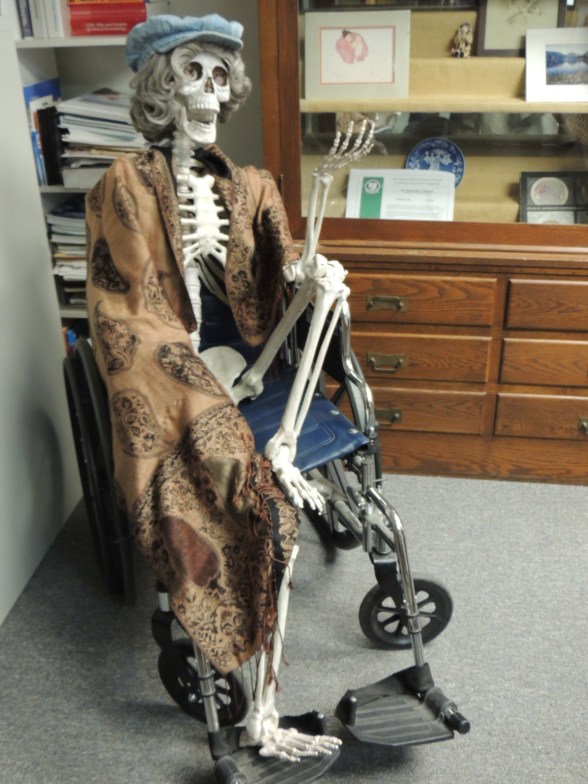
Mordechai, our clinic skeleton, had such a wonderful time out at dinner last month. As you can see, she is still conversing about it. We’ll have to take her out more.

For the Daily Prompt: inchoate. I’m not sure quite how inchoate relates to this. My ideas are unformed. Where to take Mordechai next?

Causes of death: which does your doctor treat?

What is the number one cause of death in the United States? The heart. You know that.

You might know the number two: all the cancer deaths put together.

Number three is lower respiratory disease: mostly caused by tobacco.

Number four. Can you guess? Number four is accidents. Unintentional deaths. In 2012 number four was stroke, but unintentional deaths have moved up the list, here: https://www.cdc.gov/nchs/fastats/deaths.htm. The CDC tracks unintentional deaths, here: https://www.cdc.gov/nchs/fastats/accidental-injury.htm. And what is the number one cause of unintentional death right now? It is not gun accidents. It is not car wrecks. It is not falls. It is unintentional overdose: usually opioids, legal or illegal, often combined with other sedating medicines or alcohol. Alcohol, sleep medicines, benzodiazepines, some muscle relaxants. No suicide note. Not on purpose. Or we don’t know if it is on purpose….

And does your physician try to prevent accidental death? Do they talk to you about seatbelts, about wearing bicycle helmets, about smoke alarms, about falls in the elderly, about domestic violence, about locking up guns? About not driving when under the influence? Do they talk about addiction and do they treat addiction?I think that every primary care physician should treat the top ten causes of death. I am a family medicine physician and I try to work with any age, any person. I treat addiction as well as chronic pain. I have always tried to talk about the risk of opiates when I prescribe them. I treat addictions including alcoholism, methamphetamines, cocaine, tobacco and opioids. Legal, illegal and iv opioids, from oxcodone and hydrocodone to heroin. That doesn’t mean I can safely treat every patient outpatient. People with multi drug addiction, or complex mental health with addiction, or severe withdrawal must be treated inpatient. But I have taken the buprenorphine training to get my second DEA number to learn how to safely treat opiate overuse. I took the course in 2011. I was the only physician in my county of 27,000 people who was a prescriber for two years. Now we have more, but still the vast majority of physicians in the United States have not taken the training even when it is offered free.

I don’t understand why more physicians, primary care doctors, are NOT taking the buprenorphine and recognition and treatment of opiate overuse course. Most are not trained. Why not take the training? Even if they are not prescribers, they will be much better informed for the options for patients. People are dying from opioids daily. Physicians have a DEA number to prescribe controlled substances: I think that every physician who prescribes opioids also has a duty and obligation to train to recognized and intervene and be informed about treating opioid overuse.

A large clinic group in Portland, Oregon made the decision last year that every primary care provider was required to train in buprenorphine. One provider disagreed and chose to leave. However, everyone else is now trained.

We as a country and as physicians need to get past fear, past stigma, past discrimination and past our fixed ideas and step up to take care of patients. If a physician treats alcoholism as part of primary care, they should also be knowledgeable and trained in treatment of opiate overuse.

Ask YOUR physician and YOUR local clinics: Do the providers prescribe opiates? Are their providers trained in preventing, recognizing and treating opiate addiction? Do they treat opiate overuse? Do they understand how buprenorphine can save lives and return people to work and to their families? Are they part of the solution?

For the Daily Prompt: provoke.

Reducing recidivism: Snohomish County Sheriff’s Office and Human Services Program

The last two days have been at the 20th Annual Fundamentals of Addiction Medicine Conference in Washington State, 15 lectures. Everything from science trying to understand addiction via studying dopamine in ratbrains to the last presentation: Snohomish County started a program two years ago that pairs a social worker with a county sheriff or deputy to work with the homeless.

The county is trying to stop the revolving door of homeless to arrested to jail to homeless. 95% of the county homeless are addicted to heroin and some to methamphetamines. They don’t access services when they are “dope sick”. They describe heroin as being 10x worse than the worst influenza. I think of withdrawal from opioids as having all the pain receptors turned as high as they can go and screaming at once.

The sheriff and social worker go to the camps. They get to know people and offer services. They have helped over 100 people get their identification replaced. When someone is arrested, their homeless encampment is often stolen. No honor among thieves, you say? The rat studies address that: in addiction the brain puts the drug first, in front of food, water, sex. Some rats will access the drug until they die, just like people. I think of it as the person losing their boundaries to the drug. The conference used the phrase “incentive salience” — dopamine is released when the person or rat is cued that the drug is now available and again when the drug arrives. More on that in another write up.

At any rate, the clients do not get to appointments. So the deputy and social work start at the beginning: they make the appointment, go knock on the tent that morning, remind the person to get dressed, take them to get food and coffee and then take them to the appointment. Then they return them to their camp.

After two months, the first sheriff and social worker were so successful that the program was expanded.

They have 206 chemical dependency evaluations.
232 have gone to detox. The detox is 3-5 days. They are taken straight from there to inpatient treatment, 30 day minimum, but ranging from 30-90 days. After treatment, clients are taken straight to sober housing, with a 6 month supported stay and intensive outpatient treatment.
85% get through the detox.
59% graduate from the treatment
50% go on to sober housing and intensive outpatient.
Their first clean and sober client is two years out.

50% of the homeless who agree to the program getting to sober housing is huge. Recidivism and incarceration drop, so it is making a true difference.

The program is expanding. They have a Community Court set up, much like Juvenile Drug Court, modeled after a program in Spokane. If the person agrees to drug treatment, they can do that instead of jail. This is for minor offenders. The sheriff says that once the homeless person is incarcerated, everything is stolen. They then steal food and supplies for a new camp when released and it happens again. If the client completes the program, low level charges may be dropped. They are setting up a service center right by the court where the clients are sent immediately to talk to a chemical dependency person, to get medical treatment, dental emergencies, centralized services because these people do not have transportation.

The social worker is in kevlar and heavy clothes as well and is never to go in the encampments without the law enforcement officers: it’s usually private land so it would be trespassing anyway.

This was an absolutely inspiring presentation. It starts with outreach and intervention, and gives people choices. They will soon be opening a temporary site, up to 15 days with medical support and beds, for when a client is ready but the social worker needs to arrange the detox, the treatment, the housing. Sometimes when a client is finally ready, there are no beds. And they don’t want to send them to detox and then back to the streets. The sheriff says that he was “volutold” for the program, but he, the deputy and the social worker are all clearly inspired by the program and enjoy their work and that it is making a difference.


Any write up on addiction fits today’s Daily Prompt: messy.