Where oh where is love?

How could we have love without grief?

The US culture seems to suppress grief, take grief away, heal grief, get over grief, but think about love without grief.

Could we love someone if we didn’t grieve when they died?

No. We couldn’t. That wouldn’t be love. Or that would be the pale shadow of love, love without loss, love that turned from the grave and forgot.

We cannot love without grief, so we need to make room for grief. We need to stand by each other during grief. We need to help each other, be present, be there, say the wrong thing, say the right thing, say nothing and just give love.

Love builds the Taj Mahal. Love writes Rumi’s poems. Love is the memories of the person we loved, we tell our children about them, we hold them in our hearts.

Love loves without logic, without sense. Love in spite of alcohol, addiction, lies, how can a person love an abuser? They love the person, not the abuse. They love the person, not the actions, not when the alcohol takes over, when the meth takes over, when the oxycontin takes over. Love loves the whole person and grieves the damage.

Love and grief are intertwined, a rosebush with thorns, there is no one without the other. No joy without despair, no light without dark, no you without me, no joining without separation.

I enter grief as I enter love, whole heartedly, oh, I may be afraid of the dark but I go there anyhow, I know as the waves close over my head and I sink into the depths:

There is no love without grief.


The picture is my mother, Helen Burling Ottaway, in high school. She died of cancer in 2000 and I still miss her terribly.

Songs to raise girls: Long Black Veil


This and The Fox are what I think of as the two core family songs. We sang this from as early as I can remember and my father played the Band’s version on the record player all the time. I taped his records to take to college…

This is the song my parents chose to raise girls on? Oh, and I do have it memorized….

Ten years ago on a cool dark night
There was someone killed ‘neath the town hall light
There were few at the scene and they all did agree
That the man who ran looked a lot like me

Ok, it starts with a murder. Someone is killed, in the town, at night. Be careful, little girls, bad things can happen at night.

The judge said “Son, what is your alibi?
If you were somewhere else then you won’t have to die”
I spoke not a word although it meant my life
I had been in the arms of my best friend’s wife

It is about infidelity and not only infidelity, but infidelity with his best friend’s wife. This song is a morality play. He doesn’t speak. I see the magazines at the counters in the grocery store and think about how different this song is from our current culture. Divorce and splashed all over the papers, that’s what the celebrities do today.

She walks these hills in a long black veil
She visits my grave where the night winds wail
Nobody knows, no, and nobody sees
Nobody knows but me

So she doesn’t speak either. She remains faithful to him in visiting his grave, but the marriage must continue, because she only goes at night.

The scaffold was high and eternity neared
She stood in the crowd and shed not a tear
But sometimes at night when the cold wind moans
In a long black veil she cries over my bones

She watches him die for what they considered a sin. This song is about ethics, really. The two of them had broken their code of honor and paid the price, which was that he died for a different crime. And did the man who really killed the person in the first stanza then go free?

Why wouldn’t they speak up? Perhaps she had children and he couldn’t support them. Perhaps they truly considered it a sin, a dishonor, a horrible mistake. Perhaps honor and honoring his best friend was more important than love…. Our current culture seems to think that love conquers all, but it doesn’t in this song. Did they do the right thing? This is a song to discuss and to think about and yes, a song to raise girls.

Though I think the husband and any children would know that there was something…. a parent and partner can’t really hide that deep sorrow….

It was written by Danny Dill and Marijohn Wilkin in 1959 and originally recorded by Lefty Frizzell.

Lefty Frizzell: [https://www.youtube.com/watch?v=50k18gL76AU]

The Band, 1968

Johnny Cash, 1968

Lots of others…. and us.

The photo is me and my sister, probably in 1993 or 1994.


Songs to raise girls: Pack up your sorrows

This song interests me. It is the fourth in my series about the songs that my sister and I learned growing up.

When we recorded our family songs, my sister said she liked it. I said, I think it is creepy, with that juxtaposition of a sweet tune and then words that are not so sweet.

No use cryin’
Talking to a stranger
Namin’ the sorrows you’ve seen

Oh, ’cause there are
Too many bad times
Too many sad times
Nobody knows what you mean

If somehow
You could pack up your sorrows
And give them all to me

You would lose them
I know how to use them
Give them all to me

The line that bothered me was “I know how to use them”. What does that mean? Use them for what?

No use ramblin’
Walkin’ in the shadows
Trailin’ a wanderin’ star

No one beside you
No one to hide you
An’ nobody knows where you are

Ah, if somehow
You could pack up your sorrows
And give them all to me

You would lose them
I know how to use them
Give them all to me

And how could you give your sorrows to someone else? The singer is offering to listen to sorrows but also take them away. “You would lose them.” And then the singer “knows how to use them”.

No use roamin’
Walking by the roadside
Seekin’ a satisfied mind

Ah, ’cause there are
Too many highways
Too many byways
Nobody’s walkin’ behind

Ah, if somehow
You could pack up your sorrows
And give them all to me

You would lose them
I know how to use them
Give them all to me

I never got around to asking my sister if it was the tune she liked or the words or what it meant to her. I chose to play that recording at her Washington memorial. I could not go to her California memorial because I was too ill. My father had terrible emphysema and was on oxygen. I thought I had pertussis but it turned out to be systemic strep A, which hurts. At any rate, I was too sick to travel. Her Washington Memorial was a month or two later, when I was well enough to organize it…..

You would lose them
I know how to use them
Give them all to me

It is by Pauline Baez. The version by Richard and Mimi Farina is the one I’m familiar with, so my parents probably had the record:  https://www.youtube.com/watch?v=U4LbU8w7Th4.

Joan Baez, Pauline and Mimi Farina were sisters. Joan Baez recorded it https://www.youtube.com/watch?v=NAMe1bRW8Ao. So did Peter, Paul and Mary: https://www.youtube.com/watch?v=IVxNleqVpx4.

And so did Johnny Cash and June Carter: https://www.youtube.com/watch?v=_ctVhDEuTYE

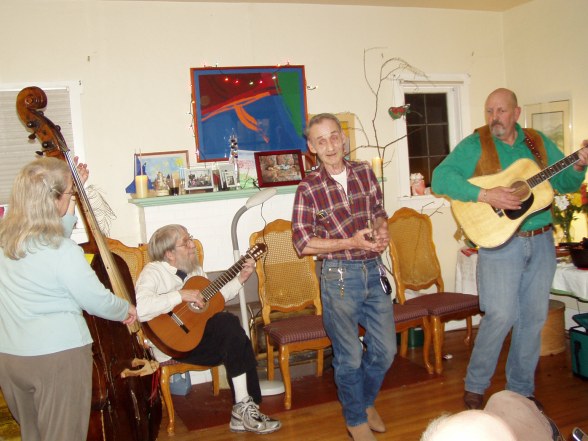
The picture is a music party at my house in 2009, my father seated and Andy Makie on harmonica, Jack Reid standing with the guitar.

Songs to raise girls: Dark as a Dungeon

We sang Dark as a Dungeon as a family song and at singing parties from when my sister and I were very little. We learned many of the songs before we knew what the words meant. At some age I considered this a cautionary song and was glad that my father was not mining coal. I also decided that I didn’t want to mine coal.

It was written by Merle Travis, whose father was a miner in an Appalachian shaft mine: https://www.youtube.com/watch?v=-FPmSLzsbdM&list=RD-FPmSLzsbdM#t=1. Johnny Cash sang it: and Willie Nelson: https://www.youtube.com/watch?v=nKGCKwACj1I and Willie Nelson https://www.youtube.com/watch?v=s66nbyzqq8o. It became a protest song, to fight for safer conditions. We learned this and Drill ye Terriers, Drill and Sixteen Tons, so we were raised on protest songs.

The song words have morphed a little, since we sang from memory. Here is our version:

Come all ye young fellows so young and so fine
And seek not your fortune in the dark, dreary mines
It will form as a habit and seep in your soul
‘Til the stream of your blood runs as black as the coal

Where it’s dark as a dungeon and damp as the dew
Where the danger is double and the pleasures are few
Where the rain never falls and the sun never shines
It’s dark as a dungeon way down in the mines

I wrote an essay in college about a song that I learned from my mother. I researched versions of Green Grow the Rushes Oh. I had always wondered about some of the verses, because it’s a counting song, from one to 12. Twelve for the twelve apostles and eleven for the eleven that went up to heaven. In an atheist household it takes a while to figure out the meaning of apostle. But other verses are mysterious to this day: nine for the nine Bright Shiners and eight for the April Rainers. In oral traditions if you forget a verse you make up a new one.

There’s many a man that I have seen in my day
Who lived just to labor his whole life away
Like a fiend with his dope and a drunkard his wine
A man will have lust for the lure of the mine

The comparison of  mining to addiction impressed me: “it will creep in your soul, til the stream of your blood runs as dark as the coal”. “Like a fiend with his dope” — opiate addicts were called fiends. And people were called drunkards. So this song also made me cautious about both drugs and alcohol.

We didn’t learn the third verse:

The midnight, the morning, or the middle of the day
It’s the same to the miner who labors away
Where the demons of the death often come by surprise
One fall of the slate and you are buried alive

The last verse interested me. I liked the idea of bones turning to coal over time. My parents were atheists and did not go to church, but there were lots of songs that talked about God or heaven or the devil: including sacred music. We went to big chorus rehearsals when my parents couldn’t find a sitter and we were expected to behave politely during concerts: The Messiah. And we got to go to operettas. I saw Ruddigore in Ithaca at Cornell when I was 5 and the ancestral ghosts stepping out of their portraits and singing was terrible and wonderful.

I hope when I’m gone and the ages shall roll
My body will blacken and turn into coal
Then I’ll look out the door of my heavenly home
And I’ll pity the miners A-diggin’ my bones

The photo is my father’s family and he is in the back, first trumpet. This is the Bayers Family Orchestra. My great grandfather is conducting, my grandmother on violin and my grandfather on saxophone. They became a band when my grandparents moved away, because my grandmother was the only string player.

Call

For RonovanWrites weekly haiku challenge #67.

The words are cheer and call.

Calling brings up my sister, calling her and waiting for her to call back. She died in 2012 of cancer. Grief, not cheer.

Cheer and call

cheer and call. I re
member dismember memo
ry no cheer or call

The photo is the Mount Saint Helen’s crater in 2012, with the recovering area below starting to be green again.

Headache without words

When I was in residency, a staff member brought a young man to see me.

The young man couldn’t talk. He could make some sounds. His head was a funny shape, asymmetric. His mother had rubella during her pregnancy: German measles.

“His head hurts.” said the group home staff member.

“How do you know?” I asked.

“He isn’t acting right. There is something wrong. He’s different.”

“How long?”

“About a week or ten days.”

“Did he fall?”

“We’ve talked about that but we don’t think so.”

I tell the young man what I am going to do before each part of the exam. I look in his ears carefully. His ear canals are odd too and I can’t see well. His exam is basically pretty normal for him. He is not running a fever. He doesn’t have a stiff neck. He doesn’t seem to have nasal congestion.

“If he hit his head, he could have a subdural, a bleed pressing on his brain.”

The staff member shakes their head.

“Ok. I can treat him for an ear infection, though I can’t see that well. If that doesn’t work, we will have to image his head. Would he stay still in a CT scanner?”

“No.” says the staff member.

“Then I would have to set it up with anesthesia. Which is difficult.”

So we treated him for an ear infection. No improvement. He returned. Exam unchanged. The staff was still sure his head hurt. I had never seen him before the initial visit, so I couldn’t tell.

I set up the CT scan with anesthesia. Twice, because they mucked it up the first time and it wasn’t coordinated right. I had to explain to multiple people on both anesthesia and radiology what and why I was doing it. “His head hurts and he can’t talk?” I argued until they gave in.

The ENT chief resident called me with the results. Not radiology. “What?” I said.

“It’s the biggest pseudocyst we’ve ever seen!” said the ENT chief. Surgeon. “He needs surgery!” His voice said “Cool!”

In residency I’d noticed a striking difference between family practice and other residency folks: internal medicine, surgery, neurology, all the subspecialties. They got excited when there was something rare or weird. I always thought, oh, shit, my poor patient.

“What is a pseudocyst?” I actually didn’t ask, because they knew I was just a lowly family practice resident and would probably not have heard of a pseudocyst. A cyst like structure can form of snot in the sinuses and can cause headaches. It can erode through the bone into the brain. His hadn’t, thank goodness, because that can be bad. Bad as in lethal.

Because of the measles, he had some of the largest sinuses ENT had seen ever, and the largest pseudocyst. ENT happily took him off to surgery. Great case.

I got to see him in follow up. He was his normal self. His group home staff member was delighted. “He’s back to normal! Thank you so much!”

But it’s the group home staff that noticed and cared and brought him in. “Thank you for bringing him in,” I said, “I would not have noticed. And some people wouldn’t have cared.”

Differentiating pseudocysts and other things: http://www.oapublishinglondon.com/article/1266

More on pseudocysts: http://www.ncbi.nlm.nih.gov/pubmed/6595617

Pseudocyst images: https://www.google.com/search?q=maxillary+sinus+pseudocyst&biw=1366&bih=634&source=lnms&tbm=isch&sa=X&ved=0CAcQ_AUoAWoVChMIoZzWwv_QyAIVUJuICh248gGC

Rubella in pregnancy: http://www.marchofdimes.org/complications/rubella-and-pregnancy.aspx

Rubella, aka German measles: http://www.mayoclinic.org/diseases-conditions/rubella/basics/definition/con-20020067


Full lunar eclipse

Long long ago, when the universe was forming, the Moon fell in love with the Sun.

The Moon was afraid that the Sun wouldn’t see her, because the Sun was so bright. Slowly she pulled herself together. After careful thought, she chose to orbit the Earth.

Now it is another full lunar eclipse. Her face reflects the Sun’s glory back to him. She slides behind the Earth in a three hour version of her usual cycle, from full to only her own light back to full.

“Where are you, Moon?” bellows the Sun. He hates these quick disappearances. He yells and bellows and tantrums. But the Moon knows that he will forget quickly and that he has not bothered to learn and predict her cycles. He doesn’t like to be reminded of loss and endings and death.

The Sun likes it best when he has her full glory, face reflected back to him. He doesn’t see her light. Each month she moves from reflecting his light towards her quiet time when it is only her light that is visible from Earth. She needs this time to remember that she has her own light, even if it is a shadow compared with the sun.

“You should orbit me!” says the Sun, but the Moon knows that if she orbited him she would be burned and barren and dead, no rest and no light of her own. One night a month the Moon remembers who she is and is alone. She lets her quiet darkness shine. The Earth whispers, “Why do you love the Sun so? Don’t cry, Sister.” The Earth’s salt water tides move like tears.

Sometimes the Moon longs for ending, but she remembers: all love, returned or not, is longing and praise for the Beloved. Maybe she will not be loved or seen as she longs to be in this life, but she too will return to the Beloved and be One. And after her time in the dark she slowly returns to reflecting the Sun.

And the Sun loves her in his way. He loves to watch his reflection grow on her face each month, preens in it, until she is full. He is more irritable in the second half, as she turns her face away again. She wishes that he would look past his own light and see her.

Now the little eclipse is ending and she is rapidly becoming full again. The Sun is cheering up.

“It’s silly of you to hide your face.” says the Sun, fondly.

The moon does not smile. The Sun sees his own smile reflected in her face.


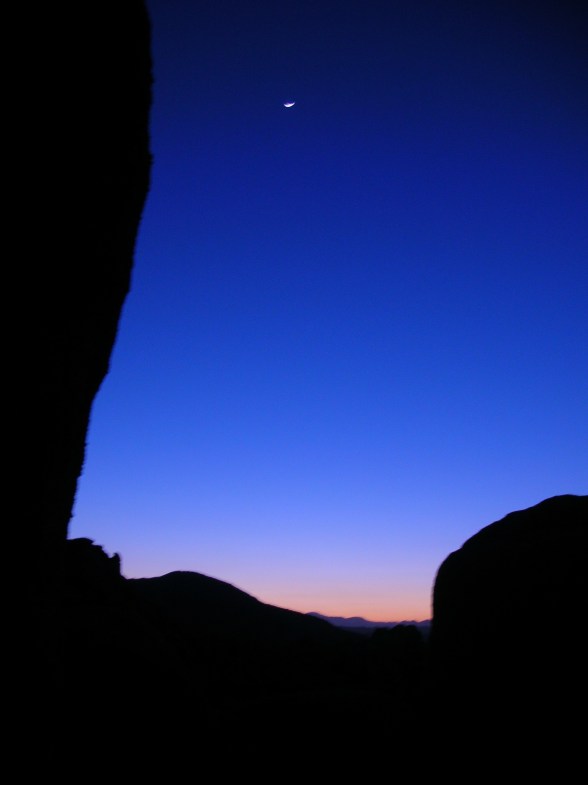
I took the photo in 2009 at Joshua Tree.

Moon song

Another poem that I adored as a child and still do is Moon Song by Mildred Plew Meigs.

Moon song

Zoon, zoon, cuddle and croon–
Over the crinkling sea,
The moon man flings him a silvered net
Fashioned of moonbeams three.

And some folk say when the net lies long
And the midnight hour is ripe;
The moon man fishes for some old song
That fell from a sailor’s pipe.

And some folk say that he fishes the bars
Down where the dead ships lie,
Looking for lost little baby stars
That slid from the slippery sky.

And the waves roll out and the waves roll in
And the nodding night wind blows,
But why the moon man fishes the sea
Only the moon man knows.

This poem is the mystery of the moon and of the moon’s light path on the sea. With any little waves the moon path looks like a net. And again, this is a poem that plays with the sound of the words and the rhymes with moon and sea and waves and water, fashioned into beauty….

Zoon, zoon, net of the moon
Rides on the wrinkling sea;
Bright is the fret and shining wet,
Fashioned of moonbeams three.

And some folk say when the great net gleams
And the waves are dusky blue,
The moon man fishes for two little dreams
He lost when the world was new.

And some folk say in the late night hours,
While the long fin-shadows slide,
The moon man fishes for cold sea flowers
Under the tumbling tide.

And the waves roll out and the waves roll in
And the gray gulls dip and doze,
But why the moon man fishes the sea
Only the moon man knows.

At church two weeks ago our minister talked about people standing on the shore at night under the moon. Each person sees the moon path leading right towards them and the people on either side appear to be in shadow and the moon path does not appear to lead to them. This is a Unitarian Church and he was talking about the idea of the sacred and about fundamentalism: maybe it is all moon paths. Each group is seeing a clear path to the sacred and wonders why the others are standing in the dark.

Zoon, zoon, cuddle and croon–
Over the crinkling sea,
The moon man flings him a silvered net
Fashioned of moonbeams three.

And some folk say that he follows the flecks
Down where the last light flows,
Fishing for two round gold-rimmed “specs”
That blew from his button-like nose.

And some folk say while the salt sea foams
And the silver net lines snare,
The moon man fishes for carven combs
That float from the mermaids’ hair.

And the waves roll out and the waves roll in
And the nodding night wind blows,
But why the moon man fishes the sea
Only the moon man knows.

We had the Golden Book of poetry and I also loved the illustration by Gertrude Eliot that went with it. Little mermaids, combs floating from their hair, the moon and his gold spectacles in the depths….

My sister and I both loved this poem and both meant to memorize it. I haven’t yet.

Grieve

For Ronovan’s Weekly Haiku Challenge #66, 2 of the 3 numbers of the beast. The words are pine and grief.

pine, supine, repine
grief, thief, disbelief is chief
rewind, rest mind, find

I suppose the image could be a pine. But this is a picture I took from the Synchronized Swimming Nationals in 2012. Water can be tears, right? Sometimes we are immersed before we can be lifted out…..

Tickle me, dear

One of my favorite halloween and nonsense poems ever is The Lugubrious Whing-Whang by James Whitcomb Riley.

I don’t remember the first two stanzas very well. I think that someone, my mother, my father or my maternal grandfather, would read it to me starting with the third stanza. I loved the sounds and the mystery of the rhymes from very young. When we are very young, many words are mysterious. At some point I gathered that the Whing-Whang was a monster and was imaginary, but to a small child it’s hard to tell what is real and what is not. And then there is Santa Claus and the tooth fairy and the Great Pumpkin and religion and what is one to believe?

The rhyme o’ The Raggedy Man’s ‘at’s best
Is Tickle me, Love, in these Lonesome Ribs,–
‘Cause that-un’s the strangest of all o’ the rest,
An’ the worst to learn, an’ the last one guessed,
An’ the funniest one, an’ the foolishest.–
Tickle me, Love, in these Lonesome Ribs!

I don’t know what in the world it means–
Tickle me, Love, in these Lonesome Ribs!–
An’ nen when I _tell_ him I don’t, he leans
Like he was a-grindin’ on some machines
An’ says: Ef I _don’t_, w’y, I don’t know _beans!_
Tickle me, Love, in these Lonesome Ribs!–

Out on the margin of Moonshine Land,
Tickle me, Love, in these Lonesome Ribs!
Out where the Whing-Whang loves to stand,
Writing his name with his tail in the sand,
And swiping it out with his oogerish hand;
Tickle me, Love, in these Lonesome Ribs!

Is it the gibber of Gungs or Keeks?
Tickle me, Love, in these Lonesome Ribs!
Or what _is_ the sound that the Whing-Whang seeks?–
Crouching low by the winding creeks
And holding his breath for weeks and weeks!
Tickle me, Love, in these Lonesome Ribs!

Aroint him the wraithest of wraithly things!
Tickle me, Love, in these Lonesome Ribs!
‘Tis a fair Whing-Whangess, with phosphor rings
And bridal-jewels of fangs and stings;
And she sits and as sadly and softly sings
As the mildewed whir of her own dead wings,–
Tickle me, Dear,
Tickle me here,
Tickle me, Love, in these Lonesome Ribs!

I love the idea of lonesome ribs, longing to be tickled. And the Whing-Whang is a monster or something lonely and frightening, but he too longs for love, even with fangs and stings. He longs for a monster to love him, even with mildewed and dead wings. Aren’t we all afraid that we are monsters and that we cannot be truly loved?

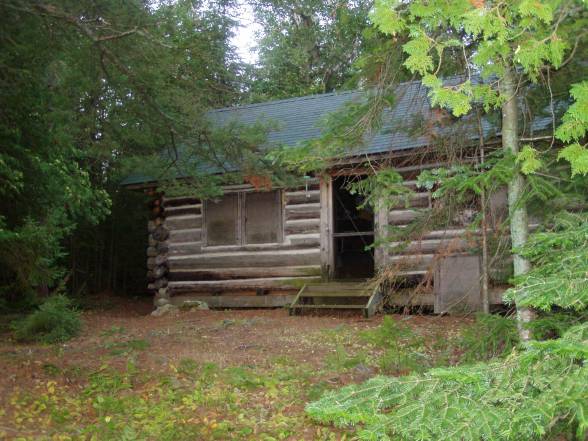
I took the photo in 2006, our family summer cabin from the early 1940s in Ontario, Canada.
Also published on everything2.com.