Peace Plague

If I can be anything I want to be
today let me be a peace plague.

Let me be a peace plague, airborne,
spread fast in the air
just a breath of wind
two neighbors who are angry stand at a fence
one drops a rake, the other a hose
they stare at each other. “Come to tea,”
says one, and the other comes.
Someone stops writing a letter of complaint
and gathers blankets for the warming center instead.
A policeman aims at a kid with a gun
shouts “Freeze.” and then he freezes too
on an intaken breath, and the kid drops the gun
hands up, breathing my plague.
And in a war zone, one side chokes on the air
and stops firing. The other aims and stops as well.
Both fall to their knees and weep. After time,
some get up and start gathering the wounded. Others
tear sheets into bandages and yet others start moving the rubble
finding the bodies. The bodies must be found and buried
in holy ground before rebuilding. My cousin
opens her mouth to gossip again and inhales and chokes
and stops. She says something other than she had planned.
Peace spreads like a wave, like a plague, and everyone
looks for someone to help.

If I can be anything I want to be
today I want to be a plague of peace.

Elder Care: Goals

I really enjoy elder care in Family Medicine. Mostly. Even some of the very difficult or very complicated people.

One thing I would try to figure out is what is the person’s goal? This can be quite funny at times.

“Can we talk about what you would want if you got really sick? If you were too sick to talk to us?”

“I don’t want to talk about death.” Ok, this person is in their 90s.

“That is fine, but if we don’t talk about it, your daughter and I have to guess what you want. And we tend to do more when we don’t know.”

That person glares at me. “Oh, all right.”

Sometimes a person says, “I don’t want to die of cancer.”

It turns out that this is an opening. “Ok, what DO you want to die of?”

“I don’t want to die!”

“Well, me either, but I can’t fix that. There are at least three “ideal” deaths that the Veterans Administration talks to people about. Maybe we could go over them. You could put your request in with your higher power.” I have written about the three here: https://drkottaway.com/2023/10/06/an-ideal-death/. The “Hallmark” or hospice death, sudden death and fight it all the way.

But, other than not dying, what is the goal? To stay in one’s home? To move to a retirement organization that has a nursing home and care until death? Home care insurance to stay home? I do have people imply that they will go into the woods or crash their car or something if they get very sick, but not very often. They are usually aware that I have to respond to any suicide threat. How much care do they want? People often say, “I wouldn’t want to be disabled,” but it turns out that life is often worth living even when very challenging. Most people want to be treated for cancer, for heart disease, for congestive heart failure, to go on.

Sometimes death comes from a cumulative load of chronic problems. We had a gentleman in his 80s in the hospital ICU many years ago. He had pneumonia, congestive heart failure and bad kidneys as well as a host of other problems. I sat down with him. “We are treating you, but when we give you enough medicine to help you breathe, your kidneys are getting worse. This is a small rural hospital. I could transfer you to the Seattle hospital, 2 hours away. You would have a cardiologist, a kidney doctor, a lung doctor. Here you just have me and the nurses. Either way, I do not know if you will live through this. What do you want to do?”

He chose to stay. “My family can visit me here.” His family was visiting daily. “I do not want a breathing tube. I do not want dialysis. If my kidneys go, let me go.” We discussed this with the family.

Four days later it was clear that without dialysis, he was dying. Dialysis might have slowed it, but he may still have died. He was no longer waking up. We withdrew the antibiotics and removed most of the monitoring and switched him to hospice. His family continued to visit and he died a few days later.

He did die in the hospital, and yes, we used some machines up until care was withdrawn, but this still seems like he got to make choices and his family understood. It can be much harder with memory loss when the person really can’t make choices any more.

He was complicated. To keep him breathing well without a machine, we had to give him diuretics, that were eventually too much for his kidneys. A bad heart, lungs with emphysema and pneumonia, and bad kidneys. Sometimes the liver is not working either, and then what is there left to work with? Nearly all drugs are broken down by either the liver or kidneys. Simethicone is not absorbed, so that’s the exception.

Sometimes people get along until too many things accumulate and then they end up in the hospital and on multiple new medicines. It can be very confusing. Regular maintenance is a good idea.

Sometimes the family wants something different from the patient. Or there is an elder parent and three adult children, who all disagree. My job is advocate for the patient. But this is Family Medicine, so I have a responsibility to the patient but also to the family. The person, the family, the community, how is it all fitting together? Sometimes functional, sometimes not.

I had one person who called me when he had been flown to a Seattle hospital. “I have to get home.” he says, “Can you release me? I have to take care of my wife!” I panicked for a moment. “Is your wife bedridden? Where is she? Why are you in the hospital?” She was not bedridden and she was fine. He was being more and more behaviorally squirrelly. He could no longer drive, but drove anyhow. His wife disabled the car, because he would disappear. I sent him to a neurologist for memory testing. The neurologist said, “Hmmm.” and sent him for neuropsych testing. The neuropsych report said dryly that his memory was fine, but he had certain long standing behaviors related to past heavy alcohol use. Oh. He was quite proud of not drinking and going to AA, but he also triangulated with his family and me. I sat him down and said, “Ok, I am not going to talk to a different one of your five children every time you see me in the clinic, because you’ve said, “Don’t tell mom I called you.” Pick ONE person for me to talk to and now you have to have a family member with you when you come to clinic.” He grinned and chose his wife. He had certainly fooled me about his memory, because he blamed his behavior on his memory. The neurologist was not quite fooled. The family calmed down and he did not drive any more, thank goodness. He was not an easy patient, but he was entertaining and educational too. And I felt that I had helped both him and the family.

Sometimes families fight. Sometimes a dysfunctional family will get way worse when someone is sick or dies. Sometimes families go on fighting. Other families are so kind and so good to each other and their elders. Every family is different.

For the Ragtag Daily Prompt: concentration.

Elder care: stairs

Most of us do NOT live in homes practical for aging. My house has four steps in the front and five in the back to get in and out. The main floor has almost everything needed if I cannot climb a flight of stairs: only the laundry is in the basement.

I am helping a friend in her 80s. The issue, from my practical and pragmatic Family Medicine standpoint, is that she is falling. She told me that she was falling, five times in a day, in November. I got involved right away, because she had a surgery canceled because of it. She has three specialists and a primary. I called them all and took her to the emergency room first and then to her primary.

We asked her primary for disabled parking and for home health services. In Washington State, if you can’t leave your house except to the store or the doctor, you qualify for home health. I also fussed about her blood pressure, but her primary thought she was fine.

The thing is, we should not always have a blood pressure goal of 130 or less systolic once we hit 75 or 80. With weight loss, people can drop a blood pressure point for each 2 pounds lost. The blood pressure range that is safer at age 75 or 80 is to keep it around 140-150, unless the person has heart disease or congestive heart failure. Over 150 is getting too high. The brain must get good oxygen by blood flow and if it doesn’t, there are sensors in our neck that make us faint. That can be a full on loss of consciousness, or just a decrease and drop to the floor. There are some instances where the blood pressure still needs to be kept down at 125-130 systolic: bad coronary artery disease and congestive heart failure especially. But being able to stand up and walk is rather important to elder health.

The distraction for my friend’s physicians is that she has had cancer for three years. We are told that she needs an MRI of her head to rule out brain tumors, metastases from her cancer. Yes, brain tumors can cause falls, so that does need to be ruled out. My friend only falls when standing, sometimes at the counter, gets lightheaded and once has had a full on syncope. No chest pain or heart racing.

It took two months to get the brain MRI, which is negative. We saw her oncologist this week and I pushed for her cardiologist to see her sooner than June. He saw her yesterday. She is on medicine for a heart arrhythmia, but it doesn’t sound like her arrhythmia is acting up. He’s still checking: a monitor and heart ultrasound, but meanwhile he says, “I don’t tell many people this, but you need to drink more fluid and eat more salt.”

“They told me low salt. I stopped salt when I cook.”

“Start salt again and more fluid and return in 3 weeks.” She has been falling 1-5 times a day in her home. She lives alone. She is stubbornly resisting leaving her home and I am ok with that. But, it would be most helpful for her health if she was not falling. That is the priority here. She will not live forever, but she wants to stay in her home. Let’s help with that.

I am NOT saying that everyone over 75 should increase salt. If a person has bad hypertension, or heart disease, or congestive heart failure, they should not increase salt unless their doctor has a specific reason. And heart is the number one killer, so there are lots of people who should continue to eat a low salt diet. But falling and breaking a hip is also a killer.

My friend has three steps to get out of her house. The first day last week that I took her to get labs, she fell three times. “But Jim, I’m a doctor, not a nurse!” Ok, I am not a good nurse. However, we got her back inside after labs and getting the CT scan contrast for her to drink. She has not fallen when I have gotten her in or out since. I’ve had to enlist help twice, since she’s taller than me. Going down the steps is worse than going up. Home health is doing physical therapy and she has a raised seat on her commode. That is good, except those are the muscles that help us go up and down stairs. She has a walker too. She is still falling, because to cook, one has to let go of the walker, right?

So if someone wants to stay at home, think about the home. Are there steps? How strong is the person? Do they have the resources to pay for around the clock care if they become bedridden? I am practicing getting down on the floor and back up every single day, because I want to be strong. I have an upstairs and a basement, and I am going to continue with stairs for as long as possible. If I break my leg, those four front stairs are going to be an issue, but I am thinking about it. Perhaps I should design a decorative ramp, or a sloping earth entry.

Will the house accomodate a wheelchair? Is there a bathroom and a bedroom, as well as the kitchen, on the main floor? Is there clutter? I know I am supposed to keep the floors clear to reduce fall risk. I had one person who kept falling at night because he wouldn’t turn on a light. “It would wake my wife and disturb her,” he said. “It will disturb her more if you break your hip.” I said. “Turn on a light or a flashlight or something.”

Harvard Medicine agrees: https://www.health.harvard.edu/staying-healthy/master-the-stairs

Be careful out there. Or maybe in there.

For the Ragtag Daily Prompt: Elder care can’t be laissez-faire.

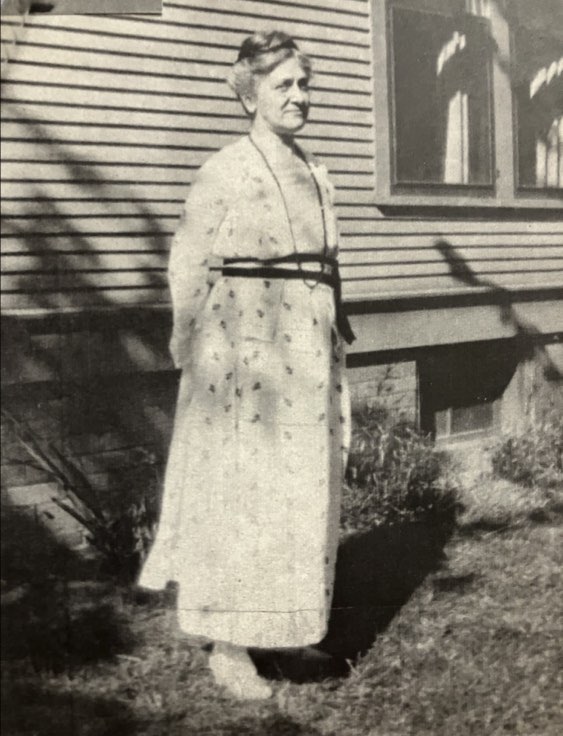
The photograph is not my friend. This is Tessie Temple, my maternal grandfather’s mother. I do not have a date nor who took the photograph. Another photograph is stamped on the back: Battle Creek. She must have gone to one of the famous sanatoriums, like Kellogg’s, for rest or the cures.