What to check before bringing your elder home from the hospital

I get a call from the hospital (this is over a year ago). They say, “Your friend is ready for discharge. What time can you pick her up?”

I reply, “Can she walk?”

“What?”

“She has three steps up into her house. Can she walk, because otherwise I can’t get her into her home.”

“Oh, uh, we will check.”

They call me back. “She can’t walk. She’ll have to stay another day.”

I knew that she couldn’t walk before they called. She could barely walk before the surgery and after anesthesia, surgery and a night in the hospital, her walking was worse. She had been falling 1-5 times at home and the surgeon knew that. He did not take it into account. The staff would have delivered her to my car in a wheelchair and then it would have been my problem.

She was confused by that afternoon, which is not uncommon in older people after anesthesia. She stayed in the hospital for six days and then went to rehab, because she still couldn’t walk safely.

Recently I have a patient, an elder, that I send to the emergency room for possible admission. He is admitted and discharged after two and a half days. Unfortunately he can barely walk and his wife is sick as well. The medicare rules say that he needs 72 hours in the hospital before he qualifies for rehab. We scramble in clinic to get them Home Health services, with a nurse check and physical therapy and occupational therapy, and I ask for Meals on Wheels. It turns out that Meals on Wheels will be able to deliver in two months.

The wife refuses to go to the emergency room. I tell her that if she does get sicker, that they both need to check in. The husband can barely walk and is not safe home alone. If one gets hospitalized, they both need it.

If you have a frail elder, be careful when you are called about discharge. Go look at them yourself, make sure that you see that they can get out of bed, get to the bathroom, walk up and down the hall. Can they eat? Do you have steps into your house or theirs and can they go up the steps? I got away with saying please check that my friend could walk because I am a physician, because I knew she couldn’t and because there was no one else to pick her up. Do NOT ask your elder. They may want nothing more than to go home and they may well exaggerate what they can do or be firmly in denial. You want them to be safe at home, to not fall, to not break a hip and to not be bedridden.

For an already frail elder, even two and a half days in bed contributes to weakness. And being sick makes them weaker. If they are barely walking when they are admitted, it may be worse even after just 2-3 days. I used to write for physical therapy evaluation and exercise when elder patients were admitted, to help them for discharge. Once I got a polite query from physical therapy saying, “This patient is on a ventilator. Do you still want a consult?” I reply, “Yes, please do passive range of motion, thank you!”

Your elder does not have to be doing rumbustious dancing before they go home, but they need to be able to manage stairs, manage the bathroom, manage walking so that they can get stronger. Otherwise a stay in a nursing home or rehabilitation facility may be much safer for everyone.

For the Ragtag Daily Prompt: rumbustious.


Pulmonary Manifestations of Long Covid

Today’s Zoom lecture was about pulmonary manifestations of Long Covid, and this is from the Schmidt Initiative for Long Covid Global ECHO Webinar Series, out of the U of New Mexico.

First of all, the talk is brilliant. The speaker is Lekshmi Santhosh, MD, MAEd, Asso Prof Med, Pulm Critical Care Med, UCSF, Intensive Care.

Two things to start with: she stressed the six minute walk test for patients, to distinguish oxygen desaturation (dropping) from the people who have terrible tachycardia (fast heart rate) only. The oxygen drop indicates that the person needs lung studies and may need oxygen, while tachycardia alone means either a heart problem, chronic fatigue/ME pattern or dysautonomia, where the heart goes fast when the person sits or stands up. Her point was that it’s a simple test and that Long Covid presents in multiple different patterns.

The second point is that there are least five main mechanisms that Long Covid can mess us up and people can have one or many. There is a review article in Nature last month (I need a copy!) and it talks about these five: immune system problems, gut microbiome problems, autoimmune responses, blood clotting/microclotting/endothelial problems and dysfunctional neurological signalling. SO: this is a MESS. She says that patient care needs to be individualized depending on which mechanism(s) are predominant and it can be more than one. This Covid-19 is a hella bad virus.

So: “The underlying biological mechanism may not be the same in each patient.” That is the understatement of the year.

She reiterates that the current diagnostic criteria, subject to change, is symptoms that last longer than 12 weeks after Covid-19 and two months past that. She states that the symptoms can wax and wane and that we need to listen to and believe patients.

In JAMA this month, there is an article that uses big data to find which symptoms are more associated with Long Covid, and lists 13 symptoms. Smell/taste tops the list but fatigue is there too. However, this is not a list for diagnosis, it’s a study list.

She also is careful to say that the treatment for the pulmonary manifestations is not the same as the people with the pattern that resembles chronic fatigue syndrome/ME. The pulmonary people can build exercise tolerance, but the CFS/ME folks need a different regimen, with pacing and energy conservation. That sounds like a subtle difference. I had both though my CFS/ME is weird. It does not put me in bed, I just can get really tired and need to sleep. It’s a bit invisible. People see me dance and would not guess that I have CFS/ME. All relative to previous function and energy, right?

For lung manifestations, she lists a pyramid, with the more rare things at the bottom. As follows:

  1. persistent dyspnea (shortness of breath)
  2. post viral reactive airways disease (asthma that can resolve from irritated pissed off lung tissue)
  3. deconditioning. She says that the isolation and quarantine with some people in very small rooms, leads to terrible deconditioning in some folks. They can build up, especially with supervised exercise with pulmonary rehabilitation and/or physical therapy. It is scary to exercise when you are short of breath and the supervision really helps, with limits on how much you should push, or encouragement to push.
  4. organizing pneumonia. This is rare and responds to steroids. Otherwise steroids are not good for the muscles in Long Covid, with the exception of inhaled steroids for the asthmatics and post viral reactive airways.
  5. post ARDS fibrosis: fibrosis is fibrous scarring that can form in the lungs. Anyone who has any terrible pneumonia and is in the ICU and intubated and on a ventilator can get this. Not everyone gets it, thankfully. ARDS is Acute Respiratory Distress Syndrome. Luckily the fibrosis is rare and it turns out that in some people it improves with time, like years. She does not recommend the pulmonary fibrosis medicines right now. There are many causes of pulmonary fibrosis besides infection.
  6. PVD: peripheral vascular disease. Covid-19 increases clotting, so we have to look for both clots and for disease in arteries, which could be lungs, brain, heart, anywhere in the body.

She says DON’T assume that chest pain is from the lungs and don’t miss cardiovascular. That is, rule out a heart attack and pulmonary embolus first.

Other lung problems have to be kept in mind that are not caused by Covid-19. This list: Reflux associated cough, pleuritic pain, neuromuscular disease, vocal cord dysfunction, tracheal stenosis, tracheomalacia. Watch for those. She says that it is very very important to look at old chest x-rays and CT scans, because those can show previous signs of emphysema/COPD/asthma/fibrosis.

Testing: She puts the 6 minute walk test first. AFTER the thorough history and making sure there are no red flags for pulmonary embolism and heart attack. Those have to ruled out if there is any suspicion. Next: pulmonary function testing. If the DLCO is low, consider a chest CT. Consider TTE -TransThoracic Echocardiogram, to look at the heart. Labs: CBC (blood count), ESR, CRP, thyroid, +/-CPK.

She has diagnosed people who are sent to her with NOT Long Covid: they have metastatic lung cancer, metastatic prostate cancer, new pregnancy, hypersensitivity pneumonitis and many other things. She says, “Don’t assume it is Long Covid. Sometimes it isn’t.”

Now, this is all a formidable list of problems and this is JUST the lungs. Long Covid can affect every system in the body and every patient is different.

She also says that she has done more disability and accommodation paperwork in the last three years than in her entire career before that. That the US disability system is a horrid mess and that she has to talk to employers and insurers OFTEN to say that the person will get better faster and have less long term problems if she treats now and they have rest and return to work may need to be very gradual.

She approaches new patients by asking which symptoms are worst. She thinks about severity of the infection, vaccination status, previous/present other medical problems and habits that can contribute or worsen things (smoking, vaping, exposures). Her clinic is for Long Covid pulmonary, but now they have opened up a neurological branch. They use multiple other specialists as well.

Last quotation: “Until we elucidate the biology and have clinical trials, treatments are largely symptomatic.” So the basic science studies working on immune system, the gut microbiome, the clotting problems, are huge in figuring out what to do in clinical trials. This is a tremendously complex illness and three years into Covid-19, we are still trying to figure out the multiple mechanisms that cause Long Covid.

This was a very hopeful lecture from my standpoint, admitting that this is complex but that we are also working to sort out the mechanisms and work on treatments. She works hard at getting patient input and feedback as well.

Two links: A free PDF from Johns Hopkins on Bouncing Back from Covid. https://www.hopkinsmedicine.org/physical_medicine_rehabilitation/coronavirus-rehabilitation/_files/impact-of-covid-patient-recovery.pdf

The American Physical Therapy Association has articles as well: https://www.apta.org/patient-care/public-health-population-care/long-covid

Also here are webinar links:

SILC Global ECHO Webinar Series Resource Links June 28, 2023

Now, how will I use the Ragtag Daily Prompt riposte for this? I think I will just say again how important it is to listen to and believe our patients!

The photograph is from Marrowstone Island, East Beach. The shape in the driftwood is sort of lung shaped.
Medicare Disadvantage

Medicare Advantage plans, from for profit insurance companies, are being rebranded Medicare Reach.

They seem like a good deal. They are if you are healthy forever! So what is the catch?

In Michigan I go to look at a nursing home with a friend. The administrator shows us around. Small rooms with two beds. We also look at an assisted living. Much larger rooms, the friend can stay overnight in the private room with the parent, at a cost of $4000.00 per month. Her insurance will not cover it.

But back to the nursing home. The administrator tells us that it’s good that her parent does NOT have a medicare advantage or medicare reach plan. “It is nearly impossible to get the insurance companies to approve a rehabilitation stay at a nursing home.”

“Really?” I say.

“Oh, really.” She says. “The insurance companies certainly don’t want you to know that when you buy their “deal”.”

So, the for profit insurance companies want you if you are of medicare age and are well. BUT the catch is that they really don’t want to cover if you are sick. Think carefully before you buy a pig in a poke!

Physicians for a National Healthcare Program is working to stop the insurance companies from skimming profit off the healthier elders and then abandoning them when they are not healthy. I wish that the United States citizens would clue in, get mad, and vote for single payer! Write your congresspeople and put pressure on them! They listen to money but in the end, they live by votes. Make sure you look at the fine print, because the insurance company is there to make a profit off you, not preserve your health.

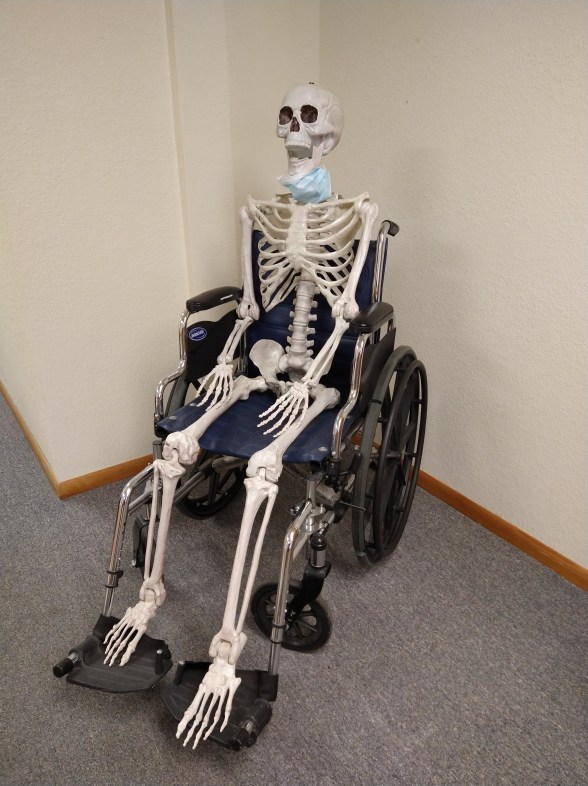
The picture is Mordechai, our plastic clinic skeleton, distrusting Profit-Over-Health Insurance Companies.

Antibodies to tubulin

All right.

I am thinking about tubulin blocker antibodies. How would they work?

About 2 weeks ago, I had trouble walking down the stairs because my quadriceps just did not want to bend. In fact, all of my muscles felt awake and grumpy. As if I were Sleeping Beauty, now awake. Of course, if I was Sleeping Beauty and some jerk kissed me awake, I’d punch his lights out. Hands off!

Anyhow, I concluded that my tubulin antibodies had released. Was I better?

Well, no. It’s been weird. In me it’s the voluntary fast twitch muscles that don’t work when I have a PANS/PANDAS reaction, so they are back on line. The grumpy muscles are the slow twitch ones who essentially are screaming “WHERE HAVE YOU BEEN, I’VE BEEN DOING ALL YOUR WORK SINCE MARCH!” Nine months. The fast twitch muscles are weak, the slow twitch muscles don’t trust them and I am having trouble getting it all to work together.

My balance is fine. It just all hurts and is a bit unreliable.

I was in Michigan for Thanksgiving, staying with old friends. My oldest friend there is 80 and does not have wi-fi or any internet. That made doing any blogging quite a challenge and many thanks to everyone who pointed creative spelling. I would go to her son’s house daily and try to put up the work I’d done at her house. Not the way I usually do it and three kids distracting me, which I enjoyed.

It is bowling that makes me realize how weird my muscles are right now. I went bowling with the middle (15) and younger (11) child. Mom watching all of us. My role is Weird Aunt, more or less. I have bowled maybe 12 times in my life. I guttered the first three balls, a 9 pound orange beauty. My muscles all started screaming at me at once in my upper and middle back. Oh, I thought. So I slowed way down and tried to slow bowl. Next was a strike. I ended up bowling 100, which I guess is not so bad for someone who really has no idea what they are doing. My muscles were grumpy but slow was ok and I didn’t pull anything badly. Next morning I am quite stiff.

I am trying to figure out how to rehabilitate the muscles. Do I exercise? Slowly? It’s as if half a team has been missing for 9 months and is now back. The remaining team members are tired, pissed off, and have figured out how to work without them. They aren’t very pleased about relinquishing control and they don’t trust the part of the team that’s been missing. I would go to my doctor and ask to see a neurologist or ask for physical therapy, except that since PANS/PANDAS is barely believed in in children, there are only a few doctors that work with adults and other doctors seem to think they are quacks. One writes articles for Psychology Today. I’ve thought about contacting him, but he’s a psychiatrist. How much do psychiatrists know about muscles?

Let’s extrapolate this too, to the people with really bad chronic fatigue. Presumably they have antibodies to tubulin that affects more muscles, fast and slow twitch. No wonder they lie in bed. I would presume that they are hypoxic too, if they could walk, but they barely can. The Functional Medicine doctors are treating folks with hyperbaric oxygen and I think it might help with these muscles that don’t work and can’t move. It is sneaky. It’s not that the muscle can’t move at all, it isn’t paralyzed, it’s just that the exhaustion and fatigue that comes after moving it is terrible. The body says very very clearly : “DON’T DO THAT.” And we are still in the infancy of looking at antibodies, so we aren’t measuring them. I was going to say we can’t type them, but that’s not true. We are using monoclonal antibodies to treat cancer, so there are ways to isolate and type them. Medical science may explode with this and can’t you see the potential for misuse? Imagine an army affected by a tubulin blocker antibody, against an army with a tubulin augmenting antibody. Holy moly. It has the potential to be really really horrific, which is why I am putting all this up on everything2. Keep it in mind, ok? Nothing like making information public to prevent secrets from screwing us over.

And that’s the news from me. “Har det godt!” which is Danish for “Have it good!” or have a really good day.