Weathering emotions

Just before Christmas, I was describing the present I had gotten for a friend’s son.

“Wait,” she said, “I’m not sure he’ll like that. I want him to be happy.”

……

Oh, I thought. I reassured her, “I think that he will like this a lot.” and he did.

But… I don’t want my children to be happy.

WHAT! HORRIBLE MOM!

No, wait. Let’s play with the idea.

Say that your goal is for your child to be happy. You want them to be happy, as much of the time as possible.

Your child will pick up on what you want. Your child wants to interact. Your child loves you. So your child will try to make you happy. Even when they aren’t happy. Then you are in a vicious circle, with you wanting your child to be happy and your child valiantly attempting to be happy or at least act happy whenever you are around until finally they hit the teen years (or possibly age 3) and scream at you, “Go away and leave me alone!” Then they will be sullen and guarded and only show up when they want food, transportation and money.

My goal is NOT for my children to be happy.

Are adults happy all the time? Well, don’t be silly. Of course not.

So why do we want children to be happy all the time?

I want my children to be able to handle the full spectrum of emotions. Happy, sad, grumpy, confused, brave, scared, apathetic, all of them. I want them to be able to name each one and tolerate it. Because my children will be adults and they have to be able to handle all of those emotions. I strongly suspect that they will encounter each and every one….

How do I model this? I tell them how I am feeling AND they don’t have to fix me. My sister died in 2012. I was very sad. I cried a LOT. Sometimes I would be sitting in the kitchen crying and my daughter would wander through the room and stop and hug me. She is not a natural hugger but she knows that I am and that I find it very comforting. She wouldn’t cry with me. She had her own emotions.

I came home from work once and said that I was furious and hurt. Ok, more than once. But once I described a meeting which turned out to have me on the agenda. The other five people knew that and I didn’t. I felt jumped and attacked. It hurt.

My son said, “Five against one?”

“Yes,” I said.

“Then they didn’t have enough people, did they?” He grinned at me and I felt much better. Still mad and hurt, but he was so funny. We went out for pizza because I didn’t want to cook.

Our US Constitution includes the pursuit of happiness. We are free to pursue it all we want. But I don’t ever think we will catch it. We will and we should still have times when we are sad or afraid or feel confused or hurt. I would go to work and tell my nurse, “I am in a really bad mood because something in my family is a mess. My mood is not about anything at work.” She would nod and then through the day I would cheer up, because I had to think about work.

Emotions are like the weather. We don’t control them. My mother died fourteen years ago. I see an ornament on the tree that reminds me of her and I feel sad and miss her. Next morning I change from writing Christmas cards to writing Valentines and I am using a stamp set and stickers and it reminds me of her and I think it’s funny. I am happy then remembering her. Let the emotions come in like the weather: name them, acknowledge them, don’t try to control them, let other people know you are in a storm, accept help, and let them pass. And let your children have their full range of emotions as well.

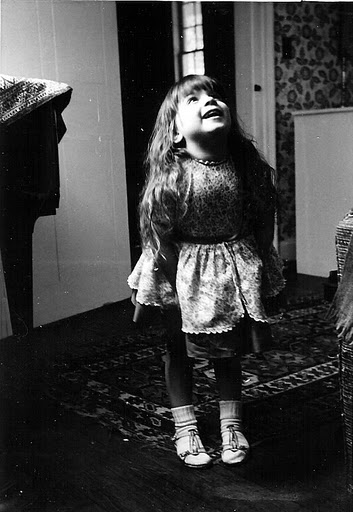
The photo is me and my younger sister, in 1965.

Painting Angels II

Painting Angels II

After my mother died, I wrote a poem called Painting Angels. It was about my kids’ comments about her death, but also about her being an artist. I wondered whether she was painting the sky or sunsets or clouds. She loved watercolors.

I was driving to the Boiler Room yesterday and came to the hill going down to Water Street and the sunrise was glorious. The leading edge of the front caught fire and there were yellow and orange and pink streaks up into the clouds.

I think my mother and my sister helped paint that sky. I stopped and took photos with my phone until I got too cold and the sun was up.

Thank you, mom. It was a beautiful show in the sky. I lost my mother in 2000, my only sister in 2012 and my father in 2013. I feel that the show has been blessed, and that getting my mother’s artwork out of storage fourteen years after her death and showing it is the right thing to do.

The Mother Daughter Show II

Over the last two days, I hung the Mother Daughter Show II, at the Boiler Room in Port Townsend, Washington. It will be up for the month of December.

This time it is the joint work my mother and I did in the 1980s. She did etchings to go with nine of my poems. The tenth poem was written for an etching she had already done. I asked my mother if she would do this project with me and she replied, “Only if the poems rhyme. None of that free verse stuff.”

I worked on the poems, I think with my mother’s etching style in mind. She used a zinc plate, with a tar solution on it. She would do a drawing in the tar, usually with a dental tool. The plate was placed in acid, which would etch where the tar had been scraped away. She would etch the plate multiple times, which gave different depths to the etched lines.

When the plate was finished, she would remove the tar and run an artist’s proof. She would heat the plate on a metal hot plate. She would ink it and then gently wipe the ink off until there was a very thin layer on the unetched parts of the plate. This had to be done delicately, so that the ink was not wiped out of the etching lines. She would place the plate on the press, place a piece of wet paper gently over the plate, lower the thick pile of wool pads over the paper and run the press. After the plate had gone through, the paper was peeled up and there was an etching, with the edges of the plate pressed into the paper.

Sometimes she was not satisfied and would return to the tar and change the etching. Sometimes she ran multiple proofs until she had the color right. Then she would run an edition. The print and poems are editions of fifty. Each etching is signed and numbered: 1/50, 2/50, 3/50, and so forth. We had the poems printed first, on a lead type press, and then my mother ran the etchings. We had a show in the late 1980s in Alexandria, Virginia.

My mother died in 2000. My father died in 2013. My mother was a prolific artist, so trying to deal with the estate felt insane. I put the art in a storage unit. When I had The Mother Daughter Show in July, it felt like a remembrance of my mother. And anyhow, I have to do something with the art in that storage unit, don’t I?

I find the etchings easier to show and sell then the watercolors. I want to clutch each watercolor, but eventually I will start to let go of them. I have the etching plates, too, because my mother said she was terrible at finishing editions. I have the box of poems printed on the lead press and the guides for running the edition. I do not have the press. My sister took it to California and it disappeared. That is ok, because there are presses in Port Townsend. There is a big art community, which is part of why my parents moved to this area in 1996. Art, music, gardens and boats.

My mother did many small fantasy etchings, flying elephants, fairies, a mermaid, a merman. The poems I sent her were almost all about animals. I wrote Eating Water Hyacinths and my mother did a charming etching of two manatees. She looked in various books to see what manatees looked like and then drew them. I wrote a blue crab poem and we bought a live crab. I photographed her drawing the crab, which was skittering around unhappily on the dining room floor. I enjoyed the constraint of rhymes. It made it easier to write the poems, though I am not sure why.

I have six of the series hanging in the show. I don’t currently have the other four framed. The Gallery Walk is this Saturday. I hope that people will come and perhaps we will sell one. We are also going to show the Panda Minimum, outside. The Panda Minimum is a mountain bike camping trailer, a bit like a teardrop trailer, designed and built by a local friend. We will have it outside the Boiler Room. I’ve already told the friend that I think the Panda will steal all the thunder and the art on the wall will be ignored, but ah, well. I have a third show scheduled, for June and July, at another venue. It is easier to do shows of my mother’s artwork than my own, because I think she was so good.

Also published on everything2 today.

The Boiler Room: http://www.ptbr.org/

Donate to the Boiler Room! Or come to the auction, also tomorrow!

Painting Angels

You were an artist
You are an artist
You said that you’d have to live to 120 to finish all your projects
And died at 61
I keep wondering
what the art supplies are like
and if you work on sunsets
or mountains
or lakes

Trey, 9
made a clay fish last summer that I admire.
He said grumpily “It’s too bad Grandma Helen died before I could do clay with her.”
He tells me he’s ready to make raku pots for fire in your ashes as you wished
I ask what he’d make
He considers and says, “What was Grandma Helen’s favorite food?”
I can’t think and say that she liked lots of foods
At the same time wondering squeamishly if maybe
he should make a vase and then being surprised
that I am squeamish and thinking of blood and wine,
too, I wonder if my dad would know. “Maybe guacamole.”
I need to find a potter to apprentice him to.

Camille, 4.
asks how old Grandma Helen was when she died.
I explain that she died at 61 but her mother died at 92.
Camille asks how old I am.
40.
When are you going to die?
I say I don’t know, none of us do, but I hope it’s more towards 90.

Camille studies me and is satisfied for now.
She goes off.
I think of you.

I perpetuate
the Christmas cards you did with us
upon my children
They each draw a card.
We photocopy them and hand paint with watercolors.
Camille wants to draw an angel
and says she can’t.
I draw a simple angel
and have her trace it.
She has your fierce concentration
bent over tracing through the thick paper
She wants it right.
The angel is transformed.

My kids resist the painting after a few cards as I did too.
Each time I paint the angel
to send to someone I love
I think of Camille
and you
and genes
and Heaven
I see you everywhere

published in Mama Stew: An Anthology: Reflections and Observations on Mothering, edited by Elisabeth Rotchford Haight and Sylvia Platt c. 2002

written January 19, 2002