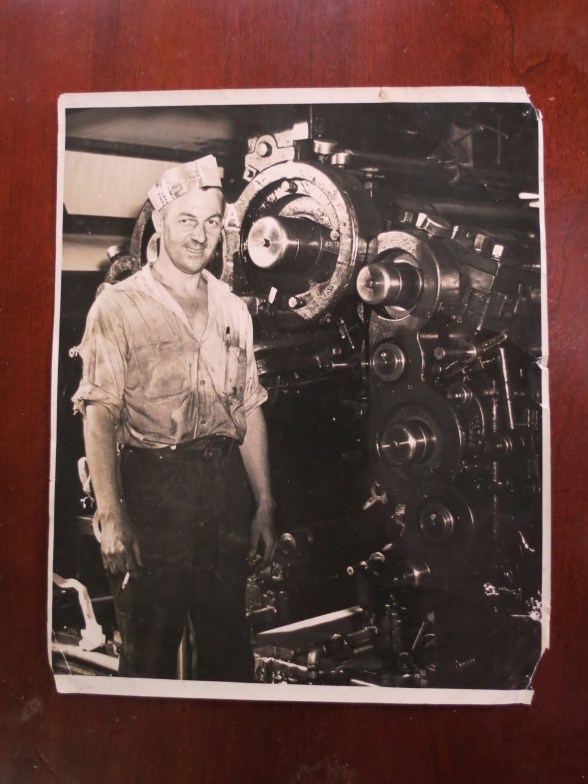
My father’s father was a pressman and the head pressman when he was in Knoxville, Tennessee. This is back in the lead type times, when the type had to be set before printing the newspapers. Before they moved to Knoxville, they lived in Connecticut. My father said that my grandfather helped develop the four color process for the comics. My father would get the new comic books, Superman, straight off of my grandfather’s press. Too bad those were thrown out!
I started cursive in school in about fourth grade and I did not like it. I learned, but I thought it was ugly. My father knew how to write in italics. I liked italics much more and asked him to teach me. I adapted the capital letters to make them easier and then I wrote my papers in italics when we were not allowed to print. The teachers objected but I pointed out that we weren’t allowed to print in the papers, but it did not say, “No italics.” I imagine that some teachers found me difficult.
My cursive is still stuck in about fifth grade and I almost never use it.
Meanwhile fast forward. A law is passed in Washington State that prescriptions cannot be written in cursive. However, it does not say that we have to print. The same loophole. I usually printed prescriptions anyhow, so that the pharmacist could read it. I got compliments occasionally for printing in a legible way. I didn’t spell certain medicines correctly, but the pharmacists never seemed to care about that. Now it is all by fax and since Covid started, even the controlled substances go by fax.
I did a porch call a bit over a year ago. It’s like a house call except on a porch.
A friend/patient asks me to see a long time friend of his. The friend has multiple chemical sensitivities. We meet, the three of us, on his porch.
My friend has had me as a physician but he has not seen me at work with someone else.
I ask a lot of questions and then launch into an explanation of the immune system and how antibodies work.
My friend states, “He can’t understand that.’
I smile at his friend. “Oh yes he can. And you followed what I said, didn’t you?”
His friend grins back and said, “Yes, I did. Most of it. Or enough.”
All of my patients are smart. One day in clinic I think how blessed I am, that ALL of my patients are smart and fascinating people. Then I think, how could that be? And, how lucky am I?
And then I think: everyone is smart.
They are not all educated in the same way I am. They may not be well read. They may not have my science background or my geeky fiction and poetry and song brain. But they ALL are smart.
Some are brilliant at mechanical things. I have a patient who is an expert in restoring church organs and is working 3000 miles away in New York City. “They are driving me crazy.” he says. “You have to have the approval signed off on over 20 groups, historic preservation, the fire fighters, etc, etc, to remove one board from the church. The organ was covered over by bad repairs over the years. We’re trying to get it back. After this I will put in new organs, but this is my last restoration.”
Veterans, teachers, attorneys, physicians, retired computer engineers, car mechanics, marine engineers, parents, grandparents. They are all smart, men and women.
We finish the porch visit with some options and the friend of my friend says he will think about what I said and try some things.
A few days later my friend calls. “I couldn’t believe he was following your science talk, but he was. He got it. He remembers it and understood it.”
“Of course he did,” I say.
“I am actually impressed,” says my friend. “It was really interesting watching you do that.”
That may be one of my weird skills. To be able to listen to the person thoroughly and then respond in language that they understand and a bit more. An assumption, always, that they can follow a complex and intricate idea.
I do not know if they always follow what I say. But they always respond to the assumption that they are smart and that they can understand and that they are an equal. I am explaining from my expertise, but I know they can understand when I explain it correctly.
And I have not seen this in the physicians that I have seen. Out of 22 physicians since 2012, four were excellent and met me and explained as an equal.
The rest did not. They dismiss me. They talk down or avoid me once they realize that they do not understand why I keep getting pneumonia. They are afraid to say “I don’t know.” Four are not afraid and recognize that it’s something weird and say, “We do not understand this and we don’t know how to fix it.”
Four out of 22 have my respect. And that is a sad number. Medical training needs to change and physicians need time to listen and need to learn how to listen.
Meanwhile, all of my patients are smart. And I am so blessed.
When my children were eight and thirteen, their parents were getting divorced. It had been a very long process involving hours of counseling and had officially started when they were five and ten. We paid counselors more than lawyers, which is a good thing. My Ex had pushed me to fire my first lawyer and to switch solo counselors. The final straw was when he decided that we needed to switch couples counselors.
“I don’t agree with anything he’s said.” said my future Ex.
I was flabbergasted but really it had been obvious. “We’ve been going to him for OVER A YEAR.”
“Yeah, but he’s on your side. I don’t agree with anything he says. I don’t want to go back to him.”
I found a new counselor and found that I had a new goal while filling out the paperwork: amicable divorce. We did one session with the children. The counselor introduced herself and talked about divorce and said that children often had questions. My extroverted feeler son went first.
“Why are you going to Grandma’s for Christmas, dad?”
Dad began to say that I was being mean to him, but the counselor intervened. “It’s not appropriate for you to tell your son about your disagreements with your spouse.” Dad argued, but the counselor stood firm.
Dad said, “I want to have Christmas with people who love me.”
The extroverted feeler just looked at him. “But we love you, dad.”
Dad stared back at his children. “Yes, you do. I am sorry. Next time I will talk to you before I decide what to do.”
My introverted thinker daughter went second.
“Mom, if you get divorced and daddy moves away, and if Auntie’s cancer comes back and you go to take care of her, who will take care of us?”
I think all the adults were stunned by the complexity of that question from an eight year old. I had left the children with their dad to go to take care of my sister for the week before her mastectomy over a year before. It was the longest I had ever been away from my children.
I replied. “If Auntie’s cancer comes back then I will not leave you to take care of her. Either she will have to come here to be taken care of or I will take you with me.”
That was it. She had only one question. She was quite clearly satisfied with the answer. I thought the counselor was amazing to make them feel safe enough to ask a big question.
Previously published on some obscure place on the internet11/2/09.
Discover and re-discover Mexico’s cuisine, culture and history through the recipes, backyard stories and other interesting findings of an expatriate in Canada
Engaging in some lyrical athletics whilst painting pictures with words and pounding the pavement. I run; blog; write poetry; chase after my kids & drink coffee.
Refugees welcome - Flüchtlinge willkommen I am teaching German to refugees. Ich unterrichte geflüchtete Menschen in der deutschen Sprache. I am writing this blog in English and German because my friends speak English and German. Ich schreibe auf Deutsch und Englisch, weil meine Freunde Deutsch und Englisch sprechen.


 KO Rural Mad As Hell Blog
You must be logged in to post a comment.