abuse, enabler style

I am raised by a family of triangulating enablers and enablees.

The enablers are my mother and two uncles. They are very very smart. Let me qualify that: they are very very smart intellectually. Emotionally, not so much.

The two uncles have PhDs and are professors. They marry wives that are lessor in their view. One tells my mother that he wants a woman who is not as bright as he is. I don’t know if she is less bright, but she is a hella better athlete. I also have the impression that she had a time where she drank too much.

The other uncle marries a woman who tends to be a hypochondriac. He takes her to India, where she gets polio while pregnant. She is then a sick hypochondriac, which is very difficult. The ill can control their families by planning things and then getting sick at the last moment. On the other hand, chronic fatigue and fibromyalgia are very real and we are on the edge of figuring them out. That uncle divorces his wife and I instantly like both of them better. They stop being a weird unit and are suddenly individuals.

My mother tells me, when I am in college, “I wondered if your father was an alcoholic when I married him.” I want to hit her. She won’t leave him, she won’t stop enabling him, they scream at each other at 2 am often. Now I wonder about that and conclude that either screaming at someone was something she needed or she was an alchoholic too.

After my mother dies, I ask my uncle, what about his parents? After all, the three of them learned enabling somewhere and it pretty much has to be at home.

My uncle tells me his parents had a PERFECT marriage and that my grandmother LOVED being the wife of a physician and professor.

Um, so, then, why did she pay my tuition to medical school, uncle?

And I think about my mother’s stories. Once, she says, your Uncle Jim bet his friend Dick that Dick was too chicken to shoot a cigarette out of Jim’s mother’s mouth. Ooooo. With a rubber band shooter. Yes, my grandmother. Bob took the bet and succeeded. My grandmother roared with anger and the two boys ran like hell and hid.

And someone in the family tells me: your grandfather helped your grandmother control her temper.

There it is. The enabler/enablee.

The enablers die first. My grandfather of cancer at 79, my mother of cancer at 62. The cousins are all angry at me because I won’t follow the family rules and triangulate in a satisfactory manner, and I don’t care any more. I am ignoring them. I got my father’s banjo back and I am done. The two cousins I own land with jointly are not the worst triangulators.

I have to remind myself: for them, this is love. For some people, controlling or being controlled is what functions as love and intimacy. Fighting and tears when person A talks to person C about person B and person C then lets person B know, that is how they feel close. It is not only families, but communities. Clay Shirky’s description of a group being it’s own worst enemy describes the same patterns: identify an enemy inside or outside the group and then everyone comes together against the enemy. The enemy says the wrong thing, doesn’t worship the right god/desses, wears different clothes, looks different. And the group feels safer once the scapegoat has been killed, the guy has been burned. It would be nice if we could burn a ritual guy instead of torching each other.

The real anger is in the enabler. They control it by having the enablee express it. Then it is not “theirs”. They can feel superior to the enablee who is out of control. Sadly, the problem is only fixed temporarily and they will need their anger expressed again and again and again.

The cycle can be broken. It is a lot of work.

Blessings.

______________________________________________

Adverse Childhood Experiences 8: Social cues

I am thinking about social cues for people with high Adverse Childhood Experience scores. With crisis brain wiring the response to social cues may be very different than what is considered the acceptable “norm”.

I always miss the cue when someone says “see you later”. I think “When?” Then I realize it’s a social comment and they do not in fact plan to see me later. I have a moment of disappointment. I do the same thing when someone says, “Let’s get together for dinner.” or “Let’s have coffee some time!” or “I will call you back!” or “Why don’t you come to our cabin some day?” Yes, I think, when?

And then I think “Liar.”

So I fail social cues….. or do I? Maybe I am not responding to the “correct” or “conventional” or “nice” social cues.

My father drank too much and especially while I was in high school and college. And my mother would enable and cover up and pretend nothing was happening. Children in this situation, which is way too common, develop special skills.

My sister was three years younger. As adults we discussed the stages of drinking and which one we hated most. We would both walk in the house from school with trepidation. In the door and almost feeling the air: what is happening? Am I safe? Do I need to hide? How dangerous is it? How much will it hurt?

I walked in once during high school and missed the cue. I was thinking about something. I thought my father was asleep in the kitchen. I went in to get something. I was very quiet so as not to wake him. I made a cup of tea.

He was not asleep, or else he woke up. And it was the worst stage, or the one I hated most.
Not physical violence. But he started talking. One of things he said was “You can tell me anything.” Now, he meant it. But he was crying by then and I knew I did not want to tell him anything and all I wanted was desperately to leave the room. And neither my sister or my mother was home. Finally I was crying too, because I said “I just want to go read my book.” and he was more crushed and maudlin and emotional and crying. And I tore out of the room and up to my room, as my mother walked in.

I did not cry much. Ever.

I refused to talk to my mother about it.

The next day she said to me, “Your father told me that you were talking about Lamont.” Lamont Cranston was a very beloved cat, The Shadow, who was missing now. Dead, we thought.

I said nothing. Because we had not talked about Lamont. So either my father was lying or else he’d had a blackout, didn’t remember and was making shit up. And if I told my mother the truth, she would back him and deny what I said or make it into a joke.

The stages my sister and I identified were:
1. sober
2. a little bit
3. goofy/silly/makes no sense
4. crying
5. asleep

We were ok with 2 and 5. I don’t think we saw 1 for years. We disliked 3 intensely, especially in public and especially when our mother was doing a cover up dance. And 4 we hated.
And yet I loved my parents and mostly miss them now that they are gone. Except when I remember things like this.

So, what is the point?

I miss “social cues” because that is NOT what the crisis brain, the ACE score brain, pays attention to. I am paying attention to far more intuitive things: body language. Whether what the person is saying matches what I know about them and what they have done in the past. I am looking for whether this person is telling me the truth.

I don’t trust instantly. Why would I?

I said to a counselor once that reading the “cloud” around the person was terribly useful in medicine but made me a social misfit. “I don’t know how to turn it off.” I said. She grimaced and said, “Why do you think I went into counseling?” She said, “I can’t turn it off either but I have learned to ignore it during social situations.” I was in my forties before I realized that there are people who don’t sense this cloud, who trust people until the person is dishonest, who understand that it is just fine to say “Let’s get together.” and not mean it.

Because actually, when someone says “I’ll see you later.” and they don’t mean it, they are saying an untruth. They are not planning to see me later. They don’t mean it. And my brain automatically files that under evidence that this person is not trustworthy. To them it is a social cue that is polite. To some of us, it is clearly something that is not actually true. I pick up on a cloud of social cues, but not the ones that are acceptable or conventional. And I am not the only one.

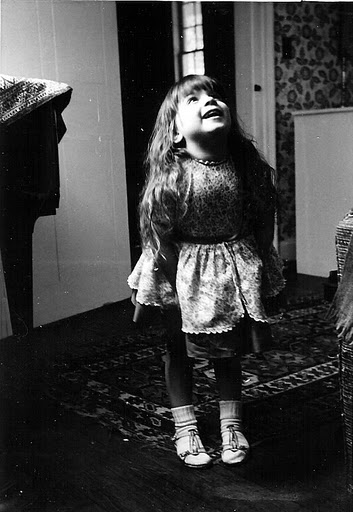
my sister on the left and me on the right, in the 1960s