Songs to raise girls: Pack up your sorrows

This song interests me. It is the fourth in my series about the songs that my sister and I learned growing up.

When we recorded our family songs, my sister said she liked it. I said, I think it is creepy, with that juxtaposition of a sweet tune and then words that are not so sweet.

No use cryin’
Talking to a stranger
Namin’ the sorrows you’ve seen

Oh, ’cause there are
Too many bad times
Too many sad times
Nobody knows what you mean

If somehow
You could pack up your sorrows
And give them all to me

You would lose them
I know how to use them
Give them all to me

The line that bothered me was “I know how to use them”. What does that mean? Use them for what?

No use ramblin’
Walkin’ in the shadows
Trailin’ a wanderin’ star

No one beside you
No one to hide you
An’ nobody knows where you are

Ah, if somehow
You could pack up your sorrows
And give them all to me

You would lose them
I know how to use them
Give them all to me

And how could you give your sorrows to someone else? The singer is offering to listen to sorrows but also take them away. “You would lose them.” And then the singer “knows how to use them”.

No use roamin’
Walking by the roadside
Seekin’ a satisfied mind

Ah, ’cause there are
Too many highways
Too many byways
Nobody’s walkin’ behind

Ah, if somehow
You could pack up your sorrows
And give them all to me

You would lose them
I know how to use them
Give them all to me

I never got around to asking my sister if it was the tune she liked or the words or what it meant to her. I chose to play that recording at her Washington memorial. I could not go to her California memorial because I was too ill. My father had terrible emphysema and was on oxygen. I thought I had pertussis but it turned out to be systemic strep A, which hurts. At any rate, I was too sick to travel. Her Washington Memorial was a month or two later, when I was well enough to organize it…..

You would lose them
I know how to use them
Give them all to me

It is by Pauline Baez. The version by Richard and Mimi Farina is the one I’m familiar with, so my parents probably had the record:  https://www.youtube.com/watch?v=U4LbU8w7Th4.

Joan Baez, Pauline and Mimi Farina were sisters. Joan Baez recorded it https://www.youtube.com/watch?v=NAMe1bRW8Ao. So did Peter, Paul and Mary: https://www.youtube.com/watch?v=IVxNleqVpx4.

And so did Johnny Cash and June Carter: https://www.youtube.com/watch?v=_ctVhDEuTYE

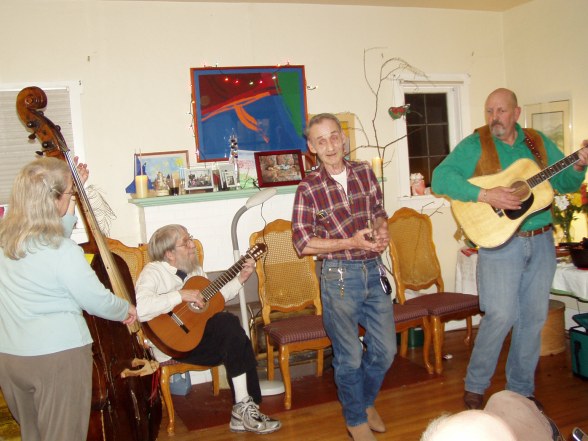
The picture is a music party at my house in 2009, my father seated and Andy Makie on harmonica, Jack Reid standing with the guitar.


Songs to raise girls: Dark as a Dungeon

We sang Dark as a Dungeon as a family song and at singing parties from when my sister and I were very little. We learned many of the songs before we knew what the words meant. At some age I considered this a cautionary song and was glad that my father was not mining coal. I also decided that I didn’t want to mine coal.

It was written by Merle Travis, whose father was a miner in an Appalachian shaft mine: https://www.youtube.com/watch?v=-FPmSLzsbdM&list=RD-FPmSLzsbdM#t=1. Johnny Cash sang it: and Willie Nelson: https://www.youtube.com/watch?v=nKGCKwACj1I and Willie Nelson https://www.youtube.com/watch?v=s66nbyzqq8o. It became a protest song, to fight for safer conditions. We learned this and Drill ye Terriers, Drill and Sixteen Tons, so we were raised on protest songs.

The song words have morphed a little, since we sang from memory. Here is our version:

Come all ye young fellows so young and so fine
And seek not your fortune in the dark, dreary mines
It will form as a habit and seep in your soul
‘Til the stream of your blood runs as black as the coal

Where it’s dark as a dungeon and damp as the dew
Where the danger is double and the pleasures are few
Where the rain never falls and the sun never shines
It’s dark as a dungeon way down in the mines

I wrote an essay in college about a song that I learned from my mother. I researched versions of Green Grow the Rushes Oh. I had always wondered about some of the verses, because it’s a counting song, from one to 12. Twelve for the twelve apostles and eleven for the eleven that went up to heaven. In an atheist household it takes a while to figure out the meaning of apostle. But other verses are mysterious to this day: nine for the nine Bright Shiners and eight for the April Rainers. In oral traditions if you forget a verse you make up a new one.

There’s many a man that I have seen in my day
Who lived just to labor his whole life away
Like a fiend with his dope and a drunkard his wine
A man will have lust for the lure of the mine

The comparison of  mining to addiction impressed me: “it will creep in your soul, til the stream of your blood runs as dark as the coal”. “Like a fiend with his dope” — opiate addicts were called fiends. And people were called drunkards. So this song also made me cautious about both drugs and alcohol.

We didn’t learn the third verse:

The midnight, the morning, or the middle of the day
It’s the same to the miner who labors away
Where the demons of the death often come by surprise
One fall of the slate and you are buried alive

The last verse interested me. I liked the idea of bones turning to coal over time. My parents were atheists and did not go to church, but there were lots of songs that talked about God or heaven or the devil: including sacred music. We went to big chorus rehearsals when my parents couldn’t find a sitter and we were expected to behave politely during concerts: The Messiah. And we got to go to operettas. I saw Ruddigore in Ithaca at Cornell when I was 5 and the ancestral ghosts stepping out of their portraits and singing was terrible and wonderful.

I hope when I’m gone and the ages shall roll
My body will blacken and turn into coal
Then I’ll look out the door of my heavenly home
And I’ll pity the miners A-diggin’ my bones

The photo is my father’s family and he is in the back, first trumpet. This is the Bayers Family Orchestra. My great grandfather is conducting, my grandmother on violin and my grandfather on saxophone. They became a band when my grandparents moved away, because my grandmother was the only string player.

Voice lesson

The picture is my father in 2009. We went sailing on his friend Paul’s boat. My father loved to sail and loved to sing. He taught me to sing from when I was tiny….

I had five voice lessons in the spring. The teacher is a woman who comes into town to see her mother, from New York. When she comes, she teaches many of the best soloists in town, including people I’ve taken lessons from. One of our soprano soloists gave her my name.

She started by asking my singing history. I explained that my family had sung folk songs since I was tiny and that I’d been in a chorus for the last 14 years. That my father had been in the chorus and that he had recently died. We are working on the Faure Requiem and the Rutter Requiem. Our director asked me to work on the Pie Jesu in the latter and I was having trouble with the high notes. She asked about my father’s voice. I said that he was a very fine bass, who had died from cigarretes. In the last few years he couldn’t sustain, but his entrances kept the bass section on track.

She took me through the lesson. There were five things that she had me work on. It was hard to keep them all in my head at once, since they were all a change.

1. To breathe in so that the back of my throat felt cold, like the feeling you get in icy air. This opens it.

2. To think of the breath as circling along my jaw when I sustained a note or phrase. This made the notes feel alive and stay alive. Richer.

3. As I went into the passagio, to think of the sound going out the top of my head and then directly out through the back of my skull.

4. On the very high notes, to press down more with my lower ribs in my back. This increases support.

5. To open my mouth dropping my jaw, but keeping it narrow. This changes the quality of the vowels tremendously.

The lesson was so helpful that I scheduled a second one two days later and had the sense to tape it. I can practice it with my tape. She will come back within a year and I hope that I’ve improved in all five.

first published on everything2 April 2014

The introverted thinkers and the fox

The fox went out on a chase one night
He bayed to the moon to give him light
He had many a mile to go that night
Before he reached the town-o, town-o, town-o
Many a mile to go that night before he reached the town-o

My daughter and my father and I are all introverted thinkers by preference.

When my daughter was in Kindergarten, she had a week where she was the child in focus. During that week she was to bring in a poster about her family and the child could choose activities.

We chose “The Fox”.

My father crossed from my house to the school two blocks away. I noticed that he was short of breath on the flat just carrying his guitar. Fifty five years of unfiltered Camels, two packs a day, will do that. I wished he was not short of breath.

We had a poster with photographs of Camille and her parents and her brother and friends and cousins and grandparents. We also had a poster with the words of “The Fox.” We introduced the song to the class and my father played guitar while we sang it. The words were on the poster. I’ve had it memorized for as long as I can remember….

He ran til he came to a great big pen
Where the ducks and the geese were kept therein
“A couple of you gonna grease my chin
Before I leave this town-o, town-o, town-o
A couple of you gonna grease my chin before I leave this town-o

My sister said that when she was little, she thought that a town-o was one of the brass ashtrays that my parents had. The ashtray was completely round on the bottom and would rock at a touch. She pictured the fox riding down a hill in the brass ashtray.

He grabbed a grey goose by the neck
Throwed a duck across his back
Didn’t a mind the quack quack quack
Or the legs all dangling down-o, down-o, down-o
Didn’t mind the quack quack quack or the legs all dangling down-o

I remember not knowing what “grease my chin” meant and also wondering whose side I should be on. The fox’s side? The goose and duck’s? Old Mother Flipperflopper?

Old Mother Flipperflopper jumped out of bed
And out of the window she stuck her head
Crying “John, John, the grey goose is gone
and the fox is on the town-o, town-o, town-o
John, John, the grey goose is gone and the fox is on the town-o

And there is that town-o again.

Johnny ran to the top of the hill
He blew his horn both loud and shrill
The fox he said “I better flee with my kill
Because they’ll soon be on my trail-o, trail-o, trail-o
I better flee with my kill  ’cause they’ll soon be on my trail-o”

Every day my father and Camille and I sang the song with the class. By Friday the whole Kindergarten class had joined in and could sing the song or at least part of it.
Camille had not been sure that the song was a good idea, but the class liked it.

The fox he ran to his cozy den
There were the little ones, eight, nine, ten
Saying, “Daddy, daddy, better go back again
‘Cause it must be a mighty fine town-o, town-o, town-o
Daddy, daddy, better go back again, ’cause it must be a mighty fine town-o”

At the end of the year, they had a Kindergarten graduation ceremony, with little white hats, at Chetzemoka Park. The teacher and the principal were there and parents and grandparents. The class had a surprise for all of us: they sang “The Fox” again.

The fox and his wife, without any strife
Cut up the goose with a fork and knife
They never had such a supper in their life
And the little ones chewed on the bones-o, bones-o, bones-o
They never had such a supper in their life and the little ones chewed on the bones-o

We didn’t discuss the ethics of the song. The fox is hunting for his family. He is stealing from people and he kills a goose and a duck. The people try to hunt him. His children think town-o must be wonderful, but it is dangerous for a fox to earn a living. And the little ones are fed. I think it is a teaching song.