Honey

Work is being a bit of a difficult place. I think that if a clinic is has two new providers with one new medical assistant, there should be some formal support in place. Not the manager of multiple offices sticking their head in the room with the three of us at computers and saying, “Everyone happy?” Um, no. This came to a head two days ago. Then yesterday I am asked to write up what I said to the manager.

No. I don’t think that is appropriate. If they have formal evaluation forms, fine. If they want a biweekly formal meeting, fine. If I ran the zoo, I would be sitting down biweekly with the job description to say, “This area is going well, this part needs some more attention. What is going well from your perspective and how can we communicate better to help each other and the patients?”

In fact, in my very first practice in 1996, I asked for a meeting with my receptionist. They had one for each pod of 2-3 providers. She was so freaked out by it that she brought the office manager, much to my surprise. I didn’t care and just said, “What is going well, what isn’t, where are the communication gaps, how do we fix them?” The receptionist looked at the office manager, said she had been scared that I was going to yell at her, but since I wasn’t, she let the office manager leave. We were fine after that. I just want a well functioning team and I am happy to help build it.

So, after thought, I am going to refuse this write up and ask what their HR process is and say that I am not satisfied with the office support and that it is quite unreasonable to leave two providers new to the clinic to guide and train a new medical assistant.

The Ragtag Daily Prompt is honey pot. That bring up this delicious and quite naughty Taj Mahal song, ooooooo. As my mother would say, you catch more flies with honey than vinegar.

Busy clinic

Clinic has been hopping. I have been at the present site now for six weeks, so I am starting to know a few of the patients. That is, the ones that are sick and I am worrying about. It is best if your doctor’s pupils don’t dilate when they hear your name.

I have been getting helpful calls back from specialists. I have a person who has high liver tests where hepatitis and overweight and alcohol don’t seem to be the cause, so I needed an updated list of what labs to send for some of the less common liver problems. Thyroid disease, hemochromatosis, alpha one antitrypsin deficiency, smooth muscle antibodies, various other antibody disorders. The list is quite a bit longer than in the past. I warn my patient that some will come back right away and some may take a week or two. The patient is anxious and wanted to go right to the emergency room, but I ask them to wait: I get a call back from gastroenterology within 24 hours to set up the current laboratory order list.

For liver tests, we ask about alcohol intake first. Then look at weight: a high body mass index can cause fatty liver disease. Unfortunately, that can lead to cirrhosis and liver failure, so it is not trivial. We check for hepatitis A, B and C. Then we start looking for the less common causes. My person is relatively young, but that is with me taking care of age 18 and up. I tell my person not to take any supplements, I look at any prescribed medicines. No alcohol for now.

The list of tests changes quickly. If I have not worked this up recently, it’s good to check in with the specialist. The gastroenterologist may not be up to date on ankle sprains, but they are tracking the changes in their specialty. My specialty is everything, so sometimes I need a current update. Most of the specialists are just fine with this phone call.

Occasionally I do this by message. I have a new diabetic who has a cardiologist already. Diabetics are usually put on either an ace inhibitor or an angiotensin receptor blocker to protect kidney function. I message the cardiologist and get a fast answer. Start an angiotensin receptor blocker and the suggested dose. Also very helpful.

A patient tells me on the phone that I get an “A” for the day. I called them to check on them two days after changing a medicine dose and to say that the other specialist wants even MORE laboratory tests. The patient says she has not gotten a call from a doctor before. The “A” made me laugh, but it did feel good.

I am learning the local medical pathways and how to get things done in this particular medical system. The functional bits, the dysfunctional bits, and how to work around them.

For the Ragtag Daily Prompt: functional.

Sol Duc really likes staying in her pillow fort. Sometimes I want to hide in a pillow fort too. So much for being “grown up”.

The isolated working

I ran my own small clinic from 2010 to 2022, working somewhere else, got Covid, was on oxygen for a year and a half, did some healing and then came back to work.

There has been a culture change in medicine that feels very strange to me. I did not notice it because I was in a solo clinic and not “part of the system”.

All the doctors, providers, are more isolated. I got a compliment yesterday when I was doing a “warm hand off” of the most sick or complicated patients, three new diabetics, a person with cancer, a person with a genetic heart problem. The doctor who I was handing off to is in the same clinic but we have barely talked since May. I don’t know her at all. She complimented me on excellent care “and calling specialists”.

I thought, huh. But I think that is a dinosaur doctor thing. I think mostly people communicate through the electronic medical record email, send messages about patients. For the decade that I was solo, I had to call other specialists because I was on a different electronic medical record. The email didn’t connect. The hospital reluctantly gave me a “link” to their system, but it was only a link to look. I could not write or send anything.

About two months ago I got an echocardiogram result. I read it and thought, ok, it’s not normal but what does it mean? Outflow obstruction by the thickened heart wall. Hmm. I called cardiology and spoke to the cardiologist who read it. He sounded surprised and said, “Idiopathic hypertrophic cardiomyopathy, most likely. It’s a classic echo.” “So, what do I do?” “Send him to me.” “Anything that I should change meanwhile?” “Yes,” says the cardiologist. He had me stop one medicine and start another. “No vasodilators and the beta blocker slowing the heart rate should help decrease the outflow obstruction.” “Got it.” I said. He also gave me two more tests to order.

I referred the patient to cardiology but it was a month before he got in. The two tests were done and they ordered more. If the diagnosis is correct, he’ll be sent to a special clinic in Denver. I called my patient while we were waiting for the cardiology visit. The medicine change had not made much difference as far as he could tell.

I was also told when I got here that I would never get a local nephrologist to see a patient, they were two busy. However, I have called two nephrologists about two patients and both took the patient and again, gave me instructions.

Two specialties have been very difficult to contact: orthopedics and gastroenterology. I have no idea why they are so difficult.

I can see that email feels faster. But there is no human contact, asking follow up questions is difficult, I don’t get that bit of further helpful education: this is what you do next. I have learned so much over the years by touching base with specialists. Once I fussed at a patient to go to hematology oncology about their high platelet count. The patient didn’t want to. He came back and said, “Apparently I have this newly found genetic problem. They put me on two medicines, not expensive. And I feel better than I have in 20 years.” I asked the oncologist about it the next time I called. He lit up, excited, and told me about the JAK-2 mutation. It is so exciting to learn about new areas in medicine and my patient says, “I have to thank you for pushing me to see the oncologist. I feel so much better.” Wow and cool.

Clinic feels like I am mostly isolated, a silo, an island, rarely talk to the other physicians unless I go to find them. I think hospital administrations like this, keeping the physicians in line by having their schedule be so packed that they almost never talk to each other. What a good way to keep physicians from interfering in the money making production! Ugh, I think it is quite horrible and unhealthy for the providers and for our countries medical system in the long run. I was seriously less lonely in a solo clinic.

The prognosis for our current medical system is very poor. The patients say to me, “Why do my doctors keep leaving?” They aren’t attached, they are isolated, I don’t think the physicians know what they are missing. Colleagues. Not silos.

For the Ragtag Daily Prompt: prognosis.

The photograph is from the Fruita Fall Festival.

Diabetes update

Friday I attended a Zoom diabetes update all day. Sigh. We are really doing diabetes wrong.

Diabetes affected every system in the body and so the guidelines want us to check everything. They made the point that controlled diabetes does NOT lead to blindness, kidney failure, and amputations. Only uncontrolled diabetes. There, do we feel better now?

There are three NEW things to check for. One is CHF, aka Congestive Heart Failure. Heart Failure is pump failure. It makes a lot more sense if you think of the heart as a pump. Diabetes doubles the risk of heart failure in men and increases it by five times in women. We are now to do a yearly BNP (Brain Natriuretic Peptide, got that?) except that it is useless if the person is in renal failure, because that raises it artificially.

The second NEW thing is liver problems. Liver failure is back in the top ten causes of death, having fallen off that list for a while. People drank more alcohol during COVID, there was more drug abuse adding to hepatitis B and C, but the biggest cause is NASH and NAFLD. More acronyms: NASH is Nonalchoholic Steatohepatitis and NAFLD is Nonalcoholic Fatty Liver Disease. This is related to overweight and obesity. Being overweight or obese messes up fat storage and over time this inflames the liver and then cells die, leading to cirrhosis. We are to watch liver tests, think about an ultrasound, and then there are two specific tests for cirrhosis.

Third NEW thing is Diabetes Distress. This is not depression. People score “depressed” on the PHQ-9 test, but don’t respond to anti-depressants. The lecturer said that we have to talk to the patient and find out why they are distressed, or what part of diabetes is getting them down. I thought that we should have been talking to the patient all along. There is a convenient 30 question tool we can use for this, if we have time. Will we?

Now, the old guidelines said that we are to check these things:

HgbA1C every 6 months if not on insulin, every 3 months on insulin and even more in pregnant patients.

Microalbumin/creatinine ratio: a urine test that tells us if the kidneys are starting to leak albumin. They shouldn’t.

Yearly eye test to check for diabetes damage.

Specific blood pressure ranges.

Keep everyone’s LDL cholesterol under 70. So nearly every person with diabetes gets a statin drug.

Do a foot check yearly for neuropathy.

So six things plus the new three. Can’t explain that in one visit and can’t do it in one visit either. I think we should revamp the Diabetes Distress tool and check if physicians and nurses have Guideline Distress. Diabetes is the most complicated set of guidelines other than pregnancy.

Diabetes also takes a lot of time for the person who has it. To check things “correctly”, it takes a minimum of two hours a day for Type II not on insulin and more like three or more for Type I and II on insulin. Think if you have to take two or three or more hours away from your current daily activities and devote it to diabetes. No wonder people are distressed.

The medicines are also confusing. Wegovy is in the same class as Ozempic, but is FDA approved only for weight loss in people who are overweight and have a complication, or people who are obese. Ozempic is for diabetes but people often lose weight so think about it if the person is overweight. Some of the medicines in that class also are approved to reduce the risk of heart disease, which goes up with diabetes. Another class has medicines some of which have approval for diabetes and others for diabetes and renal problems, BUT don’t use it if the eGFR is under 20, got that? The lecturer on medicines said that we’ll see less in each of those classes after they fight it out for dominance of the market. He’s been an endocrinologist for 30 years and remembers when the very first non-insulin medicine was approved. Cool! He is not discouraged, but another lecturer said that we have one endocrinologist for 5000 people with diabetes, which is not enough. We were encouraged to do more continuing medical education.

There is one guideline that I disagree with and would like to see changed. I will write about that next. After I memorize all of the different things the new medicines do, which is changing every month as new research comes out! Stay tuned!

I think I will put the clutch in and coast a bit. Or perhaps clutch handfuls of hair and pull at them, I don’t know.

For the Ragtag Daily Prompt: clutch.

I hiked again yesterday and had a very cooperative bunny stop for a snack in camera range.

We change

In clinic, a very common complaint was, “My body has changed!” This was often with shock or annoyance or betrayal. Weight up, a knee hurting, headaches, menses behaving badly as menopause approached, gentlemen with their own problems.

My muscles are getting stronger but are really grumpy. I am starting to rebuild muscle and endurance but my muscles and joint complain. I think that pain is the pain of wisdom. I am clearly very very wise, if that pain is wisdom pain. It feels better to frame it as wisdom than as “Oh, I am old.” Also it’s fun to watch people when I say, “My wisdom is really acting up today.” They get a funny look on their faces.

Medicine changes all the time too. Isn’t that a little unsettling? Science changes, ideas change, frames change. A treatment that I used 15 years ago would not be done for the same problem now. And we can treat hepatitis B and C! Hepatitis C was still named “Non A, non B hepatitis” back when I was in residency in the early 1990s. Hoorah for some things getting better.

It’s been interesting watching the changing ideas about Long Covid. Over the last year they’ve said, “Better in nine months.” “Mostly better by a year.” “Better by two years, mostly.” Also the estimates of people affected in the US have ranged from 3% to 7.4%. There is not even agreement about the definition, with the CDC talking about symptoms staying present after four weeks. Meanwhile the World Health Organization says, “It is defined as the continuation or development of new symptoms 3 months after the initial SARS-CoV-2 infection, with these symptoms lasting for at least 2 months with no other explanation.” Here: https://www.who.int/europe/news-room/fact-sheets/item/post-covid-19-condition. CDC here: https://www.cdc.gov/coronavirus/2019-ncov/long-term-effects/index.html.

I hope that we vote grown ups into office. I hope we aren’t tempted by the childish want to be dictators who say, “I can fix anything, I can do what I want, I am so great. I can make YOU great too.” I think the pandemic was very frightening and the temptation is to try to hide in an imaginary past or freeze the future or think that if we make everyone behave a certain way, no further pandemics will come. I do not think that will work, people. Vote for adults.

The photograph is from the US Botanic Gardens. Here is the model, inside:

The sculpture faces are over each arch. Here is a close up.

I think the carved face will last the longest, then probably me, then the one on the model. The model looks like it would be delicious for various smaller creatures.

For the Ragtag Daily Prompt: change.

Doctors are leaving medicine

https://www.healthgrades.com/pro/7-reasons-doctors-are-leaving-medicine?CID=64embrdTINL120523

Ok, reason number five: “One study finds doctors spend two hours on EHR record-keeping for every single hour in clinical contact with patients. EHR dissatisfaction has been linked to higher burnout scores, and burnout can lead doctors to leave clinical practice or quit medicine altogether.”

Back in 2009 I argued with my employer about their policy. They had put us all to 20 minute visits, one 40 minute one a day, and continuous visits 8-noon and 1 to 5. Also, they had daily meetings from noon to 1. Full time was four eight hour days, except they are nine hours with the meetings. I said, “Look, one day of clinic generates at least two hours of work: reading lab results, reading radiology reports, calling patients, calling specialists, dealing with insurance, dealing with phone calls, refills, patient requests, calling pharmacies. So four 8 hour clinic days generates another 8 hours minimum of work, plus I have call nights, plus those four hours of meetings every weeks, so I am working 44 hours of week minimum and with call I can hit 60-80 hours in a week.” The administration did not care. I promptly cut to 3.5 patient days. They initially said, “You can only do 3 or 4 days, not 3.5.” I said, “Why?” They said it was not the most efficient use of clinic space. I said, “You don’t have anyone to put in for the full day, so using it for a half day generates more income than having it empty.” They reluctantly agreed.

I could finish a clinic EMR (electronic medical record) note in the room with the patient in 25 minutes but not 20, during the visit. The administration and computer loving doctors had said, this system is to let you finish the note in the room. It took me three years to be able to consistently do that in 25 minutes. Many providers were allowing their home computer to access the system. This meant they were working after hours at home after everyone else was asleep or on weekend morning. I refused to have it at home. I came into clinic at 5 am to do the work, since then I wouldn’t get interrupted, but I wanted home to be home. Also, I live four blocks from that employer.

I decided that I was sticking with finishing the notes in the room. I ran late. I apologized to patients, saying that the hospital was now requiring a quota of 18 patients a day and that I disagreed with it. I tried to convince the administration that I needed more time and help, but they dispensed with me.

Two years later another physician quit medicine and the hospital dropped the quota to 16 patients a day.

So it makes me laugh to see that it says in that article that eight hours of clinic generates sixteen hours of “EMR work”. The implication is often that it is busywork but much of it is NOT busywork. I have to read the xray report and decide what to do with it. Same for every lab. Same for the specialist letter. Same for physical therapy, respiratory therapy, home health, hospice, occupational therapy, notes from psychology or psychiatry, notes from the hospitalization here or elsewhere. Read, decide if I need to do anything, update the EMR? Sign the document off. Decide, decide, decide and get it right. Call the patient or a letter or call a specialist or ask my partner for a second set of brains, am I missing something? This is all WORK.

At one point a clinic shut down in three counties. My clinic (post hospital) took a new patient daily for months. We couldn’t get the notes so we had to look at med lists, get history from the patients and wing it. Or get hospital records labs xrays specialist notes. Yep. Nearly every patient had “deferred maintenance”: they were behind on colonoscopy, mammogram, labs, specialist visit, echocardiogram. We ordered and ordered. Then we had to deal with all the results! After about five months I say to my receptionist, “I’m TIRED.” She was too. We dropped to three new patients a week. Then two. Then one.

I also spent an hour with new patients and my visits were 30 minutes. I was the administrator of my clinic too, and pointed out to the physician (me) that we were not making much money. With 30 minutes I could look at things during the visit and explain results and get much of it, but not all, done.

So if a 20 minute clinic visit generates 40 more minutes of work, in labs, reviewing old records, reading specialist notes, reading about a new medical problem, keeping up on continuing medical education, reading xray reports, echocardiograms, writing letters for jury duty exclusion, sports physicals, disability paperwork, sleep apnea equipment, oxygen equipment, cardiac rehab reports and orders,etc, then how many patients would give us a forty hour week? At one hour per patient, that is 40 patients a week, right? 18 patients daily for 4 days is 72 per week and that is not including the on call or obstetrics done at night and on the weekend. 72 patients would generate another 144 hours of work according to that article which is untenable. 36 hours+144 hours+call = over 180 hours weekly. And so I am not surprised at the levels of burnout and people quitting.

We have to value the actual work of not only “seeing a patient” but “thinking about the patient, reading about a disorder, reading all of the notes and test results and specialist notes”. Isn’t that what we want, someone who will really spend the time and think?

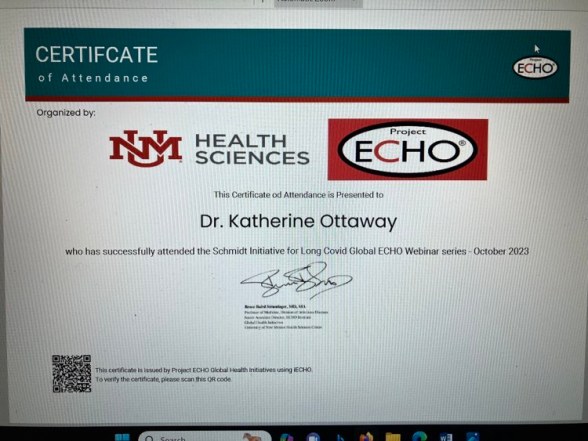
Schmidt International iECHO: Long Covid Patient Perspective

The latest Schmidt Initiative iECHO Long Covid zoom two days ago is by Hannah E. Davis, MPS, the co-founder of the Patient Led Research Collaborative (PLRC).

She got Covid-19 in March of 2020. Her first sign that something was really off was that she couldn’t read a text message. She thought that most people recover in two weeks so didn’t do much about it. She went on to clotting and neurocognitive problems and MECFS.

Her job and expertise were in machine learning data sets. As she realized that she was really sick and was not improving, she also realized that Long Covid was not even on the radar for physicians, overwhelmed by the acutely ill and dying. She started the interdisciplinary team co-led by four women and with over fifty patient researchers. The group is 61% women and 70% disabled.

They published an op ed piece about the body politic in the New York Times in April of 2020. By May of 2020 they had a fifty page article out documenting that even mild cases of Covid-19 could cause long term impacts. They describe multiple symptoms long term, not just respiratory. They also noted and documented medical stigma happening and were instrumental in changing the dialog from anecdotes of non-recover to data about non-recovery.

In June to August of 2020 they appealed the the World Health Organization (WHO) with a video message presenting data about long term effects.

In December of 2020 they presented a paper characterizing Long Covid. There are now 3-4 biomedical papers coming out each day.

She states that there are multiple myths about Long Covid: “It’s mysterious, we don’t know anything about it.” is not true. She listed other myths, but I have to go back through the slides.

The group is still highly active in research and is advocating for patient involvement in research. They have developed score cards for the level and quality of patient engagement. Tokenizing gives a score of -1 or -2, where instead of patient engagement in all stages of the research project, they are told “Come look at our final paper and give us the patient engagement gold star.” That is not adequate engagement. Other diseases have also made patients push for engagement in research: HIV, Parkinsons, PANDAS and more. Patients just want to get better and they want research that matters.

Worrisome data include that 10-12% of vaccinated people who get Covid-19 still can get Long Covid. This is less than the unvaccinated, but it’s still one in ten.

Their data shows that the majority of that 10-12% are not recovered at one year.

Another myth is that there is no treatment, but there are treatments at least for symptom management.

They published the Long Covid paper in the January 2023 Nature, documenting the many many symptoms and ongoing early stage treatments, many taken from other diseases such as MECFS.

One third of people who get Long Covid do NOT have preexisting conditions. It attacks all ages, women more then men, and prior infection may increase risk. Respiratory problems are more likely to recover, barring lung scarring. 43% of Long Covid patients report a delayed onset of neurocognitive symptoms.

Regarding mental health, research shows that stigmatization is still common and that patients who have experienced that are more likely to be depressed, anxious or even suicidal. In contrast, even one non-stigmatizing encounter, medical or family or friends, makes people have lower rates of depression, anxiety or suicidal ideation.

It is abundantly clear that this is a biomedical illness. Enabling google research will allow those papers to be delivered daily. I am on a list where I get daily reports of Covid-19 research and papers.

Next she talked about the current treatments, many taken from other similar illnesses. I have to say that the microclots scare me the most. There are clinical trials ongoing as well as amazing bench science, but meanwhile physicians need to listen to patients, believe them, pay attention to the ongoing research and help patients.

I spoke to a provider yesterday that I last saw two years ago. I said I wanted to work with Long Covid patients. “Good!” he said, “Because I don’t want to!” I think that attitude may be very wide spread.

I also looked at our county (and only) hospital’s page on Covid-19. There is not ONE WORD about Long Covid. Isn’t that interesting? Denial ain’t just a river in Egypt.

This is just what I got from the lecture. There was and is more. Physicians and patients can attend and they file the talks so that you too can watch them. Here:

https://hsc.unm.edu/echo/partner-portal/echos-initiatives/long-covid-global-echo.html

Blessings.

Work dream

Last night I dream that I am back at work.

I get called to do an emergency surgery. I am a Family Practice Physician. I assisted in surgery, C-sections, and did minor repairs of lacerations (yeah, we don’t use small words like cut) and biopsy of skin lesions (lumps, right?). In the dream I do the surgery, but it worries me. I am not a surgeon. I talk to Dr. L. afterwards. He is a surgeon and has worked here for longer than me, and I’ve been here for 23 years. We get along well.

“I shouldn’t be in the surgical call schedule.” I say.

“Don’t you have the certificate for appendectomies?” he says. Now, that isn’t really a thing. My brain made it up.

“No.” I say.

“Oh.” he says. “I thought you did. Great job on that surgery. We need you.”

“But I am not a surgeon, I would need more training.” I say.

“Oh, we’ll figure it out.” he says. I am worried that I’ll be called for an appendectomy. Or something way worse.

I wake up with a very stiff neck. It has relaxed now, but clearly some part of me is not totally on board with work. I need to be careful what I am getting in to. I am not sure, what if I get pneumonia number five? We are short on physicians though. I can argue with myself very easily. Ok, ok, says the part of me that really wants to return to work: we won’t do appendectomies.

The head of our Legion says that some of his people wish I were working again. I really got along well with my veterans and liked them almost always. They could be really gruff and growly and I would growl back. Then they’d be cheerful. Another person at an outside dance said he missed visits with me and appreciated the time I took. Last night a third person asks how they will know if I start a Long Covid clinic. They have two friends who may have it.

I don’t know. I am mostly absent from medicine right now, but still doing my continuing medical education. I have about 30 hours on Long Covid now, which means I have a lot of strategies to improve things but I can’t cure it. May the research will get there eventually. I am maintaining all of the certifications: medical license, board certification, DEA, membership in the American Academy of Family Medicine. But I also listen to dreams.

For the RDP: absent.

foxglove

The source of digoxin and digitalis. I am interested when people tell me they don’t take prescription medicines and that they only take “natural” medicines. Meaning pills. Pills do not grow on trees or bushes and are made by human beings. How exactly is the person defining “natural”?

My father said that anything a human could think up was “natural”. “Though that does not mean safe.” Think wingsuits and basejumping.

Digoxin and digitalis are used less than in the past, because there are many other medicines to choose from to control heart rate. However, they are still used because digoxin is one of the very few rate controlling medicines that does NOT lower blood pressure. Most of the others do lower blood pressure. When nothing else works or is tolerated, the cardiologist may sigh and say, ok, start digoxin. It is a tricky medicine because levels that get too high are toxic and the dose is different for each person and the dose must be lowered as kidney function changes with age. We still use it, though.

About one third of prescription medicines originate from a plant source like this, where the plant actually makes the active substance. Plants and animals and humans evolved together. We have deer all over town and they do not eat the foxglove. They love roses but stay away from foxglove.

I am seeing advertisements for a book to make your own medicines at home. I have not bought it. I would stay away from any recipe with foxglove: I want a lab to test to get the dose exactly right.

For Cee’s Flower of the Day. Heh, it turned into an essay of the day too. Wordy, wordy, wordy.

Update on whatever it is I have

I had the heart echocardiogram bubble study. Normal. I really really did not like having the mix of blood, saline and AIR injected and I COULD FEEL IT. My logical brain knew it was going into a vein, but my emotional brain kept yelling “Air embolisms kill people!” Yes, but that is arterial. My emotional brain did not care. Anyhow, it was fine.

Saw the cardiologist who said he can understand why I feel PTSD going into my local hospital. He says I should not need oxygen at age 60 with no smoking. He says “Not your heart.” Yeah, duuuude, I know. He suggests I go to the Mayo Clinic. I agree.

Meanwhile, my primary sent a referral to rheumatology to have me seen at Swedish to confirm chronic fatigue. This is to keep the stupid disability off my back. Swedish rheum doesn’t call me. I ask my primary’s office. Swedish STILL doesn’t call me. I call them, as follows.

“Hi, I was referred to Swedish rheum and I have not been called.”

“Name, serial number, date of birth, length of little toe. Ah, we just received the referral yesterday.”

“Um, I don’t think so. I was referred over a month ago.”

“Uh, oh,” scrabble noises, “Oh, uh, we got a referral in December. We were not taking new patients in December.”

“When did you start taking new patients?”

“Oh, um.”

“When did you start taking new patients?”

“Oh, uh, January. But we only took the ones that called us, because after they call, we then review the notes.”

“So you ignored the referral until I call? How am I supposed to know that?”

“Oh, uh, we will expedite your referral. Maybe even today.”

So THEN I get a message from my primary that they have REFUSED the referral. Great.

Meanwhile I read the cardiologist’s note, which pisses me off. “We will refer you to Mayo Clinic since you have unexplained hypoxia and you think you have PANS.”

I send my primary a very pissed off note saying, could we please phrase this as “a psychiatrist suggested PANS in 2012 and while no one likes this diagnosis, no one else has suggested an overarching diagnosis since that time in spite of her seeing four pulmonologists, neurology, cardiology, infectious disease, four psychiatrists, allergy/asthma, and immunology”. Saying “the patient thinks she has PANS” automatically labels me as crazy and obsessed.

So, it seems I should write a book, about how the medical communities treat patients, including a fellow physician, horribly. Of those doctors, three have treated me with respect and were grown up enough to say, “We don’t know.” The neurologist, the infectious disease doc and the present pulmonologist. All the rest are dismissive and disrespectful. Oh, and the one psychiatrist, but the next one says, “I don’t believe in PANDAS.” I stare at him in disbelief, thinking “they are animals related to raccoons that live in China, you moron”. I did not even know it was controversial until that moment. Holy PANDAS, Batman.

My primary has suggested I write to the Mayo Clinic myself, and I am going to. Because the present people aren’t listening, except my pulmonologist and she is short staffed and looks like death warmed over post call every time I see her.

So it’s all annoying as hell. The cardiologist seemed pretty nice, but damn, he put the same damn rumor down about me self diagnosing. Most of the doctors apparently think I might be a tolerable person if they could just drug me with psych drugs. And from what I have seen, there are many patients who are in this situation.

For the Ragtag Daily Prompt: WAR.

https://pubmed.ncbi.nlm.nih.gov/30724577/