Flower buds.
For Cee’s Flower of the Day.

Flower buds.
For Cee’s Flower of the Day.
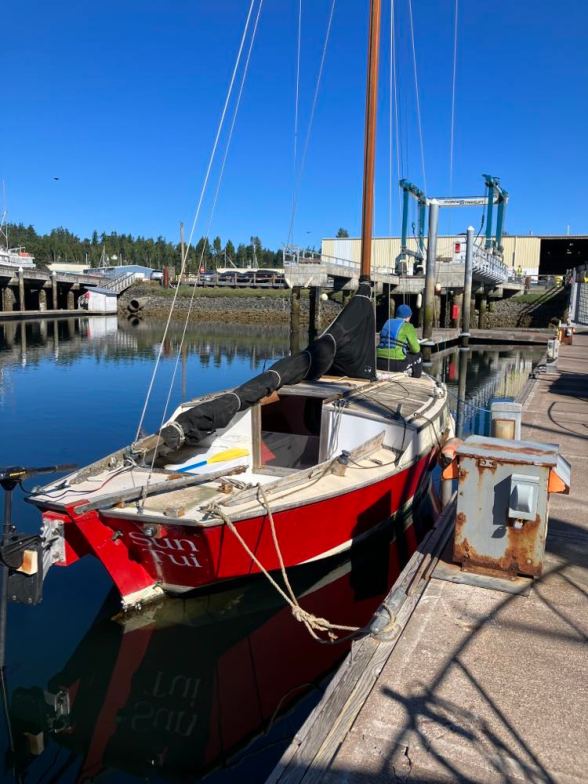
Sun Tui is a 23 foot sloop, built in Hong Kong by American Marine in 1960. She is plywood sided and has a nearly full keel. The crane operators yesterday say that she weighs 5000 pounds: that keel makes her very very stable to sail. The tiller is a carved dragon with the world in its’ mouth and there is a carving of Kwan Yin inside.
My daughter and I used a 40lb trolling motor to drive her through the boatyard yesterday. That is equivalent to 1/2 horsepower, but the little motor could still move the boat. There was very little wind or waves. We got to the smaller of the two cranes. The crane operators measured Sun Tui and then looked at the trailer. Huge thanks to my friend R! He and I replaced the tail lights on the trailer two days ago and he brought it to the boatyard. I don’t have a truck.
Here my daughter and I are waiting until the crane is in place and the slings are lowered.
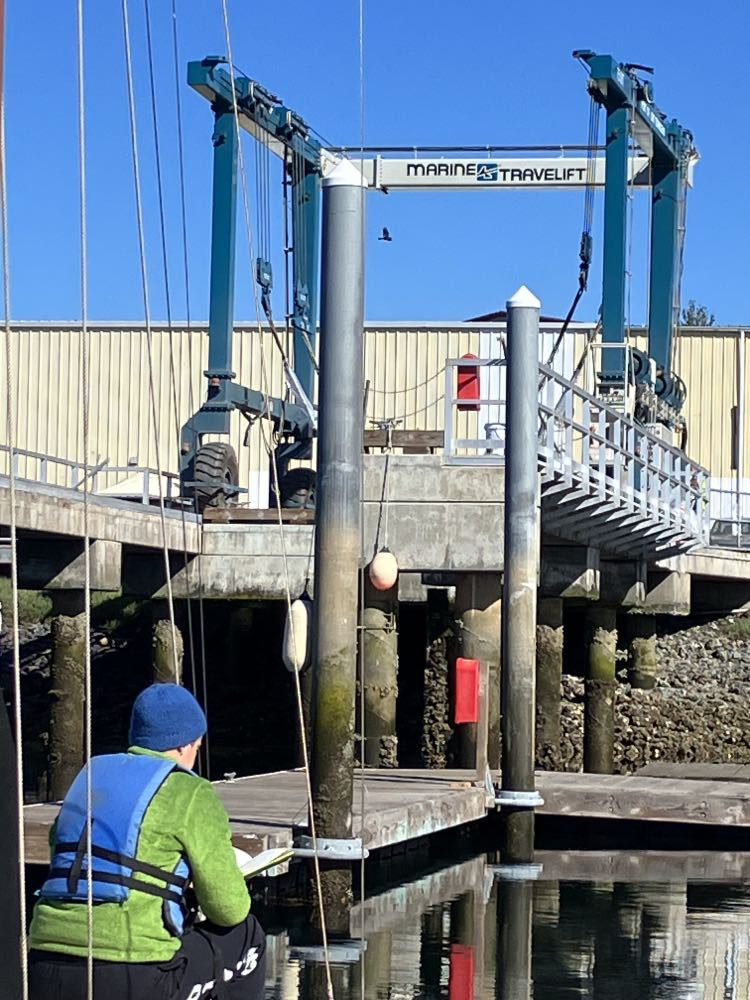
We motored slowly into the sling. The crane operators caught the boat and held it with boathooks while the operator slowly started lifting the slings. We rode up to the street level, they moved the boat towards the street, and we stepped off. The boat is raised until it can be carried through the boatyard.

Here she is pressure washed, to help prevent species from moving from one place to another.

Rolling. We have one huge crane and three smaller. This is one of the smaller ones.

They were very careful and thorough putting Sun Tui on the trailer.
On the trailer, but not home yet! The mast is too tall to go through town without hitting wires that cross streets! Next we go to Haven Boatworks, where a second crane removes the mast and the shipwright helps secure everything.
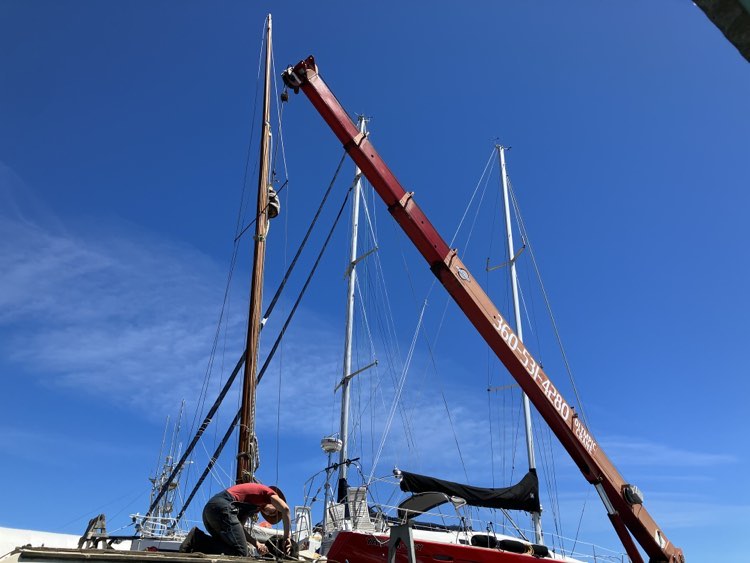
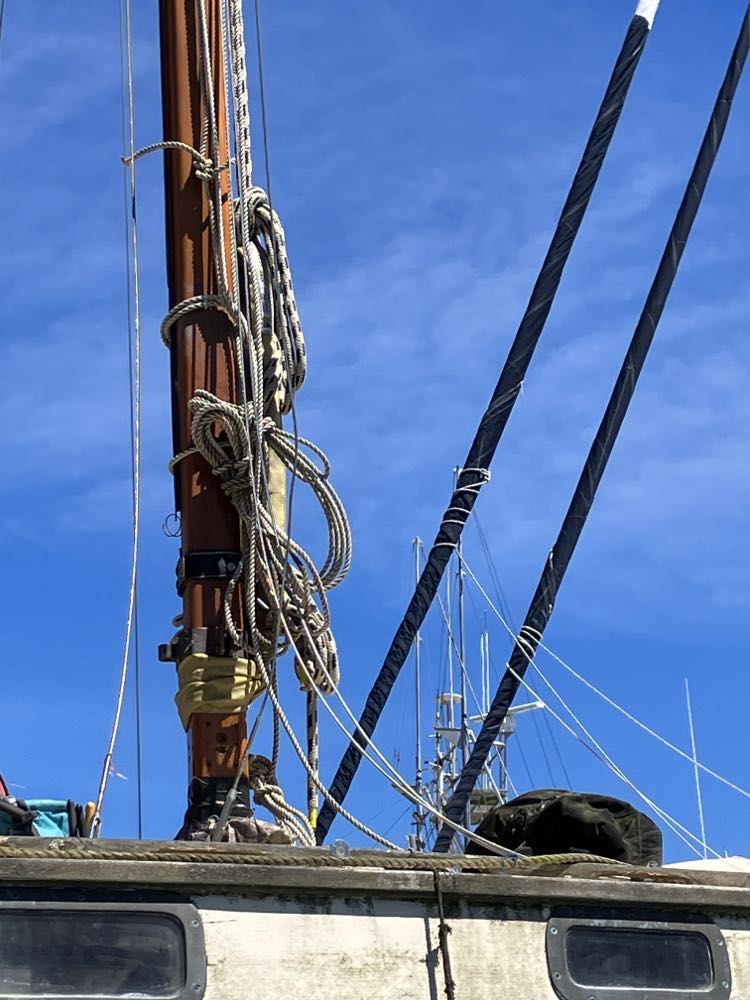
All packaged for transport!
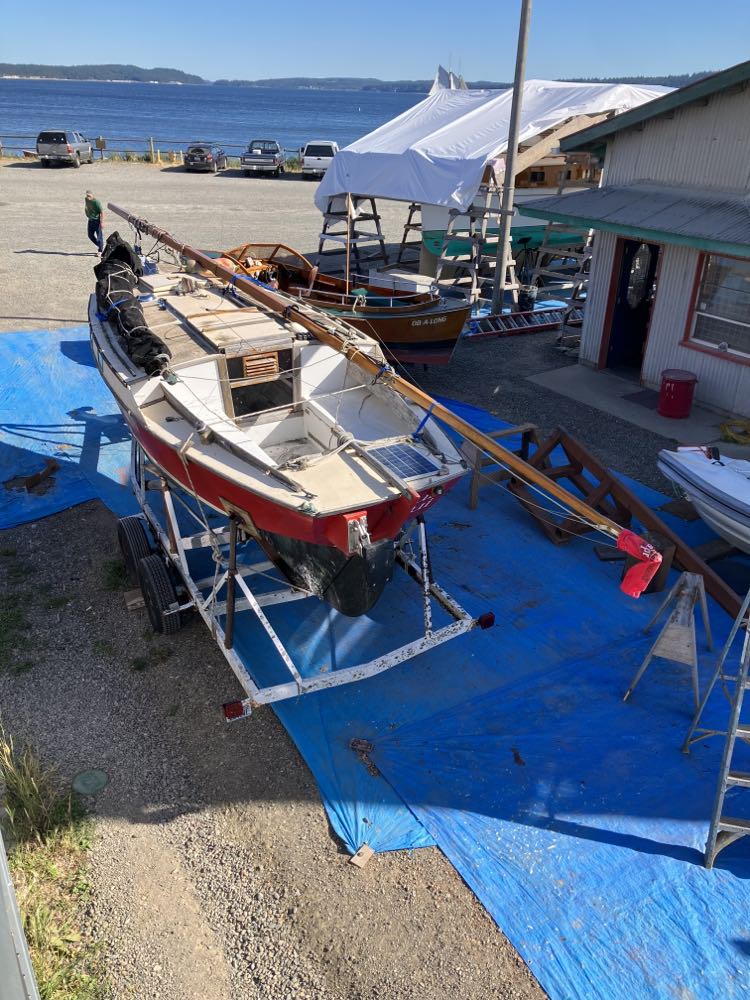
Now Sun Tui is at my house, ready for further cleaning and work. I hope that we find her a new home and much love!
I sent my son the final photograph and he sent back “Congratulations!” Hooray!
For the Ragtag Daily Prompt: congratulations.
For further information about owning this boat, email me.

Medicare doesn’t cover everything.
It can’t. There are new things being thought up all the time. Some are legitimate and some are scams. There are tons of quack medicine videos and supplements and stuff on line.
But there is also a matter of personnel and resources. Sometimes we do not have enough. Then we have to do the best we can with what we have.
There is a particularly difficult case from my second year of rural Family Medicine with Obstetrics. Things went right but just barely. This is from memory and over 25 years ago, in the 1990s, so I can’t violate hipaa because I can’t remember names from then. Mostly.
I had a pregnant woman whose pregnancy had gotten complicated. Her ultrasound showed an abnormal placenta. Very rarely, the placenta can grow into the uterus too far, and form a placenta increta. Even more rarely it can grow THROUGH the wall of the uterus and into another body part. That is called a placenta percreta.
In this case we thought that the placenta had grown into the bladder. We were not certain. The obstetricians were aware. Our patient was aware. A cesarean section was planned for when the fetus was mature.
Then she developed a second pregnancy complication. Preeclampsia. This is a complication where blood pressure rises, there is protein in the urine and many things can go wrong. It can progress to eclampsia, which means seizures. This is Very Bad, which means the mother and fetus can die.
She developed HELLP syndrome. This is an acronym. The P is what I worried about, platelets. Platelets help your blood clot. Her platelet count was dropping out of sight. We were rural, 180 miles from the nearest high risk obstetrician. We did have blood for transfusion but NO PLATELETS.
The treatment for preeclampsia with HELLP syndrome is to deliver the baby. I called our obstetrician the minute I got the lab result. “No platelets — can I fly her out?”
“YES! FLY HER OUT!”
Transfer to a bigger hospital with facilities for a premature infant and with platelets, because she needs a cesearean section and she could need a hysterectomy if that darn placenta has grown through. Messy.
Problem number three: weather. We are in Alamosa, Colorado, at 7500 feet, which is the valley floor. We are surrounded by 14,000 foot peaks with passes in four directions. That nearest hospital with platelets is 180 miles and over a 10,000 foot pass and it is snowing.
I call Denver first. 250 miles. Fixed wing life flight. Nope, the weather is too bad to the east and north.
I call Albuquerque. 250 miles. Nope, the pass is socked in, the plane can’t get through.
I call Grand Junction. About the same distance. They say “WHERE are you?” I’ve never tried to send anyone there before. They demur and I cajole and beg. “Okay, okay!” The high risk obstetrics doctor can’t be looking forward to meeting this patient, but they accept.
From the start of calling to the arrival of a plane and crew usually takes about four hours. I want to chew my nails.At last I hug my patient goodbye and they go.
I get the call about 6 hours later. Delivered and they did have to do a hysterectomy, but mother and baby are fine. Her bladder was untouched. They had platelets.
Whew! I was so happy, and mom and baby too. Let’s give credit to my patient too: she got prenatal care. She paid attention. She knew she was high risk. I had told her to come in if anything changed and she did, so we caught the preeclampsia on time.
But it could have gone wrong in all sorts of ways. We were both careful and we were lucky. If the storm had been over Alamosa we would have done the best we could then, too, but it could have turned out quite differently. And thanks to the high risk obstetrics doctors who accept complex patients that they have never seen from rural doctors like me!
Blessings. Blessings on all the nurses and doctors and midlevels and hospital housecleaners and security and lab workers and the Life Flight personnel and First Responders and everyone who has worked and worked and worked through the pandemic.
________________________________________
I took the photograph in Maryland in December: abstract and complicated water, ice and reflections.
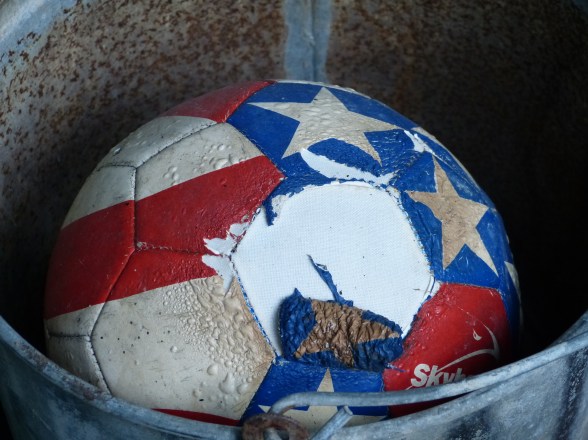
This is for photrablogger’s Mundane Monday #129.
We were two of the three first responders to a house fire across the street and two doors down two weekends ago. The house was an inferno when we got there. Both the resident and two cats got out. The fire was in the morning. We returned in the evening and walked around. It is terrifying to see what melts, what explodes, how fast the destruction can happen.
And sending love to the injured and lost in Las Vegas and still thinking of all of the hurricane victims.
I wish today were mundane.

My small clinic has only been open again with our wonderful Megan Bailey, PAC, for a month, but we’ve already seen two people with influenza. And that is seeing less then ten people daily.
Please get your influenza shot. Yes, it doesn’t cover all of the strains, but most years it covers 80%. And initially Washington was seeing influenza B but now it’s influenza A and that has better coverage.
Remember that the vaccine takes up to two weeks to provide immunity. Consider wearing a mask if you have to go on an airplane — our second patient with influenza had gotten off an airplane that day. If you get a cold within one or weeks of getting the influenza vaccine, that is not caused by the vaccine. You are still at risk for influenza as well, especially the first two weeks.
If you have influenza, stay home and try not to expose other people. If you have frail or elderly or sick family, or very young children in the family, make sure that you get to the doctor early and see if prophylactic treatment is needed for household members who are exposed. If you are in the doctor’s office with any upper respiratory symptoms, put on a mask. That way you will not infect and potentially kill other patients.
Here is the CDC weekly influenza surveillance map: http://www.cdc.gov/flu/weekly/usmap.htm
You can watch it change color as the influenza crosses the country from east to west.
Please take care and Happy New Year!
The picture is the Solstice sunrise outside my house…
“We may never know exactly how [transmission] happened, but the bottom line is that the guidelines didn’t work for that hospital,” said Frieden. “Dallas shows that taking care of Ebola is hard.”
From the Huffington Post: http://www.huffingtonpost.com/2014/10/20/ebola-hospitals-us_n_6018372.html
And for me, a lowly rural Family Practice physician, from the American Academy of Family Practice: “The first steps in preparing your office for a possible Ebola case are to make sure you have all referral contact information ready to go and that you educate each staff member on his or her role should a case present.”
There is only me and a receptionist. We don’t have hazmat suits. Actually I’ve been off sick, lung and vocal cord problems, for all of October.
We have masks, gloves, I do have a white coat that I almost never wear.
Also from the AAFP:”Appointment clerks and front-desk personnel taking calls for appointments should inquire about African travel history in patients calling for appointments for fever, headache, weakness, diarrhea, vomiting, muscle aches or bleeding,” said Mahoney. “Anyone with a positive travel history should be contacted by a provider to gather additional history and determine if public health authorities need to be involved before a patient even presents to the physician office.”
http://www.aafp.org/news/health-of-the-public/20141017eboladisprep.html
We are both going to get our influenza shots this week. Please get your influenza shot. There is a lot more influenza around than risk of ebola in the United States, and influenza kills many many people every year. And even if you “never get colds” and “have a strong immune system”, you might get a mild case of influenza and pass it on to someone who then dies of it. If you tell me “I got flu the last time I got the shot”, excuse me, but that is hooey. First of all, it takes two weeks for your immune system to respond to the shot, so if you got symptoms the next day it could be influenza but not from the shot. Maybe from being exposed to someone with influenza at the grocery store or your doctor’s office. Secondly, people say “flu” and often they mean stomach flu. Stomach flu is not influenza. Third, influenza changes all the time, so about 80% of the vaccinated people are protected most years. That’s right: two weeks after my influenza shot, I am about 80% protected. Not 100%.
Why are we getting vaccinated? For one thing, we are health care workers and we get exposed. And for another, the initial symptoms of influenza are the same as the initial symptoms of ebola. Actually the United States is really rather lucky that the ebola case happened before influenza really hit, because they look too much the same initially. Suppose that three of the quarentined people had come down with influenza….. confusion and panic initially.
So please get your influenza vaccine, because you not only help to protect yourself, but protect others and prevent panic.
Blessings!

We need to help people with ebola in other countries: or else we won’t deserve and won’t get help when the United States is the center of an epidemic.
I am a member of a doctor website called Sermo. I rarely write there, especially after I found advertisements to medical equipment and drug companies saying that they could pay to put announcements and articles on the site and “reach doctors”. Also, apparently some doctors on the site think that it is “safe” to write things. Ha. It’s the internet, silly, the opposite of safe. Your words could get back to your patient, ok?
Anyhow, there was a survey and 75% of the doctors on the site who took the survey (I didn’t) said we should stop flights from Liberia. I think they are wrong, are not compassionate, and I would cross them off my referral list as discriminatory “I’ve got mine, everyone else can go to hell.” selfish gits. I disagreed and said that the United States could be the center of an epidemic, easily. Could be. Will, some day. We need to treat our international neighbors as we want to be treated.
That being said, I am pleased to see the CDC and United States hospitals now stepping up and getting their hazmat suits on. The rest of us need to NOT PANIC.
If you want to do something, think about your communities emergency preparedness. Are you prepared?
1. Do you have a weeks worth of food, water, medicines, supplies? Do you update the supplies (ok, I have food from 2009. Time to update.)
2.Do you have a weather radio? (http://www.emd.wa.gov/publications/pubed/where_to_get_weather_radios.shtml)
3. Do you have a family meeting point? Do you have an out of state person that the family is to call to check in? That everyone knows about?
4. Have you subscribed to emergency notifications? (http://www.emd.wa.gov/publications/pubed/noaa_weather_radio.shtml)
5. Consider buying your community a shelter box. Or teaming with friends to buy one for the community and another for a disaster area. Our Rotary group buys at least one a year for international disaster relief. (http://www.shelterbox.org/ and http://www.shelterboxusa.org/)
6. Do you have skills? Can you set up a tent, cook food, do medical care, start a fire, build shelter? What skills could stand brushing up? Have you taken a first aid class recently? Have you taught your children these skills? Do you have neighbors that would need help? You would want someone to help your grandmother, who lives four states away. Adopt a local elderly person or couple that you would help……
The picture is my daughter and niece in 2009 in a 19 pound canoe that is very tippy. They only tipped it over on purpose. They both have a lot of skills, some learned at cabins in Ontario, Canada. The cabins are one room and could also be described as shacks: but the kids get to use tools, paddle canoes, start fires, sleep in a tent……
My parents taught care of the tent so well that I have a kelty tent that my sister and I set up, took down and used, and it still does not leak. It is more than 40 years old! Aluminum poles, no shock cords and a fly. Excellent.
BLIND WILDERNESS
in front of the garden gate - JezzieG
Discover and re-discover Mexico’s cuisine, culture and history through the recipes, backyard stories and other interesting findings of an expatriate in Canada
Or not, depending on my mood
All those moments will be lost in time, like tears in rain!
An onion has many layers. So have I!
Exploring the great outdoors one step at a time
Some of the creative paths that escaped from my brain!
Books, reading and more ... with an Australian focus ... written on Ngunnawal Country
Engaging in some lyrical athletics whilst painting pictures with words and pounding the pavement. I run; blog; write poetry; chase after my kids & drink coffee.
Coast-to-coast US bike tour
Generative AI
Climbing, Outdoors, Life!
imperfect pictures
Refugees welcome - Flüchtlinge willkommen I am teaching German to refugees. Ich unterrichte geflüchtete Menschen in der deutschen Sprache. I am writing this blog in English and German because my friends speak English and German. Ich schreibe auf Deutsch und Englisch, weil meine Freunde Deutsch und Englisch sprechen.
En fotoblogg
Books by author Diana Coombes
NEW FLOWERY JOURNEYS
in search of a better us
Personal Blog
Art from the Earth
𝖠𝗇𝗈𝗍𝗁𝖾𝗋 𝖶𝗈𝗋𝖽𝖯𝗋𝖾𝗌𝗌.𝖼𝗈𝗆 𝗌𝗂𝗍𝖾.
Taking the camera for a walk!!!
From the Existential to the Mundane - From Poetry to Prose
1 Man and His Bloody Dog
Homepage Engaging the World, Hearing the World and speaking for the World.
Anne M Bray's art blog, and then some.
My Personal Rants, Ravings, & Ruminations
 KO Rural Mad As Hell Blog
You must be logged in to post a comment.