
Hopes rise

Our Christmas plans are busily crashing and burning. I felt ill and tested covid positive two days before my daughter was due from her city. ALERT, ALERT, DIVERT! I called friends who agreed to pick her up at the airport and let her stay for the five days of isolation. I stay out of the car so the germs will die. I call her after her work on Friday. She takes it calmly and calls a friend to pick her up. I miss her, darn it, but well, I am not on a ventilator or dead. Doing well, right?

She stays with her friend. She plans to join me yesterday but then snow. School is canceled. She and her friend sensibly leave my car at the entrance to the ridge road the friend lives on. She has to use the chains anyhow because someone has slithered off the road right in front of my car. Still grateful, because they did not hit my car.

She makes it to my house, chains on. She heads downtown to Christmas shop but the store she wants is closed. I ordered her a present that needs to be picked up, but the pick up is Tuesday to Saturday. They don’t list a phone. I ordered it on Sunday and they had emailed “Pick up now” even though it’s not “open” on Sunday. I email back, “Can’t, covid!” Now I email again and say would they contact my daughter or me so she can pick up. They do, but well after she is home. Still grateful, because they are open today. Maybe we’ll get it!

My daughter has been looking forward to time with friends but the snow has screwed this up. Maybe to time with mom, too, but mom has Covid. I am eating upstairs, she is eating in the basement, and same with sleeping. We are both masking and everyone is sick of that. It’s cold outside and the band she wants to dance to cancels. She misses meeting a friend downtown because of chains and needing gasoline. I am still grateful. Not dead yet, right?

Now I have email from our flight saying, well, maybe we’ll go. We are supposed to fly later this week. It looks like the big storm will hit Chicago and Buffalo and Boston. Cross fingers as we head for Dulles. Might make it. We discuss going to Sea-Tac a day early but that would mean sleeping in the same hotel room and no, we aren’t going to do that. Friends say they CAN get us to the airport. Super grateful for those friends!

When things are going all awry and life seems like rather a mess, we do Happy Things. That is a check in at the end of the day where we list three Happy Things each. My son was having a miserable half way through the year first grade move when we started this. The thing is, they do not have to be VERY happy. They can be more along the lines of “No one has poured boiling oil over me today.” or “Not dead yet.” It’s complaining reframed and it can be very very funny. In first grade one of his Happy Things was “We did not have the pizza that tastes like cardboard for school lunch today.”

So my Happy Things yesterday were: “I am not on a ventilator! I am not dead! We have super nice friends who will take us two hours to the airport!” If you start low enough on the Happy Things scale, there is no where to go but up.

And a Happy Thing for today: “I think the sun will rise!”

Happy Solstice.

_____________

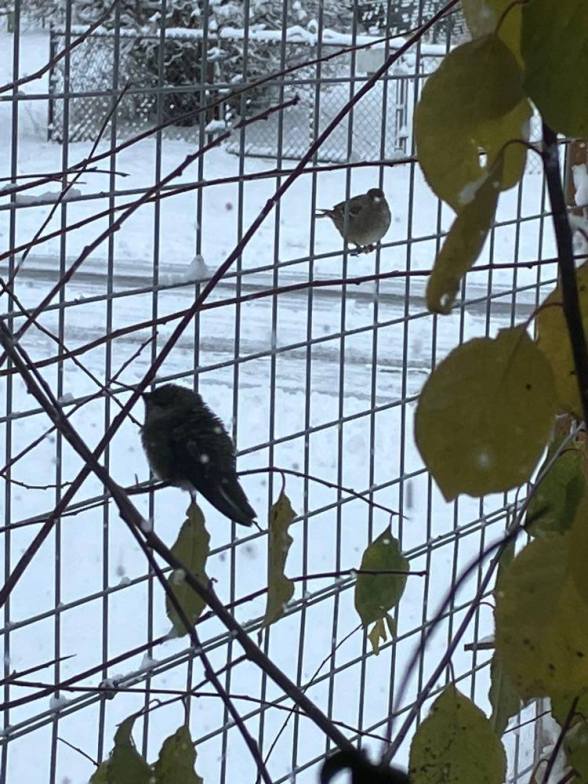
The photograph is Emerald, one of the Anna’s Hummingbirds, all fluffed up in the cold and guarding her feeder. There is a bird photobombing the background. I think it is a song sparrow but it was very early and the light is not great.

For the Ragtag Daily Prompt: rise.

Adverse Childhood Experiences 13: on gratitude

I saw a meme today about gratitude. It is saying that some people look at a garden and see thorns and weeds, but others see the roses. That we need to have gratitude. I think this is simplistic and papers over the trauma and grief that some people have. If they have endured a highly traumatic childhood, who am I to say they should focus on the roses? They may have a very good reason to see if there is something like a thorn that can hurt them before enjoying the roses.

I work with many patients with high Adverse Childhood Experience scores and mine is high too. I don’t tell my patients that they should have gratitude. I tell them “You survived your childhood. You have crisis wiring. Good for you. Some of your learned crisis survival wiring may not serve you as well now as it did when you were a child.” Then we discuss whether they want to work on any aspects and the many many different approaches. One example: a man who sleeps very lightly. He said that it was lifelong. When asked about his childhood he says, “We would have to leave in the night when there was shooting in my neighborhood. It was a very dangerous area.” I said, “I am not surprised you sleep lightly. You HAD to in childhood to survive. Is this something you want to try and change?” He thought about it and decided, no. Once it was framed as learned in childhood to survive, he stopped worrying about “normal”. He was satisfied that the way he slept was “normal” for him and he wanted to wake up if he heard shooting.

I think we have to ask why a person sees thorns and weeds in a garden before we judge them. My first thought with a new and angry or hostile patient is always, oh, they have been badly hurt in the past. What happened? I don’t worry that the anger is at me. I know it’s not at me, it’s at the system or a past physician or a past event. Under the anger there are other emotions, usually fear or humiliation or grief. I have brought up Adverse Childhood Experience scores on the first visit sometimes. One person replies, “I am a 10 out of 10.” The score only goes up to 8 but I agree. He was a 10. He stated once, “The military loved me because I could go from zero to 60 in one minute.” Very very defensive and very quick to respond. The response may seem extreme and inappropriate to other people: but it may feel like the only safe way to be to my patient.

I grew up hiding any grief or fear in my family, under anger, because grief or fear would be made into a story told for laughs. In college, a boyfriend told me I was an ogre when I was angry. I started working on it then and it was difficult to tame that. The person who took the longest was my sister: she could make me explode until I was in my residency. Medical training was excellent for learning emotional control, at least, on the surface. After my mother died, I had to do the next piece of emotional work: open the Pandora’s Box of stuffed emotions, mostly fear and grief, and let them out. It was such hard work that my day where I saw the counselor for an hour was harder than my ten hour clinic day. I did the work, for two long years. Blessings on the counselors who stood by me while I worked through it.

I do not think we are ever done with that sort of work. I think, what do I need to learn next? What is this friend teaching me? Why is this behavior frustrating me and I have to look in my inner mirror. Why, why, why?

Blessing on your healing path and may you not be judged.

Link about ACE scores: https://www.cdc.gov/violenceprevention/aces/about.html

Sometimes I do feel like a fossil, now that I am middle aged. For the Ragtag Daily Prompt: fossil.