For Cee’s Flower of the Day.
Pale purple


For Cee’s Flower of the Day.

Why would I need a weapon? I have two fierce watch cats. Sol Duc exploring and leading the way, while Elwha could stun an intruder with his very loud purr. Sixteen pounds of warm, vibrating fur.
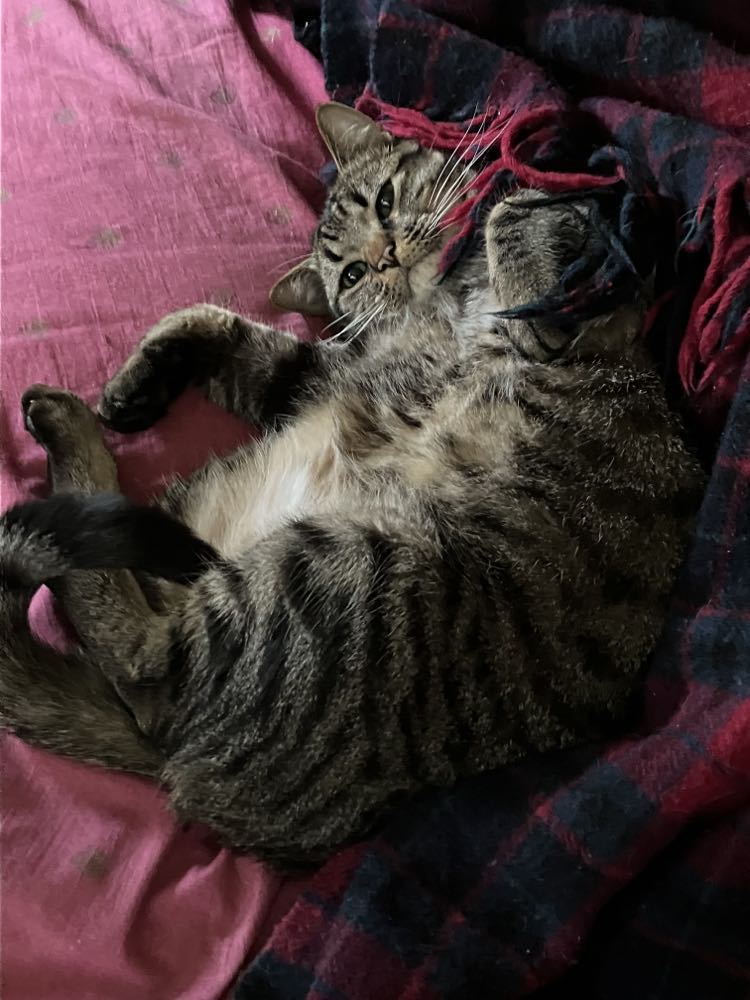
For the Ragtag Daily Prompt: weapon.

Taken in my unmown yard, the fruits are ripening.
For Cee’s Flower of the Day.

In the last Long Covid talk that I attended and wrote about (here: Pulmonary Manifestations of Long Covid), the pulmonologist and intensivist says that one problem with Long Covid is that we do not have imaging that can “see” it.
That is, the chest x-ray looks normal, the echocardiogram may look normal (heart ultrasound), the chest CT scan may look normal, a brain CT or MRI may look normal, but the patient may still be tachycardic, feel exhausted, feel brain fog and have multiple other symptoms.
That pulmonologist listed five of the top mechanisms that are prolonged in the immune system. Most of the scientists and physicians are framing this as “immune system dysfunction”. I am not. I am framing it as “you were really really sick and your immune system is still on high alert and trying to protect you so you can recover”. Now wait, you say, how could chronic fatigue like symptoms protect me? Well, if you are exhausted, you can’t go to work and you’ll stay quiet at home most of the time and less exposure chance. But what about brain fog? Again, this will slow your interaction with other people and force you to rest and heal. But, you say, I don’t like it. Well, yeah. Patience. We call grumpy patients that are recovering “convalescents”. It is a good sign when they are grumpy and over it and just want to be better. That doesn’t mean I can make myself or anyone else heal faster.
The pulmonologist says that the best test is the six minute walk test. This is usually done by a respiratory therapist. The person walks in a circle for six minutes wearing a pulse ox, with the respiratory therapist doing regular checks. This distinguishes between the people who have primarily a lung issue from all the other issues. If the person is tachycardic (fast heart rate) but not hypoxic (oxygen level dropping), then it’s not primarily lungs though blood clots to the lungs sometimes have to be ruled out. One of the mechanisms in the immune system is microclots and an increased risk of blood clots. That can mean heart attack, stroke, or pulmonary embolus, a clot in the lungs. The microclots are suspected of causing some of the muscle fatigue and exercise intolerance, by clogging capillaries and reducing oxygen flow to muscle cells. Muscle cells do not like this at all.
I have done my own quick walk test with patients since 2003, when I had terrible influenza. About a week after my influenza started, with the temperature of 104 and heart rate at 100 at rest and 135 walking, my temperature came down. However, the fast heart rate continued. Normal heart rate is 70-100 and 135 walking will make you feel exhausted. I lay on the couch and could barely make my kids dinner for two months. It resolved then. I read a book about influenza and thought that I had “influenza viral pneumonia” where there is lung tissue swelling, reducing the air spaces, after influenza.
My quick walk test in clinic is to check a sitting oxygen level and heart rate and then have the person walk. I would have them walk up and down a short hall three times then sit down. When they sat, I watched the pulse oximeter recovery. Some people would jump from a resting heart rate of 62 to a walking heart rate of over 100, say 120. Their oxygen level could stay normal or it could drop. If they dropped below 88, I would get home oxygen and forbid them to return to work. If their oxygen level held, then they needed to rest until their walking heart rate stayed under 100 and they were no longer exhausted by gentle or normal activity. If they return to work with a walking heart rate of 120, they will be exhausted and are more likely to get a secondary pneumonia or have other problems. The heart does not like to run at 120 all the time. You can see why a person who already has some coronary artery blockage would be more likely to have a heart attack if they get pneumonia from influenza or Covid-19.
The conferences I am attending are talking about “targets” in the immune system. That is, new drugs. I think the science is wonderful and amazing, but I also think we need to step back and say, this is a really really bad infection and some people need a lot of support and reassurance and time to heal. Reassure them that even though they have not yet returned to normal, the immune system is working hard to protect them from other infections and it is saying very very loudly that they need to rest. Rest, recuperate and trust the immune system. Some things need immediate treatment, especially blood clots, heart attacks and strokes, but once those are ruled out, we need to support people through their convalescence and healing.
______________
The photograph is from April 2021, a few days after I was put on oxygen. A selfie.
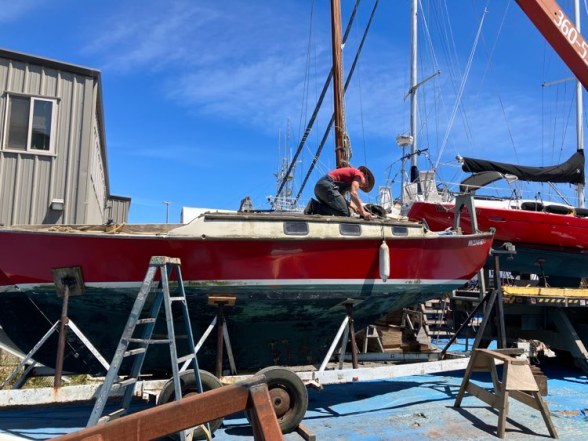
You can see the ladder that we used to clamber on and off the boat while the mast was removed, set down on sawhorses by the boat and then secured on the deck. I had a woman shipwright from Haven Boatworks and she was fast and efficient. I helped. I am not bad with knots but she is way better.
I have a ladder at home so I can do some cleaning and buffing and show Sun Tui to interested buyers!
For the Ragtag Daily Prompt: ladder.
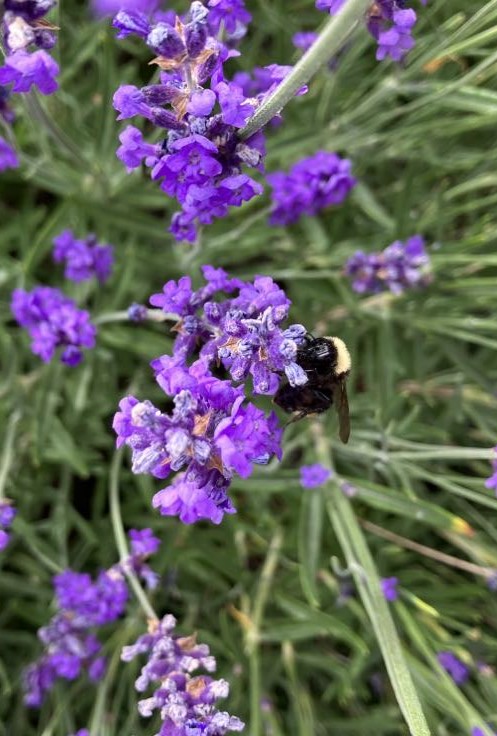
A very happy bee enjoying the lavender.
For Cee’s Flower of the Day.
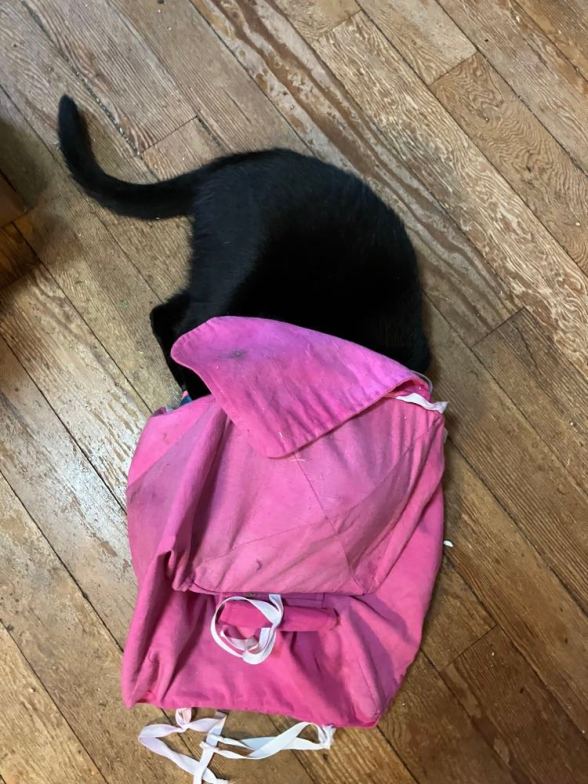
Sol Duc is choosing a present for bushboy from the Barbie tent.
I don’t know if the cats know about the Barbie movie, but right now they just love the tent. It has a center pole. As soon as I set the pole up, a cat will go in head first and knock it down. The camping gear inside includes a back pack and camping stove and sleeping bag which belong to a Get Real Girl rather than Barbie. There are also some Barbie diving gear, fins and so forth.
Happy Birthday, bushboy! Don’t know what Sol Duc will choose for you!
For the Ragtag Daily Prompt: presents.

These are rather wonderful and I have no idea what they are.
For Cee’s Flower of the Day.
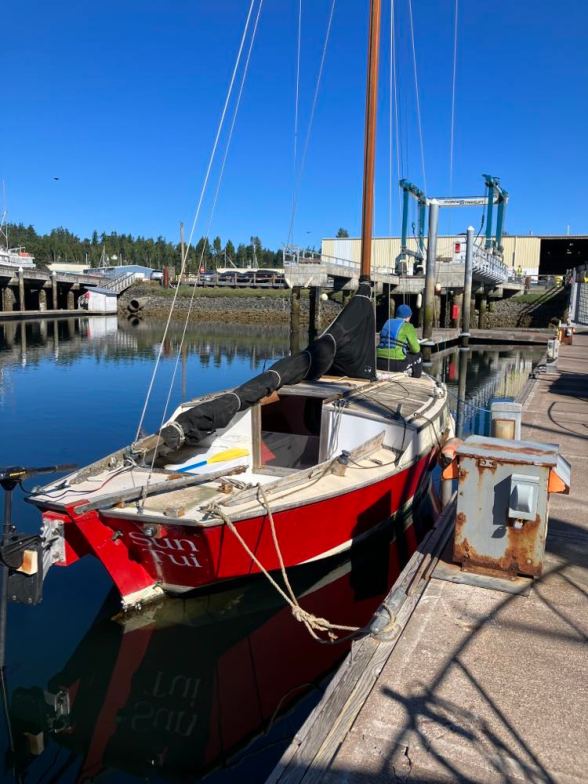
Sun Tui is a 23 foot sloop, built in Hong Kong by American Marine in 1960. She is plywood sided and has a nearly full keel. The crane operators yesterday say that she weighs 5000 pounds: that keel makes her very very stable to sail. The tiller is a carved dragon with the world in its’ mouth and there is a carving of Kwan Yin inside.
My daughter and I used a 40lb trolling motor to drive her through the boatyard yesterday. That is equivalent to 1/2 horsepower, but the little motor could still move the boat. There was very little wind or waves. We got to the smaller of the two cranes. The crane operators measured Sun Tui and then looked at the trailer. Huge thanks to my friend R! He and I replaced the tail lights on the trailer two days ago and he brought it to the boatyard. I don’t have a truck.
Here my daughter and I are waiting until the crane is in place and the slings are lowered.
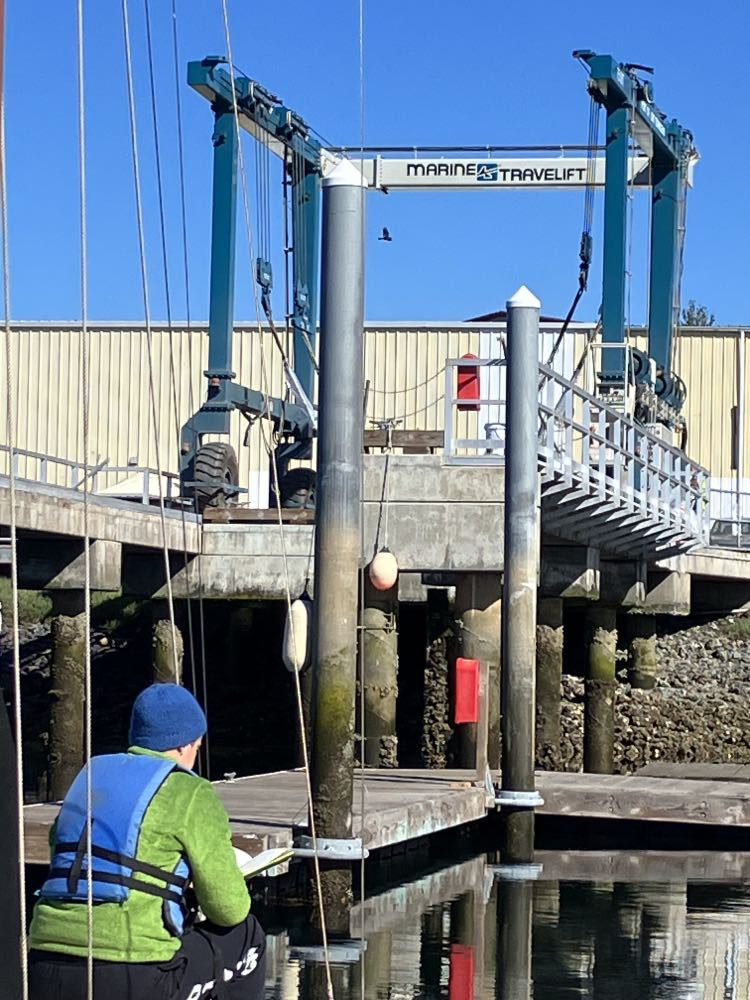
We motored slowly into the sling. The crane operators caught the boat and held it with boathooks while the operator slowly started lifting the slings. We rode up to the street level, they moved the boat towards the street, and we stepped off. The boat is raised until it can be carried through the boatyard.

Here she is pressure washed, to help prevent species from moving from one place to another.

Rolling. We have one huge crane and three smaller. This is one of the smaller ones.

They were very careful and thorough putting Sun Tui on the trailer.
On the trailer, but not home yet! The mast is too tall to go through town without hitting wires that cross streets! Next we go to Haven Boatworks, where a second crane removes the mast and the shipwright helps secure everything.
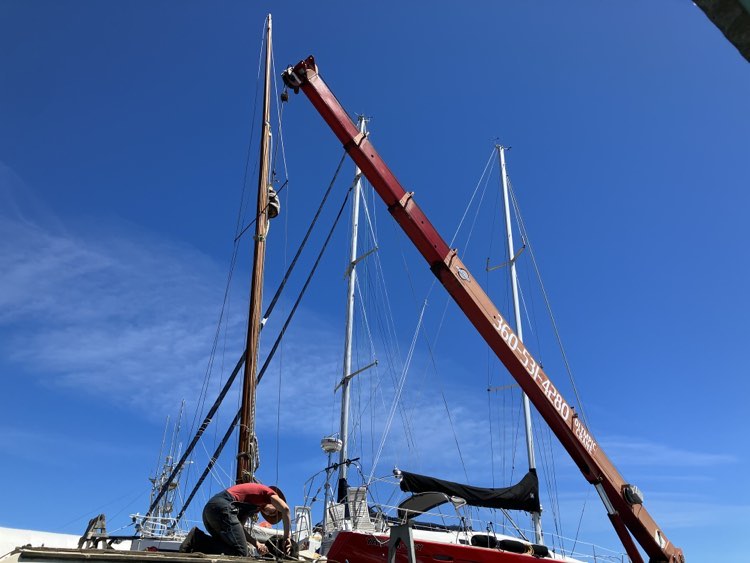
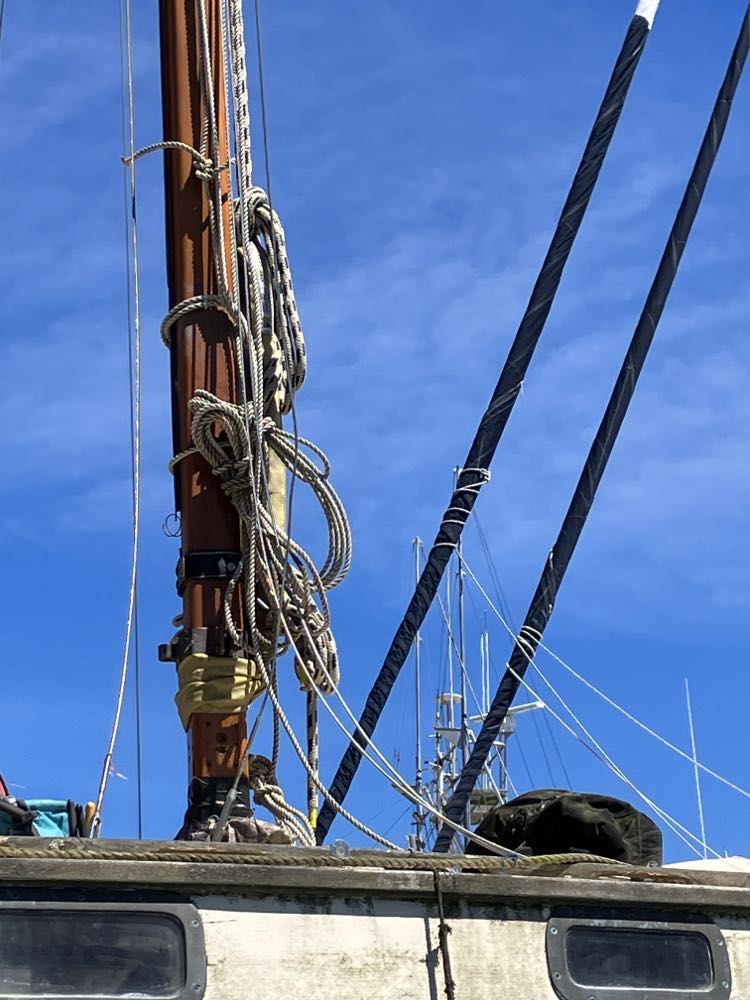
All packaged for transport!
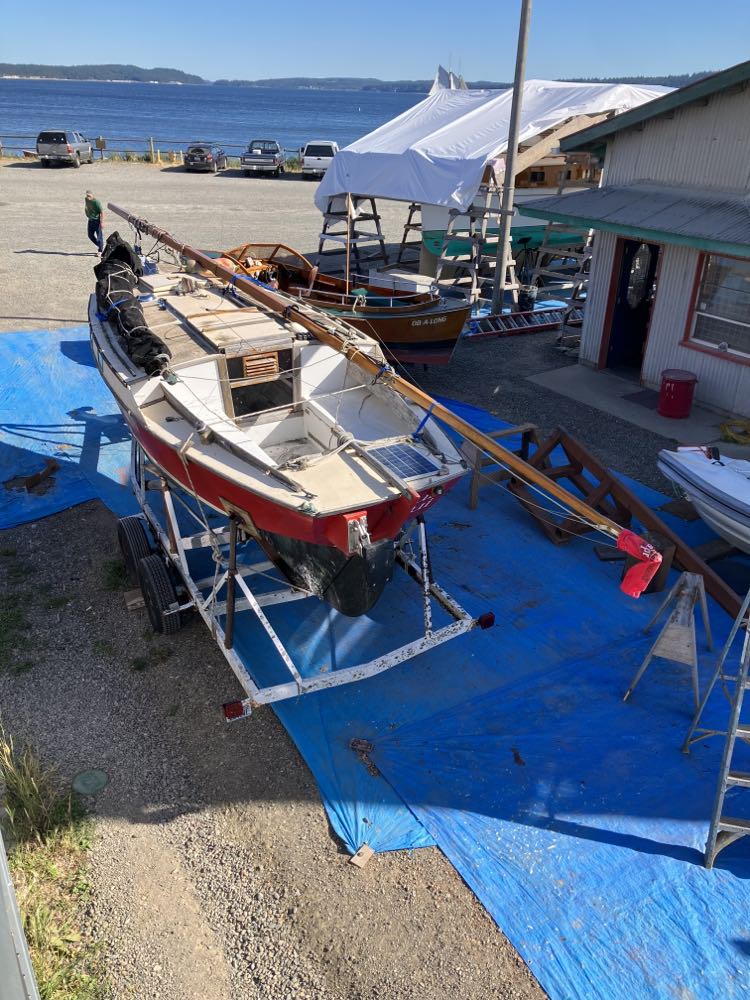
Now Sun Tui is at my house, ready for further cleaning and work. I hope that we find her a new home and much love!
I sent my son the final photograph and he sent back “Congratulations!” Hooray!
For the Ragtag Daily Prompt: congratulations.
For further information about owning this boat, email me.

The blackberries are on their way. This is the invasive species.
For Cee’s Flower of the Day.
BLIND WILDERNESS
in front of the garden gate - JezzieG
Discover and re-discover Mexico’s cuisine, culture and history through the recipes, backyard stories and other interesting findings of an expatriate in Canada
Or not, depending on my mood
All those moments will be lost in time, like tears in rain!
An onion has many layers. So have I!
Exploring the great outdoors one step at a time
Some of the creative paths that escaped from my brain!
Books, reading and more ... with an Australian focus ... written on Ngunnawal Country
Engaging in some lyrical athletics whilst painting pictures with words and pounding the pavement. I run; blog; write poetry; chase after my kids & drink coffee.
Coast-to-coast US bike tour
Generative AI
Climbing, Outdoors, Life!
imperfect pictures
Refugees welcome - Flüchtlinge willkommen I am teaching German to refugees. Ich unterrichte geflüchtete Menschen in der deutschen Sprache. I am writing this blog in English and German because my friends speak English and German. Ich schreibe auf Deutsch und Englisch, weil meine Freunde Deutsch und Englisch sprechen.
En fotoblogg
Books by author Diana Coombes
NEW FLOWERY JOURNEYS
in search of a better us
Personal Blog
Raku pottery, vases, and gifts
𝖠𝗇𝗈𝗍𝗁𝖾𝗋 𝖶𝗈𝗋𝖽𝖯𝗋𝖾𝗌𝗌.𝖼𝗈𝗆 𝗌𝗂𝗍𝖾.
Taking the camera for a walk!!!
From the Existential to the Mundane - From Poetry to Prose
1 Man and His Bloody Dog
Homepage Engaging the World, Hearing the World and speaking for the World.
Anne M Bray's art blog, and then some.
My Personal Rants, Ravings, & Ruminations
 KO Rural Mad As Hell Blog
You must be logged in to post a comment.