
Climbing the walls

When my father died, he left me a will written more than 40 years earlier. He and my mother and my maternal grandparents were all pack rats. It was a house and two barns and ten years worth of some mail. A mess.

After working on it for a year, I felt like I was in knots and couldn’t relax. I was quite sick of counseling and wanted to do body work instead. I found a massage person and worked with him for over a year.

On the first visit he talked to me and then had me stand and walk around. “You are head forward and your toes are gripping the floor.” “I am not!” I said, lifting my toes. He was right, though. I had to relearn how to walk for two weeks, lifting my toes up.

I went to see him once last spring, knotted up again. I thought I was much better at unknotting during the work. I asked, “So am I pretty relaxed?”

He laughed. “You’re NEVER relaxed. Your baseline is 7/10 but you notice that you are tight when you get up to a 9 or 10.” He said that relaxed was 1-3.

I was hurt and annoyed. All that work and he’d never said that and never given me tools. I tried to contact him by email but he either didn’t remember what he said or just wouldn’t deal with it.

I was grumpy.

Meanwhile in clinic, I was teaching the breathing technique to try to relax, to go from sympathetic fight or flight, to parasympathetic. Breath in for a slow count of 4 seconds, then out for a slow count of 4 seconds. I thought, well, I should do it more too. I decide that when I wake up, I will do the breathing technique.

It promptly put me back to sleep. I have used slowing my breathing to go to sleep. I also had three years in college and after where I did daily zen meditation, facing the wall, on a zafu, for forty minutes. Add my flute playing and singing in chorus for the last 24 years and I can do the count way past four. My mind, however, is a very busy place, and meditation often felt like letting a cage full of crazy monkeys out. They all wanted attention. My understanding of zen is that I am supposed to let the monkeys show up but not hold on to them, converse with them, or let them hold the floor. Return to the breath.

When we wake up, we have a cortisol burst in the morning. It gets us going. I am pretty sure that I have some adrenaline too. The slowed breathing calms that right down. According to the pain clinics, twenty minutes of slowed breathing calms almost everyone down into the parasympathetic state. I don’t think that the high Adverse Childhood Experience people are used to parasympathetic. Honestly, looking at the movies and television and video games, I think our culture is not used to it either.

The breathing in the morning is working. My neck and shoulder muscles are more relaxed (in spite of computer use). Maybe I am down to a 5/10! That would be huge progress, right?

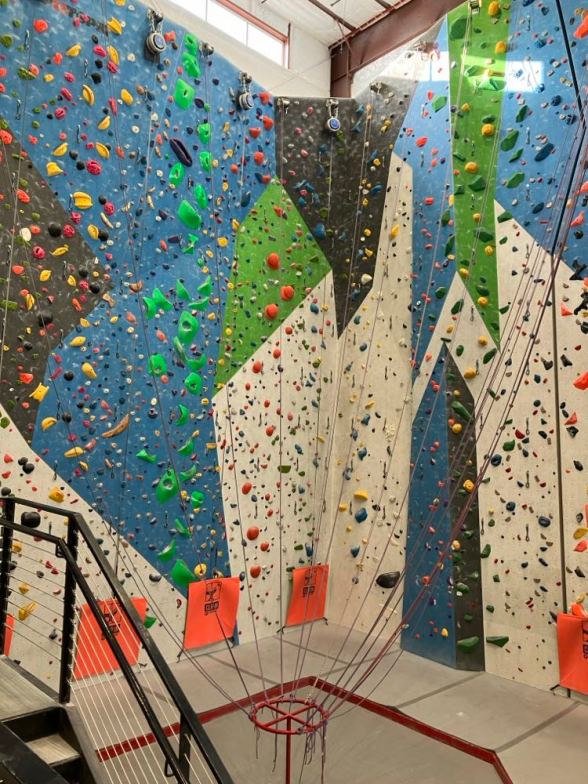
And my muscles love the climbing walls, too. Not that I am that good at it, but my muscles really like the intensity and focus. It is so different from clinic, where everything is focused on listening to the patient, typing as they talk, watching, sensing, trying to get a handle on what is happening with them. The wall is like clinic in focus, but my whole body is involved and there is lots of reaching and stretching out of that contained focus.

Sol Duc seems to be good at slow breathing. Cats go from 1/10 to 10/10 in just a heartbeat, or that’s my impression.

There is no alabaster in this house. Not a bit. Perhaps I will meditate on that.

For the Ragtag Daily Prompt: meditate and alabaster.

sleep and defiance

Oh, gosh, CNN is making everyone panic about sleep again: https://www.cnn.com/2022/11/08/health/sleep-deprivation-wellness/index.html

Don’t buy it. It used to be 8 hours. Now they are saying 7 in this article. SLEEP AT LEAST 7 HOURS OR YOUR BRAIN WILL MELT.

Nope. The media likes us to panic because it sells papers and gets shares. Don’t buy the hoopla.

After all, I took call at night for 30 years and my brain has not melted. (Ok, if you disagree, post your own blog, heh, heh.) Starting third year of medical school. Sometimes it was every third night, sometimes every fourth. We were often up and awake and working for much of the night and then through the next day. If we had to be ready for rounds at 8 am, we had to be there earlier to see the patients, check the lab work, check any studies, drink a gallon of coffee and then be coherent on rounds, where the faculty physician might quiz us about the nineteen causes of high potassium. Uh. Taking too much potassium is one. Kidney failure, diabetic ketoacidosis, etc, etc.

I made up the number nineteen.

Anyhow, I was a sleep rather than eat person. If we got a break, I would go to sleep and skip food. The bad rotations were obvious because my weight would drop. We’d meet for “nutrition rounds” in the morning. I would skip lunch, hoping to have it at home post call, but the list might have things added even as I ran around checking things off. At last I would stop for lunch at 2 or 3 or 4 because my brain was no longer functioning.

Doesn’t sound very healthy, does it?

Here is a post on sleep from 2015: https://drkottaway.com/2015/01/08/sleep/. I sent a copy to our sleep specialist and he liked it.

When I got my flu vaccination and covid booster a month ago, it hit me pretty hard. I am sleeping as I normally do at night, for 6.5-7 hours. But I also started napping, once or twice a day. I was sleeping 11 or 12 hours total daily. I canceled pulmonary rehabilitation exercise, because it wiped me out. I was starting to feel better after three weeks, so I restarted pulmonary rehab. I promptly slept 12 hours a day again and my muscles gave me HELL.

So what in the heck IS this? Well, healing. My body is knocking me out to do repair work. It’s sending a pretty clear message that running on a treadmill is not ok right now. My immune system is busy making antibodies and is saying HEY WE DO NOT HAVE ENERGY TO SPARE FOR ANYTHING ELSE. This is sort of annoying except that having had four rounds of really bad pneumonia, the last one requiring oxygen for a year, still on oxygen to sing and for heavy exertion, I am willing to listen to my body. It is annoying, but: my mother, father and sister are dead, so even though I am struggling some, I’m not dead. It’s all relative, right?

When I had pneumonia #3 (2014) and pneumonia #4 (2021), both times part of the healing is sleeping twelve hours a day. I went back to work six months after the 2014 one and promptly slept twelve hours a night. I was seeing 4-5 patients a day and could barely do that. I went into denial about chronic fatigue, but I knew I had it. NO WAY, I AM TOUGH. Well, I am tough, but that means chronic fatigue and not dead.

I do not worry about sleeping 7 hours a night or 8 hours. I sleep when I get sleepy. Naps are fine and one gets to relearn napping after age 50 or 60 and it’s ok. If you need to stay awake after lunch, have a small lunch and no alcohol. Alcohol is not good for sleep in the long term and neither is marijuana. Benzodiazepines are worse than either. Ambien and those drugs are approved for “short term” use, meaning two weeks. Great. We don’t know what it does if you are on it for years, but some of us note that those drugs are closely related to the benzodiazepines. I think the most addictive drug is tobacco, followed by benzodiazepines and then methamphetamines. That is from asking patients and observation over 30 years. There are individual quirks though, and I have had people say, “Alcohol is no problem but the first time I was given oxycodone I wanted more.” Sometimes there is a bit of denial in those statements.

The photograph is me doing my second sleep study last week. I scored. Um, or rather, it was a positive test. Sleep apnea, darn. I am now waiting for my bipap machine. The funny bit is that I had to drive an hour to the lab. I was supposed to be there at 8. I got there an hour early because I get really tired at night. The tech let me in and wired me up. “But,” she said, “you can’t go to sleep until 9, because I have another patient and they are not here yet.” “Ok,” I said. I read for a while in the chair, put my head back and (don’t tell) fell asleep.

She came back in, did the final connections and then left. There is a ceiling camera and a disembodied voice. We tested the connections. “Flex and extend your right foot.” “Now breath through your nose.” I did and immediately fell asleep. She woke me, “Breath through your mouth now.” “Was I asleep?” “Yes.” The wires didn’t bother me much, though I had to surface part way during the night to change position.

I’ve slept sitting up in hospital meetings. I fell asleep standing against the wall in medical school. It is really a blessing to be able to fall asleep.

The year my father died, I had a terrible time falling asleep. His will was very out of date, written 40+ years before. It was a mess. His house had 13 years worth of unopened mail. I used Jon Kabat Zinn’s Mindfulness Meditation tape to fall asleep. But I used it in a rather weird way. He has a section where he says “Do NOT fall asleep.” It was a body scan. I would think, hey, you can’t tell ME what to do, and I would always fall asleep during it. So there, Dr. Kabat Zinn. Thank you.

The pandemic is enormously stressful, not to mention all of the other things. You can still relax though. What relaxes YOU? Stupid animal videos? A walk around a yard or park? Dancing in your kitchen? Knitting? Reading your absolutely most boring textbook? Put the phone and the television and the computer away at least one hour before you want to sleep and preferably two hours.

And here, to relax you, are pictures of sleep: https://drkottaway.com/2018/04/30/zzzzzz/

Blessings.