Long Covid/PASC thoughts

I am still thinking about the last two Long Covid/PASC talks. (PASC is post-acute sequelae SARS-CoV-2.) I have not written about the earlier talk, which was from the group of Long Covid patients, many of the medical people, who have banded together to do their own research and advocate for research. That group said that half have ME/CFS (myalgic encephalomyopathy/chronic fatigue syndrome) and did say that they are unhappy about the research into exercise.

How do I interpret that in light of the more recent talk, with studies about exercise?

Remember that before Long Covid, we thought that about one in ten people with any severe infection may get ME/CFS. Covid-19 is a really nasty infection and hitting people way harder. However, the second talk did show evidence that many though not all Long Covid patients respond to exercise therapy. Here is my prediction: many of the Long Covid people will recover in the two year time line. Two years more or less and that’s if they get help and therapy. However, we may have ten percent, and that’s a guess, that will have a longer course. Ten percent of the people with Long Covid is a very large number of people.

My hope is also that we will learn much more about the immune system and we will be much better at treating and even curing ME/CFS. Something good out of a terrible pandemic.

There also is a recent article about people who tested negative for Covid-19, who have Long Covid. I think I am one of them. In March of 2021 I was tested twice for Covid-19 and was negative. I was also negative for strep A, influenza and RSV and we stopped testing. I needed oxygen. I did take penicillin because of the two previous strep A pneumonias. I had had my three vaccines already. Why do I think it was Covid-19? When the immunologist tested my antibody level in November 2021, he said it was the highest level he’d ever seen. Over 50 was protective and I had 25,000. I thought, that’s weird, from the vaccines? Then I got Covid-19 again in April and had super mild sniffles. I tested because I was traveling and had to push my travel back a week. I think that I tested negative, but remember, we were testing nasal drainage. I’ve only ever had one sinus infection in my life and I’m one of those people who got strep A as a child over and over. As an adult it is throat and lungs that are most vulnerable. I think some people do not shed Covid-19 in their nose. They might have gotten a different result if they had swabbed my tonsils. With that second round the home test was negative again, but I had to get an official travel test. I did it right away, five days before my plane. That test was positive.

There is discussion going on, whether Long Covid that looks like ME/CFS is the same thing or not. My suspicion is that we will see many of the people recover from the PEM (post exertional malaise), but that some will have a longer, more difficult course. And it is not very predictable. The hospitalized people who go through exercise are mostly recovering. They were debilitated from time in bed, on a ventilator, on a heart lung bypass machine. Yet there are people who were never hospitalized, had no preexisting conditions, were athletes and are still struggling. This is a nasty, unpredictable virus. A scintilla of hope and of fear.

For the Ragtag Daily Prompt: scintilla.

The agate is from Marrowstone Island. Only part of it is clear. This is one I had to dig out of hard mud.
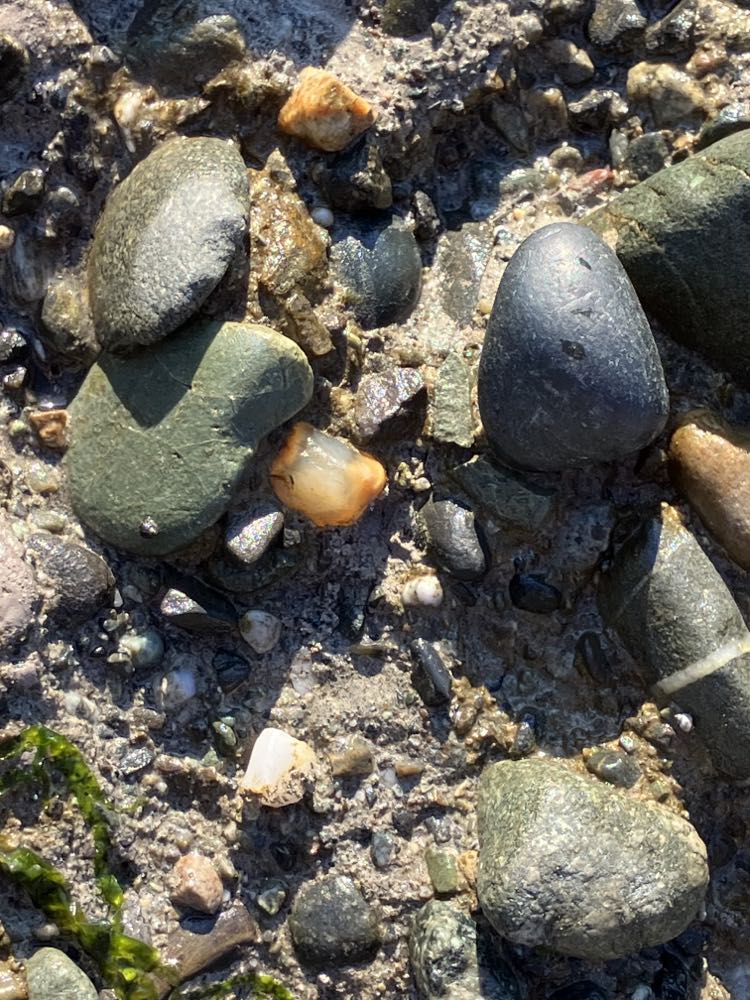
Partially clear agate in hard mud on a beach.

Long Covid and exercise

Today’s Schmidt Initiative Long Covid and exercise talk is very interesting and discussed controversies! It clarifies an argument that I have not understood very well.

Dr. Abramoff is the speaker. He calls his talk “The E-Word and Long Covid”.

His lecture broke down into three sections.

I: Exercise is good for most people and most conditions. Hippocrates thought so and there are tons of studies. We still frequently fail: more than 1/3 of world population is insufficiently active in studies. No improvement over the last 20 years and a decrease of activity in high income countries, work more sedentary, transport more sedentary, inactivity in time off. (I would add screens to that list.)

II: Before Covid, there is a study that raised major controversy regarding ME/CFS (myalgic encephalomyelitis/chronic fatigue syndrome) and exercise. The paper randomizes people with ME/CFS into four groups. 1. GET — graded exercise 2. Adaptive pacing. 3. CBT – cognitive behavioral therapy and 4. usual treatment. The study has 160 people in each of the four groups. They report lower fatigue scores in groups 1 and 3, graded exercise therapy and cognitive behavioral therapy, but not group 2 and 4. The benefits seem to still be present after two years.

There is a significant backlash from the ME/CFS population, saying this “contradicts the fundamental experience of our illness”. Controversy came out over the study’s patient selection, outcome measure selection/subjective nature, lots of letters. The result is that exercise and PT are removed from NICE and CDC Guidance Statements for treating ME/CFS.

The problem is that exercise can lead to post exertional malaise (PEM) which is not just normal tiredness or soreness from starting a new exercise. People can be bed-bound and can have trouble with ADLs (Activities of Daily Living) for days or weeks. It can disable them from working and make them worse and we still don’t know why.

Another study looked at two days in a row of activity in people reporting PEM and impaired recovery. Day one had fairly normal exercise measurements, but day two showed lower VO2 peak, reduced peak heart rate, reduced endurance, reduced peak oxygen uptake, increase respiratory exchange ratio. Something changed. This study did not have controls.

So exercise for ME/CFS is still under study, controversial and rather loaded, since in the past patients were ignored, told they should just exercise, and treated badly.

Part III:

So does Covid trigger ME/CFS? In some people is it the same? That is still unclear.

Many of the treatments are from ME/CFS – lots overlap for many. 58% of Long Covid patients meet the definition of ME/CFS (Every lecture I’ve heard gives different statistic. Constant change.) PEM is common. PEM is a major diagnostic criteria – post exertional malaise is weighted more heavily than fatigue.

The initial studies came from Italy and were on people who survived hospitalization. They mostly improved with exercise and were thought to be deconditioned.

More studies follow. Eventually studies are partly post hospitalized and partly people never hospitalized. Most of those studies show some improvement with exercise. The length of study and what they measured are all different.

In Italy there is an observational study of 506 persistent fatigue long covid, non hospitalized, group of very active before covid, skiers and ski instructors as well as previously sedentary people. Active groups had less fatigue at 12 months compared to inactive groups. Their conclusion is that functional limitations are much more transient than ME/CFS.

Conclusions: We need more clinical trials!!!

Part of the controversy is over the Recover trial in the United States that is coming up. The Recover study has 1.15 billion in funding for 4 years. There is a proposed exercise trial with PT at different intensities. There is a backlash from ME/CSF groups, who say that people with post exertional malaise should be excluded and the money should go to studying pharmacologic treatments and a potential cure.

My take on this: it is complicated. The panel discussing this says quite sensibly that each patient is different and we have to sort out and look for Post Exertional Malaise. It does change over time. It looks as if people may recover a bit better from Long Covid PEM than overall ME/CFS. However, we have known for a while that ME/CFS can be triggered by one in ten severe infections (or by stress or both!) so it is scarcely surprising that Covid-19 would trigger it. The panel says that if it’s post hospital or there is no PEM, then go ahead with graded exercise. For the PEM folks, be cautious. And the PEM folks who are athletes don’t have a good concept of pacing and find it outrageous that their bodies are responding negatively. Function and exercise level before Covid-19 is important but it does not determine who will improve.

There, can I go? My brain is full, well fed with a lot of information today. I’ve tried to pass it on to you.

Many thanks to the Schmidt Initiative, Dr. Abramoff and the panel and speakers and organizers.

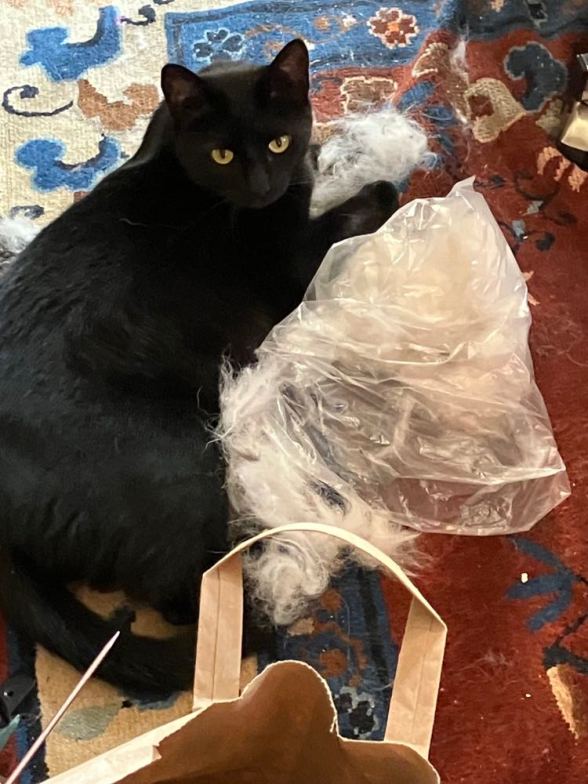
For the Ragtag Daily Prompt: feed. How many hours a day do cats loll? Is it fatigue or do they just like it?

Long Covid and framing

Long Covid is being framed as the immune system going nuts and there are all sorts of ideas about what it is doing and why. And it may be that more than one of them is correct. But the assumptions that I am hearing are that we have to “fix” it. A disease model.

Since I have been through four rounds of pneumonia, and two other rounds that were probably also flares, I have a different feeling. I think that Covid-19 is a really nasty virus and that the immune system is CORRECT to be on high alert and upset.

But wait, you say, we are just supposed to put up with it?

No, that is not what I am saying. Treat infection. I wouldn’t be here if it weren’t for penicillin and clindamycin, not to mention that we know that tuberculosis is airborne and infectious. I would most probably have died as an infant if we did not know what we did about tuberculosis. However, rather than thinking of my immune system as broken now, I am thinking of it as being hyperalert. Perhaps having PTSD. What it is really saying is, “Do not get another infection.”

How does it say this? In my case, relatively mild chronic fatigue. Also, slower healing each round, this time taking two full years to get back to a chronic fatigue baseline. I am still feeling very lucky to not have a hypoxia and permanent oxygen baseline. I am also feeling lucky that my fast twitch muscles work again. But I have about half of what I would consider my “normal” energy. But don’t we all judge that “normal” from our peak energies in our teens and twenties? One friend says, “Welcome to your sixties!” when I complain that each time it takes more work and is slower rebuilding muscle.

Am I an outlier? I don’t think so. I think I am the canary in the coal mine, warning of what can come. I think that ANYONE can get a version of this, resulting from too much stress, infection or a combination of the two.

I don’t think we have to develop medicines to tweak the immune system. I think we have to change our CULTURE in the United States. We have to learn to value the parasympathetic state, not just the sympathetic fight or flight, aggressive, go go go, peak performance state. I think we are driving ourselves nuts and setting ourselves and our children up for illness and damage and a highly unhappy immune system.

So my approach to my version of PANS or Long Covid is to work on the parasympathetic state. Listen to my body. Rest. Think about what I want to do and then plan half of it. Be realistic about my energy level. Because if I can convince my immune system that I will take care of myself as best I can, and rest daily, and not be crazy, it will stand down. It will calm down. It doesn’t need drugs as much as rest, good food, good friends, and some work but not too much.

In a high sympathetic nervous system state, the immune system works less well. It is hyperalert too. People are more likely to develop auto-immune diseases, with Hashimoto’s thyroiditis being the most common. People are more likely to get infections too. We have to learn to value and support the parasympathetic nervous system.

The start is rest. If that sounds awful, the next step is breathing. Five seconds in, five seconds out, count and use a timer. Start with a couple minutes and work up to twenty. Pay attention to how your body feels at twenty minutes. It may feel unfamiliar. It’s also hard to keep paying attention to that five seconds in, five seconds out, even if you count. I start thinking about my grocery list or food or a friend I want to call and I have been doing this for YEARS. When you realize that you are not counting, return again.

I am a minimalist on pills, any pills. Supplements, vitamins, prescription. None of the pills grow on trees so I don’t distinguish between “natural” and um, what, “unnatural”? I think of it as “less tested” and “more tested”. As an allopathic physician, I prescribe when necessary and I get rid of pills whenever I can. It is better to take a daily walk and eat healthy food. And maybe take a nap too.

So this is where I start. I attended a whole program on LDN this week, low dose naltrexone. It is being used for fibromyalgia pain and for Long Covid and ME/CFS fatigue and brain fog. It has a very reassuring safety profile, pharmaceutical companies don’t want to fund research because it is old and relatively cheap, and we don’t know how long to put people on it, or what it does long term. More detail soon.

_______________________

One thing I am doing for health and joy is dancing. I try to dance at the Bishop Hotel every Tuesday, because it makes me so happy. The music makes me happy too and my friends.

Brain thoughts

The attendees of the conference are all excited and hopeful at the fleshment of our understanding of Covid-19’s effects on the brain.

I am still absorbing the information, getting ready to write about it.

For the Ragtag Daily Prompt: fleshment.

Working theory

I attended two Zoom one hour programs on Long Covid this week.

Thursday from the University of Arizona, 330 people logged on, hard science with thirty minutes of information about Mast Cell Activation Syndrome. They said 17% of the population, which is huge, if it’s correct. This is not mastocytosis, the cancer. This is the immune system going rather batshit. Though I would frame it differently, as the immune system fighting a really difficult battle.

Friday from the University of Washington. I don’t know how many were logged on. This was at a much more aimed right at the physicians level. People sent in questions and they collated and gave answers. They promised to answer some of the questions later on. My question was whether a high Adverse Childhood Experience Score predisposed to Mast Cell Activation and they did not address that.

So mast cells apparently can produce over 1000 different signals: cytokines, histamines, proteases and I don’t know what all. They are all over our bodies (are you creeped out? I am a little.) near the boundaries: skin, nose, gastrointestinal tract, genitals. They produce different signals depending on what is happening. The Thursday researcher basically said that they could affect nearly any system in the body.

I’ve heard of mastocytosis and even had a patient with it, but Mast Cell Activation Syndrome was barely on my radar. I am not sure if 17% of the population is at risk or has it. It is tricky to diagnose, because the best lab test is a rather tricky and rare one, and it is sort of an orphan illness: few doctors know about it and it does not fit neatly into any specialties. Patients have seen an average of ten specialists before they get diagnosed. Hmmm. Sounds familiar.

This researcher has a ton of papers out, that I have not started reading yet. MCAS is implicated in Ehlers-Danlos, a connective tissue disease and in ME/CFS (myalgic encephalomyelitis/chronic fatigue syndrome) as well as POTS (postural orthostatic tachycardia syndrome) and can get triggered by Covid-19. Well.

The good thing is that treatment is quieting the sympathetic nervous system to let the parasympathetic take over. The sympathetic is the fight or flight hyper one. Parasympathetic is the rest, relax, mellow out, slow heart rate, blood pressure down, digestion and quiet one. I think United States culture is crazy fight or flight most of the time (We’re number one!– so what?) and the pandemic has put the whole world into fight or flight mode. Crazy.

Back in Family Medicine residency, 1993-96, I had a number of ME/CFS, chronic fatigue patients. They tended to be hyper sensitive to medicines and have all sorts of symptoms which were fluid and changable and difficult to pin down. What I noticed though is that many of them had been super high acheivers or working multiple jobs or crazy high stress, until they hit some sort of wall. Often an infection but not always. The ones I saw wanted to go back to working 18 hours a day. I said, “Um, that’s how you got this, I do not think that is a good goal.” This often pissed people off. Even back then, I thought that chronic fatigue was a body reset, where the body rebels, some sort of switch is thrown, and people rest whether they want to or not. Some do recover but it can take ages. The Thursday speaker seems to think it’s the mast cells doing this.

The UW speakers were careful. They said we do not know how long Long Covid lasts. One said they do not like to diagnose POTS, because POTS is usually permanent and the Long Covid tachycardia usually resolves. They are seeing people who got sick 2-3 years ago and are still sick, but they also have people who have recovered in 9-12 months. They do not know if patients are entirely recovered or whether there will be other problems later. They also aren’t sure that the chronic fatigue like symptoms are the same as the rest of the ME/CFS. Remember when dementia was Alzheimer’s? Now there are all sorts of different dementia diagnoses, Lewy body, frontotemporal, Huntington’s, stroke dementia, alcoholic dementia, Parkinson’s, Alzheimer’s, and others. When I was in residency, we had hepatitis A, hepatitis B and non A non B. Now we are up to G or beyond. Medicine changes and it’s moving as fast as possible for both acute Covid-19 and Long Covid.

The mast cell reasearcher talked about getting the sympathetic and parasympathetic nervous systems back in balance. I think maybe we ALL need that. Every person in the whole world. One way to quiet the sympathetic nervous system is to slow your breathing. Try it. For five minutes, or three minutes. Slow breath in for a count of four or five and slow breath out for a count of five. Let your brain roam around and fuss, but let go of each thought as it passes by and return to counting and breathing.

Slow in, slow out.

Practice and heal.

_____________________

The musicians are Johnathan Doyle and a friend. They were fabulous, last Tuesday at the Bishop Hotel.

.

Xeno or infection phobic?

So is Xenophobia a pathological fear of strangers or foreigners? Like agoraphobia or arachnophobia? The Mayo Clinic site has a listing for agoraphobia but not for arachnophobia or xenophobia. Perhaps agoraphobia is more disabling. Though with our world having more and more people, xenophobia might be terribly dangerous as well.

Current world population: https://www.worldometers.info/world-population/.

Number of people with Long Covid: at least 65,000,000, though the talk I attended yesterday say that’s a low estimate. Nearly one percent of the world population.

This article in Nature: https://www.nature.com/articles/s41579-022-00846-2 is about Long Covid, the research to date and the areas that need research. This is a very fast moving target with information exploding from multiple labs.

I attended an on line continuing medical education about Long Covid yesterday: https://hsc.unm.edu/echo/partner-portal/echos-initiatives/long-covid-fatiguing-illness-recovery/. This is a global monthly teaching session about Long Covid and current research and diagnosis and treatment. Yesterday’s talk was about immune cell abnormalities that persist and evidence is showing up that they are causing some of the problems. However, as one researcher said, the problems are multifactorial and any system in the body can be affected in more than one way.

Essentially some of the immune cells are puffy, sticky and enlarged. The suspicion is that the postexertional malaise is related to these puffy sticky cells. During exercise, or for some people normal activity, the muscles need more blood flow and more oxygen. The puffy sticky cells are stiff and won’t slide through capillaries easily. The muscles send a panic “I need oxygen!” message to the brain and the muscles do not work. The recovery can take a day or two days because of the food/oxygen deprivation. The researcher said that the same mechanism is suspected in ME-CFS (myalgic encephalopathy-chronic fatigue syndrome).

My muscles are feeling normal. My chronic fatigue is comparatively mild and happens with bad infections or with a vaccine that raises antibody levels, as it is supposed to. That’s how immunizations work. Do I have antibodies that shut down my muscles or do I have puffy cells? I would postulate the former but I can’t be sure right now. My home science kit is not quite up to that study.

When my fast twitch muscles are not working, are affected, it is very weird. They DO NOT WORK RIGHT. It is hard to describe: it is sort of pain, but it’s more of a very very strong STOP EXERCISING NOW message. And then I am exhausted for 1-2 days. In contrast, my muscles are a bit sore after a four mile beach walk 2 days ago and then an intense physical therapy session, but I am not exhausted. No naps the last two days. I have returned to my normal sleep patterns, less hours.

One of the researchers presented new technology that can make a movie of the microscopic cells going though a space with a narrowing like a capillary. Video electron microscopy. They are describing the cell shapes and whether they go through a capillary diameter normally or stick, for people with no Covid, diabetics, acute Covid and Long Covid. All are different. It is fascinating new technology.

I think I am more infection phobic than xenophobic. People all have the same basic blood cells inside, even with lots of different genetic patterns. So far infection phobia has not led me to agoraphobia, but the talk yesterday sure makes me want to keep my mask on.

There were over 350 attendees yesterday from all over the world. Lay people can sign up as well and the videos are stored for anyone to watch. I will watch yesterday’s a second time because five different scientists presented in 30 minutes and I ignored the chat which was going full speed with references to look up. Homework. And progress is being made.

Blessings.

______________

For the Ragtag Daily Prompt: xenophobia.

______________

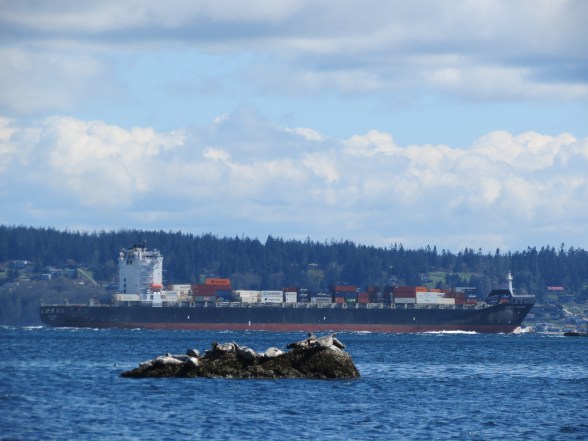
I took the photograph two days ago from East Beach on Marrowstone Island. The distance between the sea lions and the container ship is much further than it appears, and this is taken with a Canon PowerShot SX40HS zoomed most of the way out.