
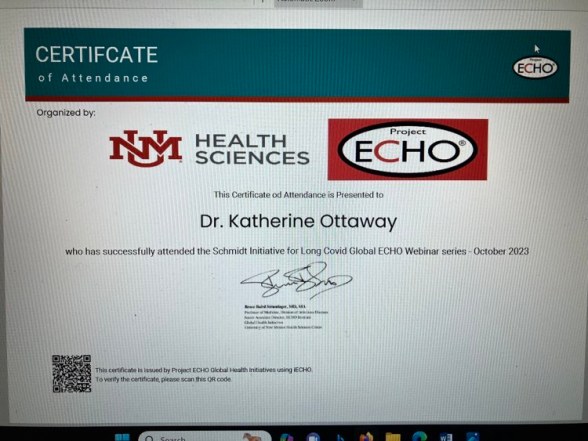
Schmidt International iECHO: Long Covid Patient Perspective

The latest Schmidt Initiative iECHO Long Covid zoom two days ago is by Hannah E. Davis, MPS, the co-founder of the Patient Led Research Collaborative (PLRC).

She got Covid-19 in March of 2020. Her first sign that something was really off was that she couldn’t read a text message. She thought that most people recover in two weeks so didn’t do much about it. She went on to clotting and neurocognitive problems and MECFS.

Her job and expertise were in machine learning data sets. As she realized that she was really sick and was not improving, she also realized that Long Covid was not even on the radar for physicians, overwhelmed by the acutely ill and dying. She started the interdisciplinary team co-led by four women and with over fifty patient researchers. The group is 61% women and 70% disabled.

They published an op ed piece about the body politic in the New York Times in April of 2020. By May of 2020 they had a fifty page article out documenting that even mild cases of Covid-19 could cause long term impacts. They describe multiple symptoms long term, not just respiratory. They also noted and documented medical stigma happening and were instrumental in changing the dialog from anecdotes of non-recover to data about non-recovery.

In June to August of 2020 they appealed the the World Health Organization (WHO) with a video message presenting data about long term effects.

In December of 2020 they presented a paper characterizing Long Covid. There are now 3-4 biomedical papers coming out each day.

She states that there are multiple myths about Long Covid: “It’s mysterious, we don’t know anything about it.” is not true. She listed other myths, but I have to go back through the slides.

The group is still highly active in research and is advocating for patient involvement in research. They have developed score cards for the level and quality of patient engagement. Tokenizing gives a score of -1 or -2, where instead of patient engagement in all stages of the research project, they are told “Come look at our final paper and give us the patient engagement gold star.” That is not adequate engagement. Other diseases have also made patients push for engagement in research: HIV, Parkinsons, PANDAS and more. Patients just want to get better and they want research that matters.

Worrisome data include that 10-12% of vaccinated people who get Covid-19 still can get Long Covid. This is less than the unvaccinated, but it’s still one in ten.

Their data shows that the majority of that 10-12% are not recovered at one year.

Another myth is that there is no treatment, but there are treatments at least for symptom management.

They published the Long Covid paper in the January 2023 Nature, documenting the many many symptoms and ongoing early stage treatments, many taken from other diseases such as MECFS.

One third of people who get Long Covid do NOT have preexisting conditions. It attacks all ages, women more then men, and prior infection may increase risk. Respiratory problems are more likely to recover, barring lung scarring. 43% of Long Covid patients report a delayed onset of neurocognitive symptoms.

Regarding mental health, research shows that stigmatization is still common and that patients who have experienced that are more likely to be depressed, anxious or even suicidal. In contrast, even one non-stigmatizing encounter, medical or family or friends, makes people have lower rates of depression, anxiety or suicidal ideation.

It is abundantly clear that this is a biomedical illness. Enabling google research will allow those papers to be delivered daily. I am on a list where I get daily reports of Covid-19 research and papers.

Next she talked about the current treatments, many taken from other similar illnesses. I have to say that the microclots scare me the most. There are clinical trials ongoing as well as amazing bench science, but meanwhile physicians need to listen to patients, believe them, pay attention to the ongoing research and help patients.

I spoke to a provider yesterday that I last saw two years ago. I said I wanted to work with Long Covid patients. “Good!” he said, “Because I don’t want to!” I think that attitude may be very wide spread.

I also looked at our county (and only) hospital’s page on Covid-19. There is not ONE WORD about Long Covid. Isn’t that interesting? Denial ain’t just a river in Egypt.

This is just what I got from the lecture. There was and is more. Physicians and patients can attend and they file the talks so that you too can watch them. Here:

https://hsc.unm.edu/echo/partner-portal/echos-initiatives/long-covid-global-echo.html

Blessings.

Neurogognitive effects of Long Covid I

Here is the first part of my notes from this lecture: May 24, 2023 Neurocognitive effects of Long Covid (International) part 2, by Dr. Struminger PhD, neuropsychologist.

I am trying to make this fairly clear to almost anyone. Some words may be unfamiliar to start with, but I will bet that you can sort it out. I would be happy to try to clarify any part if needed. These are my notes from the first half of this lecture, fleshed out to be clearer.

This is the Schmidt Initiative for Long Covid Global in English with real time translation into Arabic, French, Spanish, Portuguese and closed captions. Session recordings: https://app.box.com/s/onh1ma57ttjpi2c19qqxvmdao0kd2nsr

Dr. Struminger said that 1/4 to 1/3 of Long Covid patients have cognitive symptoms. A study comparing Long Covid patients with people who never got Covid-19 shows the Long Covid people to be three times more likely to have attention deficits or confusion. Part of the barrier to treatments is to define the problem, figure out the mechanisms and then start studying treatments. She said that she would share a few proposed mechanisms for cognitive impairment in Long Covid, but that it is probably multifactorial and it’s a rat’s nest. (Ok, I said rat’s nest. Dr. Struminger did not use that term.)

There are two main phenotypes of Long Covid brain problems: Hypoxic/anoxic and Frontal/subcortical. In hypoxic/anoxic certain brain functions are intact: Attention, visuospatial, cognitive fluency and memory encoding. There is impairment in problem solving and memory retention. This pattern is associated with the people who were hospitalized, deathly ill, on ventilators, or heart/lung bypass machines.

Frontal/subcortical is more common in the people who were never hospitalized and were not on a ventilator or ECMO machine. It can show up even in people who seemed to have mild Covid-19. The impairment is in attention, cognitive fluency and memory encoding, while the intact functions are visuospatial, memory retention and problem-solving.

Here are those lists in a table, HA for hypoxic/anoxic and FS for Frontal/subcortical.

Attention: HA intact, FS impaired
Visuospatial skills: HA intact, FS intact
Cognitive fluency: HA Intact, FS impaired
Memory Encoding: HA intact, FS impaired
Memory retention: HA impaired, FS intact
Problem-Solving: HA impaired, FS intact

The two types probably have different mechanisms and the super sick are more often the hypoxic anoxic. And there can be a mixed or both presentation.

Neuropsychologists test people to see what parts of the brain are working. Testing locally usually takes about four hours or more. Some brain functions have been mapped to parts of the brain but others are still mysterious. Efforts continue to match function to neuroanatomy. Going through each of the brain functions, some are mapped and others are not.

Attention is mapped and mediated by the frontal lobes. Attention is impacted by physical fatigue, dysautonomia, pain, shortness of breath, further impacted by emotional symptoms. It is REALLY easy to get stuck in a vicious cycle where physical symptoms or pain or hypoxia decrease attention function, which in turn makes physical symptoms worse. For example, hypoxia can decrease attention, which makes the person anxious and tachycardic, which in turn affects attention more.

The frontal lobes are very sensitive to hypoxic damage and to inflammation. Any inflammation in the body messes with them. The frontal lobes need oxygen and glucose. If a person can’t breathe, this messes up attention; if they are dizzy, it messes up attention.

Cognitive fluency. The anatomical correlates are less clear. Probably frontal and temporal, vulnerable to hypoxia and broad networks in the brain, vulnerable to physiological and mood disturbance. So vulnerable to the same things as the frontal lobes.

Learning and memory: Map to the hippocampi – sensitive to hypoxia and can be injured while the rest of the brain is comparatively unscathed. People have difficulty with retention of new information and not just attention/encoding problems. Neuropsychology distinguishes between attention/encoding and retention/recall problems. Those are different. In alzheimer’s, there is trouble retaining new information, even though people can encode it. In the frontal/subcortical long covid brain fog, there is more difficulty with attention/encoding. That is, if the person is tachycardic or in pain or dizzy or short of breath, it is more difficult to pay attention and encode information into memory.

Executive functioning. Frontal lobe: sensitive to hypoxia and metabolic dysregulation, significantly impacted by physical symptoms and mood disturbance.

The hypoxic/anoxic pattern has effects more like Alzheimer’s or a dementia. The frontal/subcortical is more like a concussion or traumatic brain injury. Neither sounds great, but there is more healing from the second than the first. Treatments for now are coming from the Alzheimer’s/dementia established treatments or from the concussion/traumatic brain injury established treatments. The first part of treatment is rest, rest, rest, and try to keep the brain from getting overwhelmed. I will write more about the ongoing changing recommendations.

More at: https://hsc.unm.edu/echo/partner-portal/echos-initiatives/long-covid-global-echo.html

The photograph is a screen shot of the brain from below from one of the conferences. There were over 300 people attending this zoom lecture, which is encouraging and hopeful.

For the Ragtag Daily Prompt: covert. The covert damage from Covid-19 is being sorted out.